
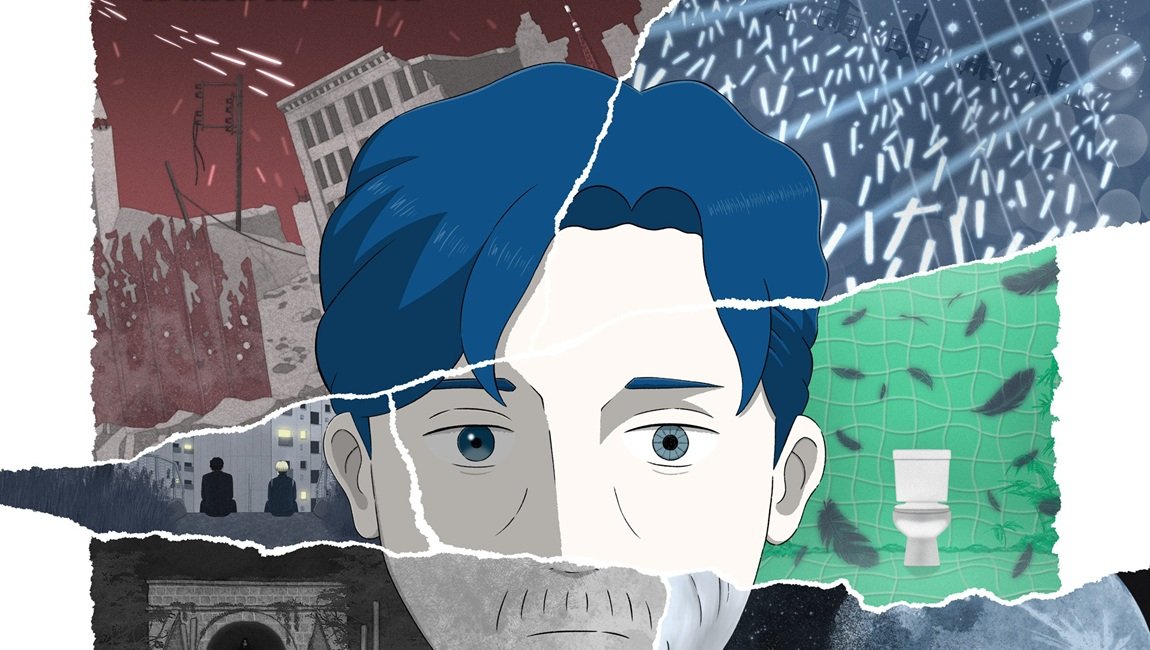
Ryuya Suzuki’s Jinsei is clearly a labor of love. Completed over an 18-month period, Suzuki wrote, directed, hand-drew, and scored the film, his feature debut, from his home computer. To those who subscribe to the ideal of film as a form of individual personal expression, then, it’s a dream scenario, and Suzuki’s commitment and obsessive care are never in question throughout the film’s sprawling vision of a J-pop idol’s fractured relationship with reality. Unfortunately, Suzuki also isn’t quite able to achieve the bounty of his film’s vast, episodic ambition.
Jinsei‘s opening gives us a rapid-fire race through a couple’s life; their meeting, marriage, and ultimate tragedy told in elliptical blinks. It’s cold and detached, but also mordant in a deadpan sort of way, as if Kaurismäki decided to remake Up using Flash. And this is the dominant mode the film operates within; sparse and reserved right down to its spartan animation, utilizing a technique that resembles David Firth’s if he’d grown up in Logan’s Run rather than Doncaster. The style is well-suited to Jinsei‘s tone of downbeat alienation, one that finds its home in the film’s taciturn protagonist who we watch glumly float through his youth like a slightly gormless fog, only energized by an adolescent fixation with fictional boy band Blue Bloods. Suzuki handles this early section ably, managing the often taxing tasks of maintaining both tonal chilliness and narrative momentum with legitimate aplomb.
It’s when the film jump-cuts forward into the protagonist’s time spent in his own group that things start to wobble. The jump cuts themselves aren’t a problem, but rather the way they come accompanied by mountains of exposition. It empties the film of the mysterious air it otherwise cultivates, and these cuts end up feeling less like a narrative choice than a simple heavy-handed structural one. Suzuki is by no means hiding this, and indeed makes quite clear that it’s a thematic choice to highlight his protagonist’s shifting identity throughout the narrative, but in practice it makes the film feel like a collection of shorts that never quite coalesces into a functioning whole. This isn’t helped by the patchiness of the respective sections, with the film’s central idol section reflecting a sharp decline from the childhood portion in terms of pacing and precision. Things become increasingly incoherent as we move through this section, and not in the nightmarish way that one could see it lending itself to, but rather in the way of a badly told anecdote. It leaves the sum to feel almost sketch-like, but in the SNL-bit-that-outstays-its-welcome mode.
That leads us to Jinsei‘s final third, which is at once its boldest play and its most cliché. Flashing forward again, this time into a post-apocalyptic future, the film regains some of its stride with its pleasingly unfazed take on a war-ravaged future, with our protagonist retaining his stony-faced demeanor throughout. It’s the film’s finale, however, that grates most, and kind of gets to the rot of why the Suzuki can’t stick the landing. As things become increasingly abstract and brazenly transcendental, it becomes apparent that for all its structural and formal precision, what Jinsei is ultimately trying to get at is kind of hollow, and it makes the film’s straining for profundity feel overly forced. Suzuki’s film ends up a project with ambition and commitment that you can’t fault, but which feels too palpably like the work of a first-time feature director, one not short on grand formal ideas but also not yet one who can stitch the threads satisfyingly together. At least Suzuki was prepared to swing at them with everything he had, which leaves plenty of hope for a sturdier sophomore effort in the future.
DIRECTOR: Ryuya Suzuki; CAST: ACE COOL, Taketo Tanaka, Shohei Uno, Remi Tyon, Katsuya Maiguma; DISTRIBUTOR: Greenwich Entertainment; IN THEATERS: June 5; RUNTIME: 1 hr. 33 min.
Comments are closed.