
The 1987 release of La Bamba, Luis Valdez’s biopic detailing the life of Chicano musician Ritchie Valens, set a cinematic benchmark. On its face, La Bamba’s historical importance is largely representational: a mainstream, studio picture was not only depicting the Chicano experience, but was highlighting Chicano history. The movie’s most effective significance, however, was the change it marked in the relationship between Mexican-Americans and Hollywood.
The bevy of Spanish-language movie theaters that began to form in the early 1940s (following the launch of the U.S. Bracero Program and growth in Latin American migrant communities) were beginning to lose their audiences. These cinemas faced the challenges all movie theaters faced in the latter half of the century, but they also had to compete with a growing interest in Hollywood films as assimilation took hold and the concept of the blockbuster emerged. But prior to La Bamba, Hollywood had struggled to completely win Hispanic audiences over. Spanish dubs weren’t always available or reliable, and when dubs were produced, they would come several weeks after a hit movie had already left the zeitgeist. And regardless of language accessibility, mainstream depiction of Latinos still left much to be desired.
La Bamba had mainstream interest, but Columbia Pictures was determined to make an all-out appeal to Hispanic communities, releasing simultaneous versions (English, Spanish, and Spanish-subtitled) in the Spanish-language market. That gamble paid off. La Bamba wasn’t a Mexican picture, but it wasn’t a wholly American picture either. It spoke to the experience in-between, and — importantly — it was a hit.
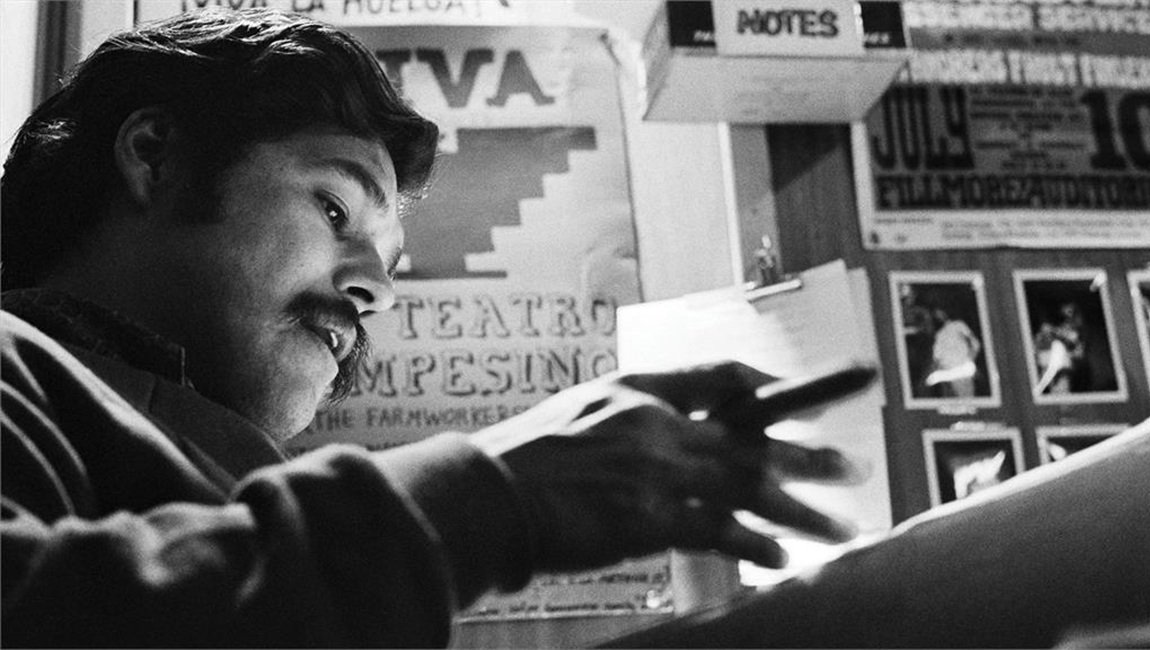
American Pachuco: The Legend of Luis Valdez, from director David Alvarado, follows Valdez’s life from the early ‘40s (when both Valdez and Richie Valens were born into farmworker families) through La Bamba — the same era of the rise and fall of Spanish-language cinemas. Those coming into the documentary expecting a boilerplate filmmaker retrospective might feel lost then when so little of the film is actually devoted to the director’s most famous work and no time is dedicated to the decades that would follow; but American Pachuco isn’t about Luis Valdez, filmmaker, but the rapidly changing cultural experience of Mexicans in America and Valdez’s role both as a witness and leader during this particular time.
Valdez’s life is a mirror of Chicano identity during this era — starting from farmworking in Delano, California, as a child, to getting involved with the United Farm Workers and forming the radical theatre company El Teatro Campesino, to the struggles faced in both having his Chicano play Zoot Suit welcomed by Broadway, only for it to be swiftly rejected and misunderstood. In fact, this reflects the strongest part of Alvarado’s documentary: the inclusion of archival footage from Valdez’s theatrical work, giving the viewer rare access to alternative political theatre seldom, if ever, canonized.
Throughout, Alvarado is thorough in connecting Valdez’s work to concurrent Chicano history, benefited by Valdez’s own astute observations about the personal intermingling with the political. But American Pachuco can’t escape the conventions of a pro forma biographical documentary. La Bamba is Valdez’s least politically interesting work, but is inevitably what the film is building toward. The result is a conclusion that mostly functions as a retelling of events, at the expense of the much more interesting thematic exploration of Valdez’s earlier work. The diminished returns are apt, though. If American Pachuco is an interrogation of Mexican-American identity and the ever-present issue of assimilation, the documentary’s gradual shift from the collective to the individual, from agitating against the status quo to achieving mainstream acceptance, is an accurate, if somewhat cynical, retelling of the cultural shifts from the 1940s through the 1980s. Even a pointed — albeit brief — acknowledgment of César Chávez’s tarnished legacy throws into question whether front-facing representation is really all that much of a win.
DIRECTOR: David Alvardo; DISTRIBUTOR: PBS; IN THEATERS: July 15; RUNTIME: 1 hr. 32 min.
Comments are closed.