
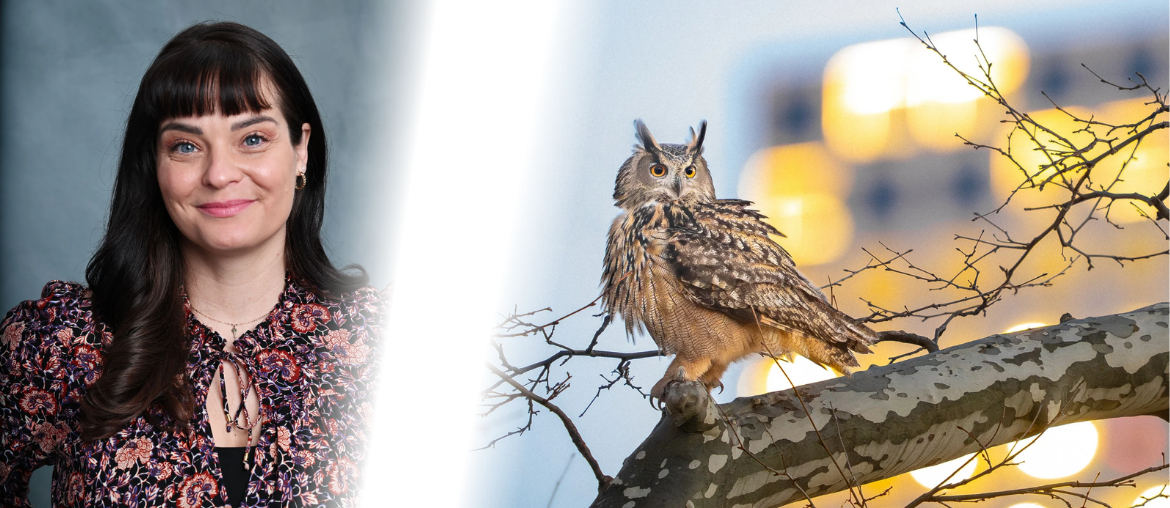
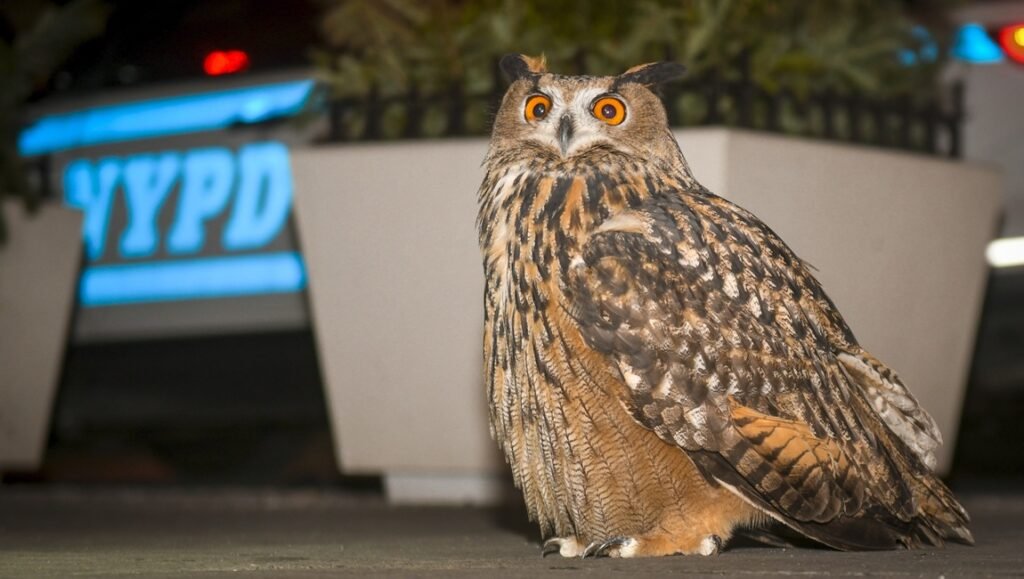
When you first see Flaco, the Eurasian eagle-owl that became a local New York City legend, appear on a hotel sidewalk, you immediately comprehend his star power. His bright, expressive eyes, stately stature, and cat-like ear tufts render him a creature unlike any other — at least any you’re likely to see in the North American wild. After over a decade of being watched in tight quarters at the Central Park Zoo, Flaco’s escape turned him from the observed to the observer. His curiosity and long-dormant natural instincts helped him evade all capture, though in turn, he captured the city’s heart (and quite a few unlucky rats).
From the first night he was spotted, documentarian (and bird lover) Penny Lane knew there was something to this bird. Her new documentary Wild Inside features crowdsourced footage, photos, and stories of NYC’s yearlong affair with Flaco. The film is one of the most thought-provoking instances of the “New York is almost like another character” subgenre, grappling with how animals fit into an ecosystem altered by humans.
In anticipation of the film’s U.S. theatrical release, Lane and I talked over Zoom about Flaco’s mesmerizing presence, Wild Inside’s deliberately communal approach, and the impossible question of squaring away our love for certain animals against our obligation to the ecosystem.
This interview has been edited for length and clarity.
Daniella Mazzio: I just want to start out, I loved your documentary as a Chicagoan who has seen a lot of interesting relationships to our own animals here, from coyotes, piping plovers — [Daniella’s cat appears on the Zoom call]
Penny Lane: House cats.
DM: Cats, yes.
PL: Yeah, I’m familiar with all the Chicago megafauna tales.
DM: So this is certainly a documentary after my own heart. First, I want to ask: when did your interest in Flaco begin?
PL: My dear friend Jeremy — the first person you see in the film — ran into Flaco that first night in February 2023, and he texted me pictures of Flaco on the sidewalk outside the Bergdorf Goodman and the Plaza Hotel. As someone in the film said, it’s the least owl-y place you could imagine. I was obsessed with Flaco from that instant on. I didn’t sleep. I was staying up all night trying to figure out if he was okay. Where did he come from? Who is this owl? How did he end up on the sidewalk?
And I was not alone. So many people were instantly engaged. It was just so crazy and absurd that this owl would be in that place — and an exotic species, not a North American bird. Seeing those photographs, there were just so many immediate questions you had.
DM: There’s this great quote in the movie about how there’s “an unresolvable tension between loving individual animals and loving ecosystems.” I think that really digs into some of the broader ideas that you’re exploring in Wild Inside. While watching, I was thinking: how do you even define an ecosystem now? And what is our relationship as humans to an ecosystem, whether it’s natural or built environment? Was that broader question something that came up for you while making the film, or did it come up a little bit later in the process?
PL: This was something I’ve been thinking about probably my whole life. The questions around the ethical status of animals, both as a species — whether a species has the right to exist or whether we should care if a species exists — and as individuals, is a huge question.
One example: the California condor was very nearly extinct, and it really was the work of zoos and trained conservation professionals who captured these remaining creatures from the wild, bred them, and then set them loose again to try to repopulate. It’s one of the few success stories that you can find in that area. But if you think about those individual animals or see footage of them being captured, they’re not happy. These six birds who were captured and brought into captivity were very upset about their life during that period. That’s an example of humans deciding that the desires of these particular individual animals were outweighed by the species.
In that part of the film that you brought up, what we’re talking about was Flaco eating all these rats. And we all were like, “Ha ha, yay, eat all the rats, we hate the rats because we live in New York, it’s part of our DNA that we have to hate the rats.” But nonetheless, the rats are also animals. They’re mammals. They love their babies. They’re just trying to care for their families. They’re just trying to survive. They’re also not even a native species. We’re the reason they’re here in the first place. Asking yourself, like, why it is that you would love to see Flaco eat a rat as opposed to feeling sorry for the rat that’s being eaten, I think, is an important question. It doesn’t mean there’s some obvious answer to it, you know?
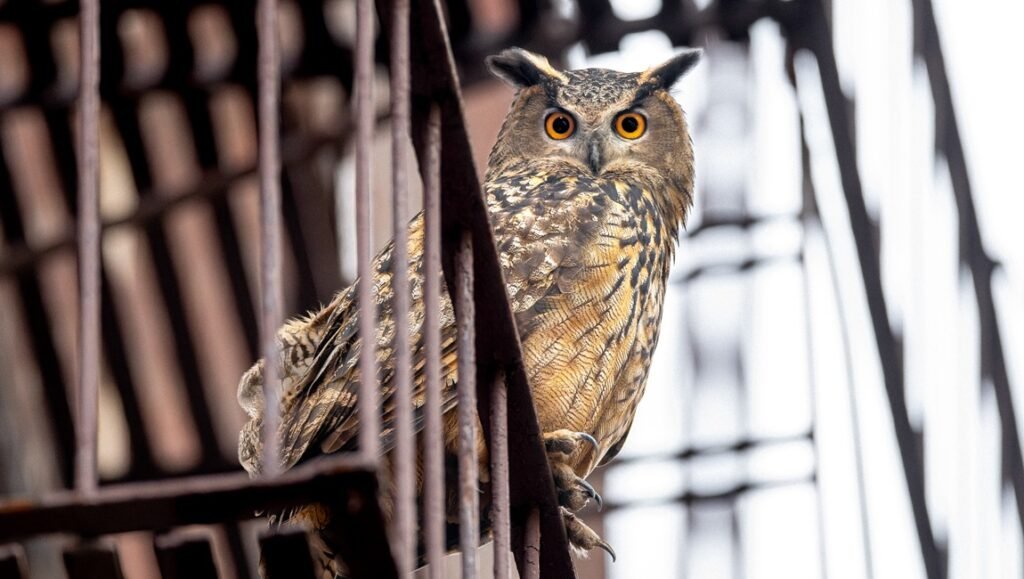
DM: There’s a tension, too, where Flaco is a predator, and rats are prey. That’s just naturally what they’ll do in an ecosystem versus this built environment. I think something comes up a lot in your documentary is that New York has been created by many people over hundreds of years, and the idea that rats and pigeons are kind of part of this ecosystem now. They’re cohabitants of New York. I found how you explored New York City as an ecosystem interesting.
PL: I definitely see the city a little differently now, and that’s part of the goal. It’s not hard to make people love Flaco. He’s handsome; he has this very dramatic story associated with him; we watch him evade his captors, and it’s very easy to root for him. It’s not hard. I probably, in my whole career as a documentarian, will never have an easier time getting the audience to root for my protagonist. The hard thing is what you do with that regard. Can .0001% of the love you feel for this charismatic stranger in a strange land be applied to a native hawk that’s just trying to live in New York City in much the same way Flaco did? That’s really the trick. What do you do with that love?
There’s part of me as a bird person and nature lover that almost feels guilty putting so much attention on this bird. I think a lot of people had that feeling about Flaco. What about other animals who actually live here and are trying to survive in this city? So I always knew if I was going to make this film, I had to make sure that I tried. Even if it doesn’t work for every viewer, I had to try to take the love that’s so easy to give this one animal and ask people if there’s any amount of it that could be extended to the rest of the ecosystem. Even rats. Or the harder one for me, cockroaches. Much harder. Rats are cute. Cockroaches are terrifying.
DM: I am a rat and pigeon sympathizer.
PL: I love pigeons and I love rats, and we definitely knew that since those were the two animals that Flaco ate, they would be other characters in the film for sure.
DM: I am really interested in how you’re not afraid to include yourself in the documentary at certain points, including your own biases of how you view animals or how you view what’s going to happen to Flaco. For example, that little confrontational moment with the representative from the World Bird Sanctuary toward the end. What made you decide when and why to include these subjective moments in the documentary?
PL: It’s a great question. It’s never my first choice. Sometimes you really do feel someone needs to push back on something in the film, and sometimes you’re just the only person to do it. You always want to try to find people to express every facet of a debate — and there’s so many different debates in the film. You do your best to cast a wide net. But sometimes you’re the one who’s there, and you’re the one who can push back if you think someone’s making a bad argument, you know? If the only way was to have me do it, then I’d do it.
DM: The part I kept thinking about is when the World Bird Sanctuary representative is insisting that animals like Flaco are born to live in captivity. And there are certainly my own biases. I know there are situations where I understand that notion to be true for conservation or rehabilitation. But this seemed to be a case where they mentioned this Eurasian eagle-owl breeding project, but never really got into — at least in what we see in the film — what that project was for. Did they ever talk about that with you?
PL: Yeah, and that’s definitely something we struggled with. We wanted to put more in the film about it, but it ended up just being so confusing because it’s so much detail.
So… the breeding programs that Flaco was part of were in response to declining populations in the wild. Is the Eurasian eagle-owl endangered? Well, there are different ways to answer that. I’ll get into this with you because you asked. On the one hand, bird populations globally have declined by 70% in the last 50 years. All birds are, in some ways, endangered. But if you were to look at the list of species and ask, “Is the Eurasian eagle-owl categorized as endangered amongst all birds?” The answer is no. They’re quite common. They’re not endangered in a categorization sort of way. But there was a sense that their populations were seeing declines — because they are. And so the North American breeding program came into being, in theory, to address that and say: “If all of Europe was to be wiped out by a nuclear bomb tomorrow, we have a healthy breeding population of this species available here in the United States.” It’s really an insurance policy. It’s not because they’re ever going to set these animals free or repopulate the way I described with the California Condor. We’re talking about keeping healthy, genetically diverse populations alive in the case that something unthinkable were to happen. That program was discontinued at some point, because… they’re not endangered. [laughs] And there are breeding programs in Europe where they release them back into the wild. So that’s why we left it out, because it’s kind of in the weeds and complicated.
But to be honest, they’re animals that are bred to be displayed in zoos and to, in theory, help people care about owls. You see the educational programs they do to spark people to care about owls in the wild. The theory of change there is that if you see this magnificent creature in person, up close and personal, that you will care more about protecting the owls and their habitats.
DM: That leads into the crowdsourced nature of this documentary. You see how many people become activated by Flaco’s story. It’s kind of a comment on people and this desire to see self-identification in others or in your environment. This is really a documentary that is as much about people — and particularly New Yorkers — as it is about Flaco. Can you talk a little bit more about your process of crowdsourcing the material?
PL: I knew the film was possible from the get-go because I knew that there would be essentially a dedicated paparazzi contingent on this owl. I knew that I would not personally be able to go with my camera crew and find this owl and get enough footage. It really is such a specialized form, and you have to be out there day after day after day. I knew that there’d be a lot of material created of him, so then capturing it became the challenge. We were making friends in the birding community, and put the word out that we were collecting this material all along.
But we also created a website and did a lot of street outreach. We literally walked around neighborhoods where he had been and talked to people and handed out flyers to say, “Have you seen Flaco? Do you have any stories? Do you have any media?” That’s how we met the halal cart guy and the barber in the movie. We really pounded the pavement to find that stuff. And it really worked. It was a collaboratively authored film in many ways.
DM: I think that also reflects what this phenomenon was, which is making these person-to-person connections with folks all across the city who you might not necessarily meet otherwise.
PL: That’s also the thing that’s cool about birding. It is a collaborative science endeavor. We know what we know about global bird populations because of everyday people who pay attention to birds. And it’s the aggregation of all that amateur data that actually is allowing us to learn about birds. So, I always felt like that was a really neat thing we could mirror. There’s a huge human cast because there’s really just one main character, and it’s Flaco. He’s a protagonist in a classic narrative sense. He has agency, and he’s making decisions, and those decisions are what made the story happen. It was such a special opportunity to be able to make a movie about a wild animal because he was available to be seen in a way that most wild animals are not. It’s just a once-in-a-lifetime opportunity as a filmmaker.
DM: Were there ever any moments going through the footage where you would just find yourself transfixed
PL: Yes. That’s why I’m not the editor, because I would just be watching Flaco footage all day, you know? I found every moment of his existence so mesmerizing. We went to Europe and we film them in their native range, and in the wild they’re usually really hard to see. They’re far away, and they don’t come near people. So again, the fact that he was so close to us for so long and allowed us to get so much incredible footage of him is such a gift.
DM: I know New York City passed legislation in response to Flaco’s death, and within the documentary as well, there is a bit of the plea, as you also mentioned earlier, to give some of the attention to New York City’s other native birds in the same way that folks did to Flaco. As Wild Inside comes out and reaches more people, is there broader change you hope to see?
PL: My first hope is that people will see that there is nature in New York City. This is a wild place and we ourselves, in fact, are wild animals. We just have fooled ourselves into believing that we’re not. The fact that we saw ourselves in Flaco is no coincidence. So be aware and notice that we live in a place where a lot of other non-human animals also live.
When Flaco went free, those of us who know what the life of an urban bird of prey is like thought, “He’s gonna die of rat poison.” It wasn’t rocket science. I didn’t know when — it could have been 10 years, it could have been 10 days, we didn’t know, but I pretty much knew from the beginning this would be the way he died. This is how birds of prey die in major cities. If the rat poison itself doesn’t kill them, the rat poison will certainly contribute, as we saw with Flaco. It doesn’t help to have a system full of rat poison if you are then exposed to a virus of another kind, you know?
The rat poison is a huge problem. Our need to feel like we’re killing all the rats is having massive effects on the native ecosystem. Poison goes into the rat, that rat moves slowly, and that becomes the rat that’s most likely to be eaten by a hawk. And the hawk is going to die of rat poison, too. Also, hawks and owls eat rats, so we should want to protect them. That would be logical. So one of the things that’s being piloted under Flaco’s Law is trying rat contraception instead of rat poison. I am looking forward to seeing what the results of that pilot are. Can’t do worse than we’re doing, so we can only do better.
DM: That’s a great philosophy. And last, I just have to ask, what is your favorite bird?
PL: Hmm. Good one. I think that my favorite bird is a pileated woodpecker because it was the first bird I ever saw. It’s what we call a “spark bird” in birding. I promise anyone who’s reading this anywhere in the world, there are birds all around you right now. If you listen, you’ll hear them. Most of us aren’t listening; we don’t hear them, we’re not looking, and we don’t see them. So there’s this moment where a spark bird switches your consciousness on, and then you can never turn it off again. I will forever be aware of all the birds around me. I hear them, I see them, I can’t turn it off. And it’s all because I saw this pileated woodpecker one day, and I was like… “What is that?” I mean, it looks like Woody Woodpecker, what can I say? I didn’t even know it was a woodpecker; I was just like, “What’s that huge bird?” I had no idea that birds that big even lived here.
Comments are closed.