
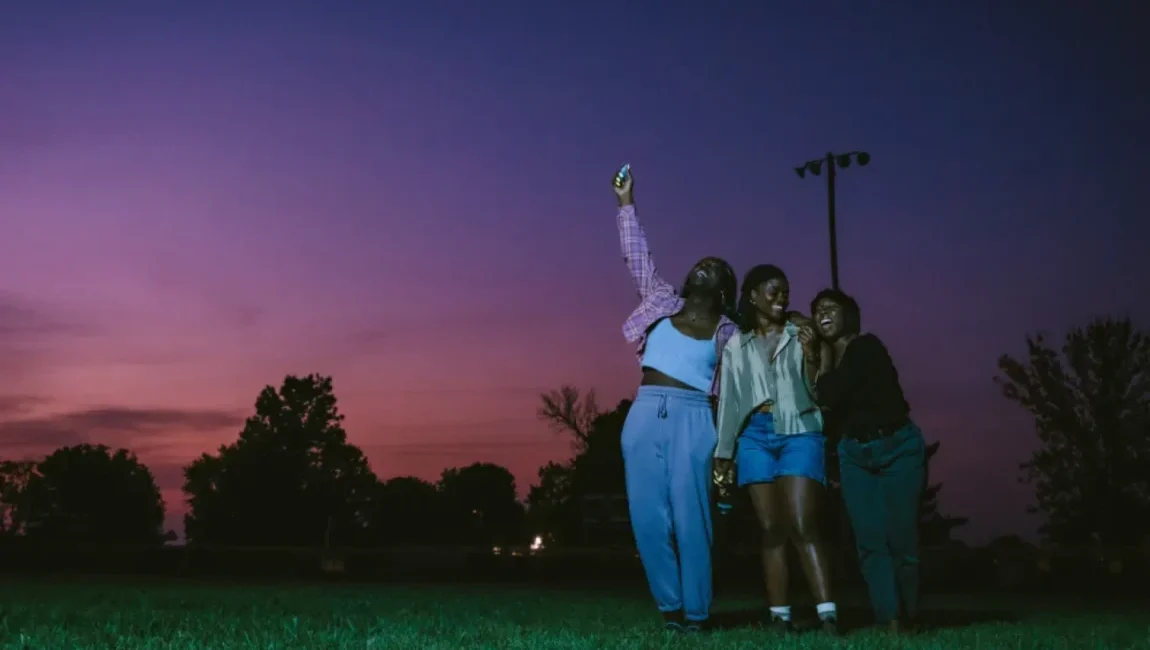
A recurring image from Shatara Michelle Ford’s Dreams in Nightmares calls to mind John Ford. In The Searchers, the darkness that frames the bookend shots of a dusty landscape there is concerned with the insidious comforts of domestic life. And while both films ruminate on the psychosexual nature of belonging, the darkness in Dreams in Nightmares is entirely more concrete. In fact, the pesky burden of history its characters are incapable of shedding is concerned with the very war John Wayne’s Ethan Edwards is pretending not to have lost. You cannot, after all, defeat someone who does not believe in surrender.
An adjunct professor in Los Angeles loses her creative writing class to budget cuts, a business professional in Brooklyn is laid off, and her roommate the poet cleans houses to make rent. This is where we find a group of college friends, Z, Tasha, and Lauren — all three Black queer women — at the beginning of Dreams in Nightmares. In Ford’s film, they embark on an often tense road trip across the Midwest to find Kel, the fourth member of their tribe who seemed to have vanished into thin air two months prior. On the road, intimacy takes different shapes: an ice breaker game at a restaurant isolates Tasha from her friends; phone calls between Z and her partner are staged as direct address shots and face-to-face conversations in metaphysical depictions of their home. As they trudge through the country, the trio visits Kel’s ex in Iowa and Kel’s parents in Kansas City, before landing in Oaxaca. But there, the questions put forth by the film’s swelling tension fizzle into incomplete answers.
Under Ford’s watchful eye, the characters and their world fill every inch of every frame. No detail is spared as the humdrum of their lives is haunted by pre- and post-antebellum imagery. The film’s opening sequence shows slaves in cotton fields and Emmett Till alike, fading on top of each other and collapsing time and space, turning the entire breadth of Black American history into a single image. At the beginning of the roadtrip, Lauren insists that they only make stops at Black- or woman-owned rest stops for their safety, turning the now chided-as-performative practice of identifying businesses into a tool of protection. And yet, when they arrive at their friend’s childhood home, the road movie becomes a horror movie of sorts. During the sequence in Kansas City, tension is relegated to Kel’s parents misgendering them in their absence, which ultimately culminates in an explosive dinner scene. Here we see the perfect metaphor: the dizziness of driving yourself toward the safety of identification, only to be betrayed by its conditionality. Z and Lauren push back on the homophobia Kel cannot defend themself from, while Tasha — who we previously saw pull up to the club strapped — is apologetic for their fussiness. Even within the sacred walls of a respectable Black family home, a strife in belonging rears its head.
In an early scene, Z grabs a drink with a woman we later find out she’s been pining after for some time. As they talk in a dark, buzzy bar, Z describes the book she’s writing, the plot of which sounds at least tangentially similar to Toni Cade Bambara’s The Salt Eaters. They talk about generational curses and Black Wall Street. “Where are we really supposed to go?” Z asks her date, poking at the film’s primary thematic preoccupation. In the first spoken line of the Dreams in Nightmares, Z tries to interpret her dreams as coded messages, saying “I think my ancestors are trying to tell me something.” Thinking of both these lines, knowing what Z finds in Oaxaca, the question of the entire film begins to appear more personal than existential. Because surely the message could not be that to break generational curses, one must become a settler in some other land, just any place where history isn’t so sticky on your body. Speaking as an immigrant who has entirely assimilated into the empire that created the very circumstances of my exile, it has become increasingly clear that — and excuse the Afro-pessimism here — there is no other place to go.
Internalizing the never ending dialectic of negotiating your existence is particularly hard to universalize because a minority oppressed class implies the existence of a majority oppressive class. Achille Mbembe’s Critique of Black Reason categorically laid out this phenomenon, Blackness conceptualized by Western corroboration as an inherent lack. The most prominent conflicts of Dreams in Nightmares, as the title suggests, are almost entirely psychological. The most racialization the characters experience is tokenized veneration from a noxious, over-eager liberal in Iowa. And though the absence of familial intimacy is heavily felt, especially in Z’s case, the film presents this at most as heightened discomfort. Robert Gessner wrote in The Moving Image that the “fragmentation of an action via shots is a distinguished characteristic of cinema that permits an enlargement of conflict through visual intensification.” In that vein, Michelle Ford masterfully stretches the medium to perfectly cover a narratively uneventful road film with the thickness of a Black woman’s inability to escape history. The problem with trying to convince someone that something is only happening in their head is that, as Fiona Apple very aptly put it, so’s everything.
DIRECTOR: Shatara Michelle Ford; CAST: Denée Benton, Mars Rucker, Dezi Bing, Sasha Compère, Charlie Barnett; DISTRIBUTOR: Lunette Films; IN THEATERS: August 21; RUNTIME: 2 hr. 8 min.
Comments are closed.