
It’s been 30 years since we lost Jon Jost. One shouldn’t worry: the American director is still alive and well, living, working, painting, traveling, and occasionally blogging. We have lost Jost not as a person, but as a relevant filmmaker: nobody talks about his new films, no major festivals invite him to walk the red carpet or participate in Q&As, and even on Letterboxd only a few of his recent works have amassed more than a double-digit audience. It’s as if Jost has been erased from the contemporary cinematic landscape, left for dead by the film critics who once hailed him as one of the most important independent filmmakers west of the Atlantic.
The rapid decay of Jost’s relevance began in 1996, when the director of cult features Last Chants for a Slow Dance (1977) and All Vermeers in New York (1990) discovered the bold and beautiful world of digital filmmaking. For Jost, filmmaking was always a struggle — he hated Hollywood and despised producers; he wanted to change the world, to provoke and challenge his audience, not spend countless hours persuading studios to give him a few bucks to shoot his next feature. The invention and widespread availability of digital cameras freed Jost’s hands: he stopped worrying about lengthy postproduction and inflated prices for film development, and began to experiment.
From 1973 to 1993, Jost directed 13 feature films, all shot on 35mm cameras from costly brands like Panavision, Aaton, and Arri. After switching to DV cameras, his productivity exploded: from 1996 onward, he shot and released 26 features and countless short films. After all, as Jost himself sarcastically noted, “one can make a digital feature for $50, which even I can scrounge up.” Saving money and time is all well and good, but Jost never would have abandoned traditional film for such a mundane reason. Rather, he was interested in how digital cameras altered our perception of the world, transforming ordinary things into distorted, pixelated phantoms of zeroes and ones. Digital filmmaking was not just a tool; it was a whole new way of making films, of interacting with the world, of breaking down the boundaries that Ye Olde Hollywood was so keen to uphold. No wonder Jost vowed to never use analog film again.
At first, Jost’s DV-works felt like a radical departure from his trademark style. An unrelenting critic of the American way of life (and death), who devoted his films to killers, mass shooters, radicals, and psychopaths, his abandonment of fiction seemed to give way to mere style exercises. In reality, Jost was simply trying to grasp the limits of the new medium.

In Muri Romani (2000), Jost turned his observant eye to the most ordinary of subjects: an old Roman wall whose surface is pockmarked by time and human hands. Jost’s camera stares relentlessly into the wall, leaving the spectator face-to-face with an alien landscape of cracked plaster, peeling paint, and hastily scrawled graffiti. Then the frame begins to shift: the wall devours itself, transitioning from one imaginary landscape — of rivers, plains, and even cities — to another. Taking advantage of the versatility of digital editing, Jost doesn’t simply interweave different shots of the same wall; instead, he transforms them into a single, unified whole that prompts a reflection on the passage of time and the inexorability of history. Jost’s abstractions are in line with the work of Stan Brakhage and Phil Solomon, but why torture film stock when a digital impression of the ordinary can produce a similar effect?
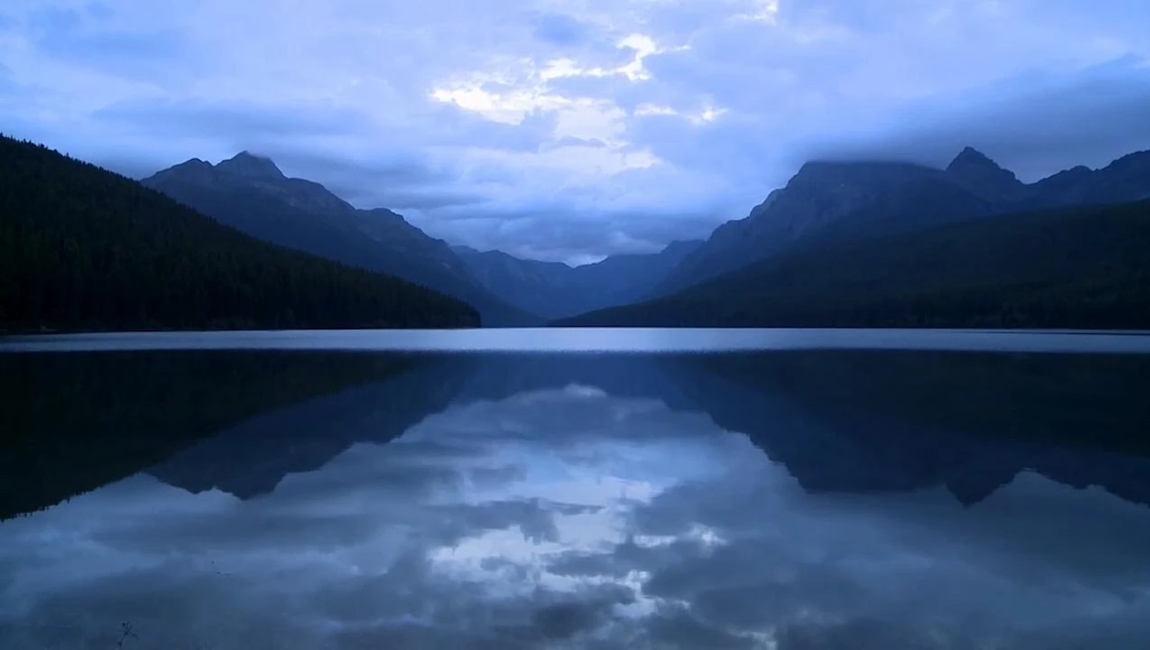
Having tamed the imaginary landscape, Jost next turned to a real one. In a series of landscape sketches, beginning with Bowman Lake (2014), Jost ironically mimics the work of the great American paysage filmmaker, James Benning. Like the main hitmaker of landscape cinema, Jost offers viewers the opportunity to test their endurance by observing a rich but immobile vista. However, Jost’s approach to illustrating the passage of time is very different from Benning’s. Bowman Lake condenses footage taken from sunrise to sunset into 114 minutes of screen time. Digital editing allows Jost to speed up time so that individual moments merge seamlessly into a single entity that still maintains an organic reality. The interplay of light and shadow, the ripple of the wind on the surface of the lake — recognizable movements of nature remain as such even at this unnatural speed. Where film splices would have pulled the viewer out of their solemn observation, digital editing allows Jost to remove all superfluity from his impression of the American landscape.
At a higher level, the mobility and flexibility of the video camera allowed Jost to steer his filmmaking into the form he refers to as tone poems. For Jost, conveying atmosphere — all those endless pauses and fleeting glances at nature — is far more important than meticulously spelling out storyline conventions, unexpected plot twists, and other clichés of Hollywood narrative cinema. The Italian-language film La lunga ombra (2006) isn’t quite a tone poem, but it’s a clear step by Jost toward free visual poetry. А trio of successful women arrives on the Italian coast in search of new meaning in their lives, which have grown stale. They stroll, chat, and reminisce while Jost’s camera surreptitiously captures seemingly insignificant moments amid their mundane daily lives. The spectre of 9/11 haunts the film’s bare-bones narrative episodes, which are interspersed with documentary footage of the attacks. Jost’s empathy for the tragedy of his homeland is palpable even a thousand miles from New York — these three women experiencing and dealing with personal tragedy reflect a Europe in deep mourning of a tragedy that didn’t even occur at home.
Extreme close-ups, superimpositions, and direct-to-camera monologues deliberately distance La lunga ombra from the conventions of Hollywood cinema. Thanks to the advanced capabilities of the video camera, Jost shot the film in five days, though he admitted that the film’s original ending didn’t work out because one of the actors refused to film it, forcing him to edit the movie while shooting. An improvised ending, typical of Jost’s bleak outlook, emerged from the freedom of his working methods: documentary footage of Al-Qaeda militants beheading a prisoner.
Coming to Terms (2013), which explores the sins of fathers and the corrupt legacy they pass on to their children, is a true tone poem. At first glance, its meticulous composition of dialogue scenes interspersed with long shots of nature once again invokes Benning’s style. (Benning also happens to star in the film). But a closer look exposes Jost’s manipulations — as in Muri Romani, the landscape shots contain invisible edits, drawing viewers into a digital whirlpool of trees, sand quarries, and vistas of small American towns. A piercing narrative — extremely rare in Jost’s later work — about a father’s shocking decision during a family gathering is forcibly pushed into the background; one is subsequently free to lose oneself in the film, letting the characters’ dialogue wash over one’s ears.
“The story is of minor importance, rather the ambience and setting take precedence,” wrote Jost about the narrative structure of Blue Strait (2015). Compared to La lunga ombra and Coming to Terms, this story of romantic discord between two middle-aged men comes across as Jost’s most anti-narrative tonal poem to date. Long dialogue scenes are set against drawn-out shots of American reality — two-story houses and cookie-cutter parking lots — that allow the viewer to immerse themselves in the characters’ daily lives and see the world through their eyes. Blue Strait is also one of Jost’s most inventive visual experiments. Using digital technology, he indulges in all manner of stylistic excesses: he enlarges the moon in the evening sky, zooms into superimpositions, and splices different moments in time together to form a single episode. For Jost, narrative convention is an easy sacrifice for the sake of visual and editorial experimentation; the beauty of the digital frame is an end in itself.
It’s no surprise that Jost’s later films are virtually unknown to the general public. In most cases, they’re too strange, twisted, and violent. Writing about the impossibility of a physical release for his film Deadendz (2023), the director shared a pessimistic outlook on the future of his legacy: “I am sure no festival will show it, and it will simply sit, along with most of my work, in a digital limbo”. There have been and are new attempts to keep Jost alive in cinema. The American Cinematheque celebrated Jost’s work in a retrospective during their Bleak Week Festival in 2025, and a touring program of his pre-digital films is currently underway in the Mid-Atlantic region of the U.S., but still, abandonment is the risk any creative revolution runs. In abandoning the analog format, Jost may have reinvented his own artistry, but he forced himself — seemingly forever — outside the mainstream cinematic ecosystem.
Comments are closed.