
Adaptation isn’t an exact science. Where one film fails for missing the essence of a text, another succeeds despite ignoring the details. Translation in the arts has existed for millennia: Roman poet Ovid translated mythic drama into poetry, Shakespeare translated Ovid back into drama; operas have been composed from novels, symphonies from folklore, children’s stories from tragedies; early advances in cinematic form inspired radial movements in literature, and many of those advances were driven by abstract painters. The humanities, in other words, are in a constant, intertwined evolution. Creative translation is a central part of art’s forward momentum, and yet no translation is as awkward, as garbled, as the poorly handled adaptation from page to screen. In this relationship, adaptation can very quickly become a cage match between oppositional mediums, where directors either lean toward what they know, heightening the cinematic voice, or else veer into the choppy waters of literary style. Very rarely can a filmmaker manage both at once.
Few authors are as widely adapted as Jane Austen, and perhaps no author’s adaptations are as broadly liked and admired. Since the 1990s, nearly all of Austen’s “mature” novels have been adapted. None of her predecessors and influences — not Samuel Richardson nor Henry Fielding — and very few of her successors — from the Bröntes to Charles Dickens — have such a lasting legacy in the cinema. Dickens comes the closest, with a massive number of films, but these are nearly all drawn from just three novels. Without checking the numbers, it’s safe to say that the most filmed writer in the English language is William Shakespeare, one of Jane Austen’s elementary sources. Shakespeare films come ready-made with centuries of theatrical practice behind them: actors, directors, and screenwriters already understand the challenge they face in bringing the Bard’s words to screen. But while Shakespeare’s work has been given a fair amount of dense, canonical adaptations, Miss Austen has, for the most, been claimed as godmother of the rom-com, and her work has received either the frivolous or hyperbolic romance treatment.
Director Georgia Oakley’s adaptation of Jane Austen is without doubt a cinematic one, sacrificing the narrative balance of novelistic form in favor of the newer medium. Oakley’s Sense and Sensibility prioritizes texture — that oftentimes ineffable literary quality — much more than Jane Austen herself does. Austen’s works prioritize the texture of life, the flavor found in human speech, the inner workings of family relationships, and the cast of character “types” one meets in genteel late-18th century English society. Cinematic texture begins with a different set of priorities. Taken literally, the texture of the image is an audiences first engagement with a work, long before story, character, or theme. Film, as a plastic, visual medium, firstly, plays upon the senses more readily than it does upon intellect or morality. Literary texture, particularly at the turn of the 19th century, has a different feel entirely. Before the radical prose advances of Virginia Woolf and James Joyce, arguably inspired by photographic detail and cinematic montage, literary style acted upon the senses through a reader’s mental images and an author’s skill at conjuring them. Speaking generally, what was often more important, and this is true in the case of Jane Austen, was the interplay of these images with the rhetorical, philosophical, or emotional content of a scene. This connection was often made through allusion. In other words, we aren’t necessarily meant to see Marianne Dashwood hiking through rural Dorsetshire — in Sense and Sensibility — but rather to engage with her ideas of the ”picturesque,” through reference to William Gilpin, Edmund Burke, and notions of the Romantic poets. It isn’t even necessary to catch the allusions as long as we feel their weight upon the character, exemplified in Marianne’s dialogue with Edward Ferrars, whom she sees as lacking “passion.” But this network of associations is dissolved the instant we see Marianne in a beautiful landscape, which is what the film does, supposedly must do. The image overwhelms us, especially a beautiful one. Perhaps we can glean a quick association thanks to its imitation of historical landscape painting, the insertion of Romantic poetry via dialogue, but the effect is necessarily different.
Austen’s novels are widely understood as proto-typical “romantic comedies,” and they end, more-or-less, with marriage. But they are not just that. They follow Shakespeare, particularly As You Like It, in examining the often-unspoken tensions of romantic love and societal demands. Austen’s fiction was first her reality. In early-19th century England, nearly the only happy ending for a woman was marriage. But how? There’s the rub. It is the process, the texture, of romance that Austen excelled at fostering. Her novels were aimed at the intimate drama of family life, of romantic duty and romantic desire. Those who followed, writers who crafted the modernist sensibility — Charlotte Brönte, D.H. Lawrence, Virginia Woolf — aimed their thoughts at psychology, perception, the ineffable. Above all else Jane Austen was concerned with the realities of love — with propriety, social knowledge, and the assigned roles of family life. Her novels are dramatic fare. They read like unabridged scripts, with witty banter, extended interior monologues, and dense stage direction. In this way, they are so obviously appetizing to any ambitious film producer, yet so readily defy simple translation. What once seemed straightforward can suddenly become double-edged. Does Elizabeth Bennett, in Pride and Prejudice, really fall in love with the dour Darcy or finally decide just to settle, having experienced the pains, both herself and vicariously, of romantic turbulence? Jane Austen’s social satire is layered thick in an irony even the most enthusiastic reader can miss. And it is an irony, a two-faced admission of complexity, that even the most confident screenwriter must ignore. The cinema seems destined to fall short of Jane Austen’s wit simply because it must choose a side. And the side it “must” choose, seemingly, is the one of grandiloquent romance. The marriage plot.
Here, again, is the rub. Cinematic translation of literary style is already fraught, and now we find that the “spinster” fiction of Miss Austen, Winston Churchill’s easy reading, is more readily complex than the common rom-com. What to do? Of course, one must at least make the film look good; intelligent actors with an easy wit are a must, beautiful music a nice addition, an engaging pace the cherry on top.
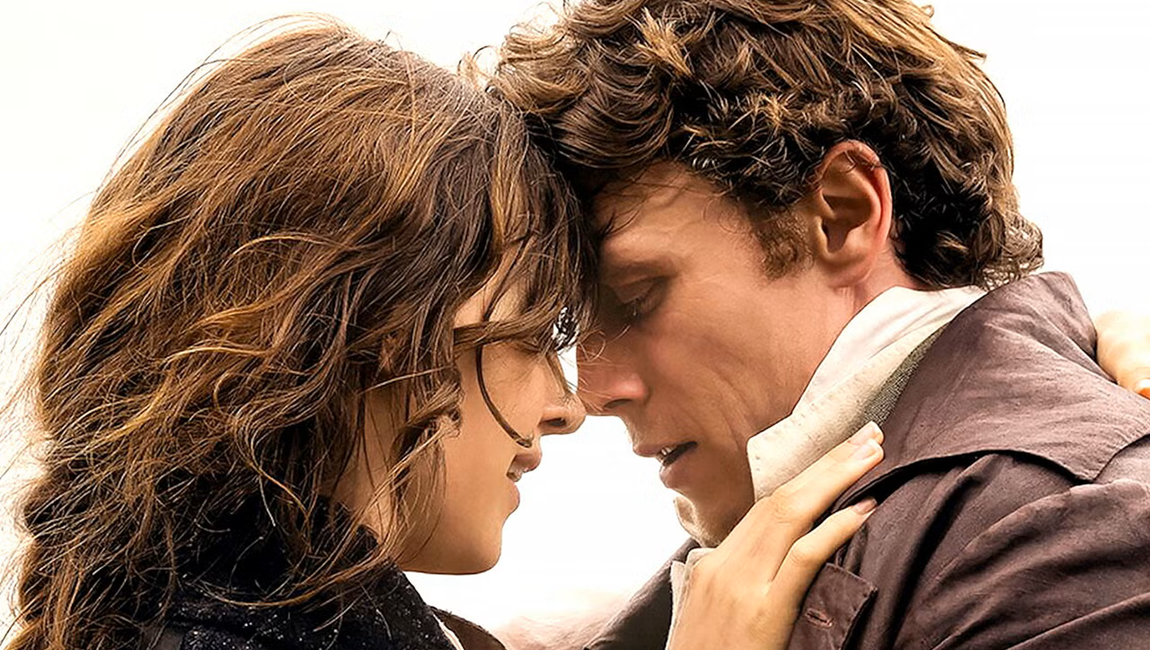
Oakley’s Sense and Sensibility opens within the intimate perspective of Marianne Dashwood’s (Esmé Creed-Miles) sensibility. Alone in a field, running her fingers through the tall grass, observing the fine textures of nature, we find a character at home among rocky crags on a blustery day, reciting the poetry of Samuel Taylor Coleridge, admiring the poet’s raw passion and gazing upon the “picturesque” promontories of rural England. Cut from the jump is Austen’s lengthy preamble situating the Dashwood’s within their family, their financial predicament. Instead, hot on the heels of Marianne’s wild exuberance, is a brief scene attempting to dramatize the reading of a will. Elinor Dashwood’s Sense intrudes. Daisy Edgar-Jones plays the elder Miss Dashwood with a kindly stoicism. She oversees her younger sisters, Marianne and Margaret, with motherly apprehension. Elinor, however, and Jones’ performance along with her, is somewhat lost in the shuffle. The cinematic urgency of the production favors sensibility, so if Elinor doesn’t come round to the rousing love story, then it won’t be her story after all. In the first minutes, we see the dangers of cinematic translation, the imbalance of mediums. The fine-tuning of Austen’s novelistic object have been rearranged to suit the machine of Oakley’s cinematic expression. One medium triumphs over the other. The images are pretty, the soundtrack swells; in close-up, Edgar-Jones loses her composure — in essence, cinema. Adaptation is a loser’s game. What we lose in literary lightness we gain in cinematic severity; we choose between the internalized imagery of the page and the whelming hypnotism of the screen. Very rarely can we have both.
One of Jane Austen’s essential flourishes is her approach to character. She type-casts, more or less. Mr. Collins in Pride and Prejudice, Harriet Smith in Emma, Mrs. Jennings in Sense and Sensibility — all functionally one-note characters, defined in relation to their role: prudish pastor, poor innocent, town gossip. These characters, flimsy as they seem, are the foundation upon which Austen’s plots sit. Frequently, it is these genteel environs that are used to cast Austen’s world as frivolous. The decisions of Hollywood screenwriters often share a perspective with the critiques of Jane Austen coming from male literary figures over the centuries. It was once common knowledge that her novels were “women’s” books, just as romantic comedies are “women’s“ films. This reading of Austen is, of course, flawed.
To do these caricatures a disservice, then, either by eliminating them or even by lending them depth, threatens to throw off the neat balance of an Austen novel. The most prominent characters are here drawn with much more care than these picturesque additions. Fiona Shaw’s Mrs. Jennings holds the center valiantly — her character is, obnoxiously, at the core of the drama; Fanny Dashwood (Stacy Martin), Lady Middleton (Chloe Pirrie), and even Mrs. Dashwood (Caitríona Balfe), Elinor and Marianne’s mother, are all rendered as background noise. Consider the novel’s description of a meeting between Lady Middleton, wife to the Dashwood’s new landlord, and Mrs. John Dashwood, Fanny, their distanced sister-in-law (who happened to talk John Dashwood out of conveying an inheritance upon the girls): “There was a kind of cold hearted selfishness on both sides, which mutually attracted them; and they sympathised with each other in an insipid propriety of demeanor, and a general want of understanding.” Austen, even with calculated, cutting wit, gives these background players far more meaning than do these casually “insipid” performances. Martin’s Fanny is simply brutal, and unfeeling, without the moral ignorance Austen implies; and Pirrie as Lady Middleton is given nothing but uninspired dialogue about the weather. A shortcut such as this, which picks up on one aspect of Jane Austen’s characterization without addressing another — the “sympathy” she might feel with a woman like Fanny Dashwood — removes the character’s social stakes, and ultimately renders her unimportant to the story. This also performs a disservice to the drama itself. So while Edgar-Jones and MacKay give fine turns as romantic leads, burning with passion beneath their propriety and indecision, and while Herbert Nordrum stuns as long-suffering Colonel Brandon, the communal context around them shrivels. The balance of an Austen novel is in its ebb and flow, in the dialectical viewpoints of the author’s heroines, often shifting as regards the setting and characters they interact with. Lucy Steele, who threatens Elinor for the love of Edward Ferrars, is first a bother, then a rival, before finally becoming the salvation of Elinor’s happiness. The insufferable Mrs. Jennings becomes tolerable to Marianne once she’s their ticket to London, where Willoughby may be found. And most (in)famously, Willoughby must be revealed as another character all together, and in this role Frank Dillane matches the energy of Esme Creed-Miles’ Marianne and rounds out the quintet.
The film’s screenplay uses dialogue pulled directly from the book, a decision which in these types of adaptations can be a bit of a gamble. When it’s done well, scenes can come alive, Austen’s language given conversational dramatic weight; several scenes between Elinor and Marianne bristle with this translated literary energy. But when this cherry-picked dialogue doesn’t land with punch and authenticity, scenes fall flat. In these instances, actors seem relegated to the work of recitation rather than truly inhabiting characters, and the illusion crumbles. Most unfortunately, due to the constraints of screen-time — Oakley’s Sense and Sensibility comes in at 132 minutes — details and contrivances of the plot are so re-worked as to become unrecognizable. Colonel Brandon’s long, stumbling backstory involving Willoughby’s indiscretions, delivered to Elinor in the book, is absent from the film. “You will find me a very awkward narrator, Miss Dashwood,” says Brandon, before delivering a quintessential Austenian speech, in which her character’s thoughts intrude upon their remarks. In the film, instead, the contents of the speech are relayed via a letter. Lucy Steele, meanwhile, is portrayed as a conniving interloper, and her admission to Elinor — key to her romance with Edward Ferrars — arrives after they have gone to London, a shift which radically changes the dramatic irony, to the point of basically eliminating it. A screenwriter must pick and choose, naturally, and these changes in themselves aren’t poorly informed, but it’s the fabric of the story that is harmed rather than the particulars. Without the careful plotting and gentle manipulation of Miss Austen, her stories run the risk of seeming frivolous.
Now, none of that is to deny the beauty Oakley conjures. The film’s images are undoubtably pretty, and the screen burns, at times, with brilliant Romantic landscapes which remind us of those of painter John Constable (1776-1837), a contemporary of Austen. The settings are period appropriate, suggest historical accuracy, and evoke an age of pictorial and architectural fancy, without becoming beleaguered by the drab hand-wringing of “realism.” And most tellingly, the tone is refined: scenes buoyed on gentle swells of stringed music; graceful camera movements settling into the moment; dress and setting pitched at a painterly register. In other words, the film aspires, clearly, to be among the better, loftier class of period piece, those films that become timeless even amidst their specificity, whose canonized stories are matched by the manufactured beauty on screen and are capable of reigniting a long-dead author’s influence.
In the end, Oakley’s Sense and Sensibility is a fine movie. It certainly looks better than most of the year’s studio releases, features several compelling performances, and it weaves the tatters of Austen’s novel into an engaging romantic plot. As an act of adaptation, however, it’s a failure. Austen’s novel, for all its specificity of milieu, achieves that grandest literary ambition of approximating life. Reading Sense and Sensibility over 200 years later, it isn’t hard to feel involved in its machinations, to easily map yourself, your own experiences and emotions, onto the story. The film, inevitably, blocks these entrances. It rushes out at us, smothers us with its own reading of the book. Oakley’s adaptation, her reading of the novel, is necessarily deliberate, intentional, and forceful. Whatever ambiguity we are allowed has vanished by the next scene, and much of the narrative remapping seems geared to this end. When every step in the filmmaking process, every decision, big and small, requires an accurate interpretation of the text, adaptation is doomed. Reading a novel requires nothing but our humanity. We’re invited to vacillate with the emotions of the text, to reinterpret something from memory, even to reread. Films, so often, are closed circuits. The sprightly ambiguity of Austen’s prose, which to this day defies the spinsterish pigeonhole it’s been forced into, deserves a better adaptation, a more open-ended one, one that speaks in many voices rather than only in pretty pictures and performed yearning.
DIRECTOR: Georgia Oakley; CAST: Daisy Edgar-Jones, Esmé Creed-Miles, Caitríona Balfe, Bodhi Rae Breathnach, Frank Dillane, George MacKay; DISTRIBUTOR: Focus Features; IN THEATERS: October 16; RUNTIME: 2 hr. 12 min.
Comments are closed.