
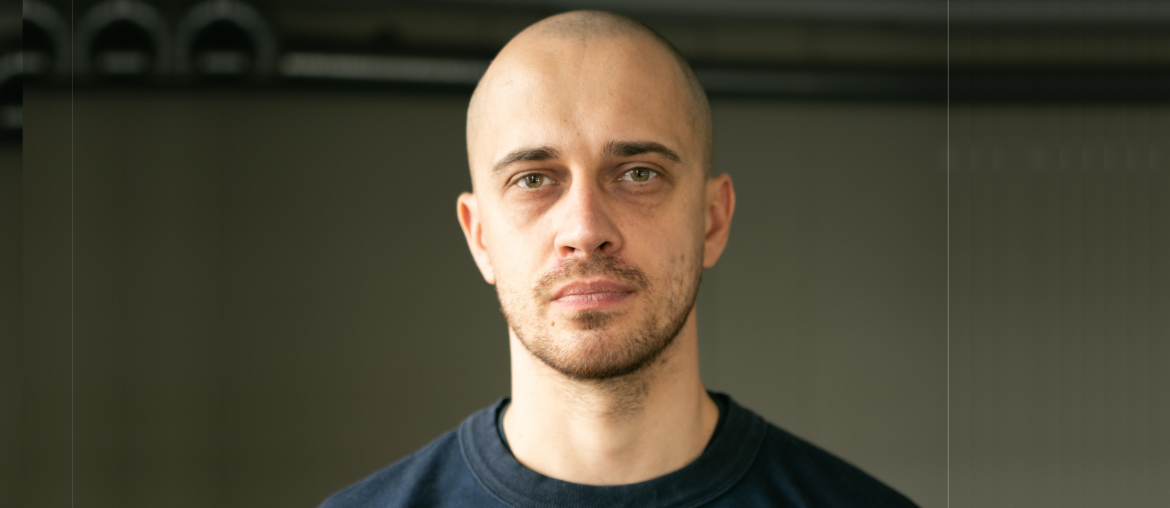
After Latvia became the first Baltic country to win an Academy Award with Flow in 2025, Conan O’Brien joked, “Ball’s in your court, Estonia!” The innocent omission of Lithuania, the region’s most populous country and thus theoretically most likely to actually produce an Oscar-worthy film, left Lithuanians on the outside. But it is Lithuania that now has an earnest chance to follow up Flow‘s at the Academy Awards with Andrius Blazevicius’ third film How to Divorce During the War. The film is the country’s official submission — and given its success in winning a major award at Sundance, and thus officially becoming a buzzy title with pressing themes, it’s the kind of film that has a legitimate chance in the international category.
Putting the dull pedantry of any Oscar conversation aside, How to Divorce During the War is worthy of broader cinephilic discourse. While they wait in the car for their daughter’s violin practice to finish, Marija (Žygimantė Elena Jakštaitė) tells her husband Vytas (Marius Repšys) that she wants a divorce. The next day Russia invades Ukraine and the repercussions extend through Lithuanian society. Businesses are pressured to cease operations in Russia, protests start, and we watch a refugee crisis unfold in real-time. The pending divorce isn’t a The Banshees of Inisherin scenario; we just happen to pick up in media res when the love has simmered to vapors. There is another person, another woman (Indrė Patkauskaitė), but the marriage seems dead regardless of an external paramour.
Andrius Blazevicius’ debut feature, The Saint (2016), took place in 2008 in a provincial town in the countryside, also starred Marius Repšys, and touched on similar mid-life anxieties as his latest film: a man looks for a new job, for a love affair, and for God, but only finds the last. The director followed this up several years later with Runner (2021), in which a young woman named Marija (Žygimantė Elena Jakštaitė) races across the city in search of her unstable boyfriend (again played by Marius Repšys). The same couple returns in How to Divorce During the War, and their chemistry as co-leads must be incredible as they convert it on screen into anti-chemistry. The two don’t hate each other so much as they have grown numb to — and fallen out of — love.
Blazevicius’ direction balances an emotional distance (an “observational” approach, he calls it) and refrains from the happy ending that would have been all-too easy. The war context, meanwhile, will be familiar to anyone fluent in the latest in Eastern European cinema (A Russian Winter), but that is also because this is the world they live in. How to Divorce During the War, though, neither over-contextualizes the war nor reduces life to it. After all, Lithuania is technically still at peace — even though every day that feels increasingly fragile to many Baltic citizens.
As the film releases into U.S. theaters, I talked with Blazevicius over Zoom about an in-world film shown on the TV in How to Divorce During the War, queerness in Lithuanian cinema, the “cold” visuals of a Baltic winter, the physical vs. metaphorical angles of a scene of domestic abuse, a frustrating interaction with a committee from the Lithuanian Film Centre, and much more.
The interview has been condensed and edited for clarity.
Joshua Polanski: Thank you for being here, Andrius. I wanted to start with an easy question, and it’s about the film that’s featured in the background on the TV. Aesthetically, it reminded me a lot of Southern Chronicles. Was that intentional? Can you tell us more about that film?
Andrius Blaževičius: No, not at all. The first idea was to use something I did myself in the past, maybe in film school, but the problem is that Marius [Repšys] is in every film of mine.
So then I asked Laurynas Bareiša (Drowning Dry), the director, whom I know really, really well. It was basically his first short film from when he was still studying cinematography. I really loved it. I remember when I saw it for the first time, I thought that he would be a future star of European Art House cinema, and I was right. And the short film wasn’t big in any way. It didn’t travel a lot. And so, I thought it would fit because I wanted it to be in this ‘90s style.
At the time when I was writing, Southern Chronicles still hadn’t been released. So when I was writing, there was still this idea here in Lithuania that we really miss films that talk about the ’90s, which was a really crucial time in our country’s history because it was a transitional time from socialism to capitalism.
I really wanted a trashy aesthetic. Plus, it looks really like an arthouse film, and I really loved that short film. This was the idea basically: something without Marius Repšys and something more Eastern European in style.
JP: You do work with the same cinematographer as Southern Chronicles though, Narvydas Naujalis.
AB: I worked with Narvydas on this and Runner. He also shot a few shorts of Laurynas Bareiša’s and his first feature, Pilgrims.
 JP: Is the film’s title the same in Lithuanian?
AB: It’s a bit different. It’s without the word “how.” It probably would sound like Divorce During the War, for a literal translation. I really love the English one, but somehow, to translate it into Lithuanian, it wouldn’t sound the same. It wouldn’t have this feeling of this wordplay.
JP: What I like about the title is it inserts Lithuania into the war, which, of course, on some level it is not Lithuania’s war. Hopefully, it will never be Lithuania’s war. [Blazevicius crosses his fingers.] But, in a way, it says this war is our problem. Was that always the title?
AB: It’s the first time ever when I didn’t change the working title. Usually, I have a totally different title in the beginning and only when the film is edited do I come up with the final title. In this case, it was the same title all along.
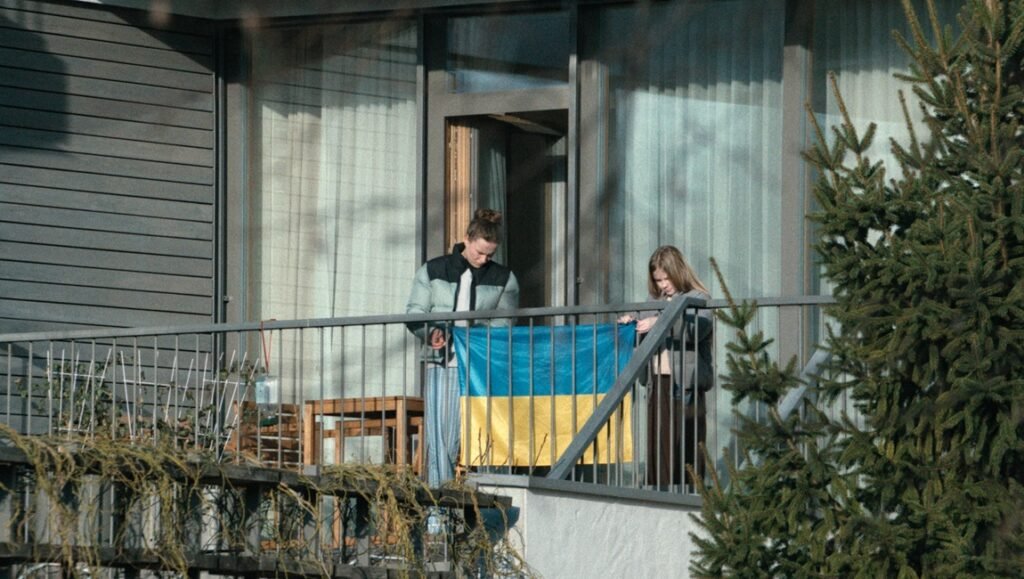
This war is a big problem for us and for our country because of our history; we are really close to the war zone, and we are very close to Ukrainians. We have been supporting them all along, actually from probably 2008 even. It was even earlier, actually, with the Orange Revolution. But when this war started, as it is shown in the film, it was a huge shock really.
It’s really hard to explain because, I think, there are just maybe three countries in Europe that are having this reaction to the war: Lithuania, Latvia, and Estonia.
JP: What about Georgia?
AB: Well, with Georgia… Yeah, for some people in Georgia [the reaction is similar]. But what is happening there with policy and who they’re electing themselves, the tendencies are not that good, I think.
In Lithuania, Latvia or Estonia, the majority of our populations are really supportive of Ukraine, and there are just [small] minorities who are supporting the other side. And again, we were fully occupied. We didn’t have our country. We were part of the Soviet Union. Poland was also socialist, but they were still Poland. There was Poland as a country. I think it’s a very big difference because still we are small and we feel — and we are actually — really fragile, but fragile in the way that we had this huge, aggressive country nearby. And what politicians say there, it is really scary.
JP: To get a little bit more specific into the film, one of the more memorable scenes for me is the early car conversation where Marija tells Vytas that she wants a divorce. It’s very difficult to watch. It’s painful, emotional, and also distant at the same time. The cameras are removed. The positioning of them in opposite seats with the camera at their center does a lot of the symbolic heavy lifting. How central was this scene and the approach you took to it ultimately to How to Divorce During the War?
AB: I think it was the most important scene in general. It defined the whole style of the film, to be honest. We did a test scene. We shot it in, well, I’ll call it a more traditional way with a master, then some closer shots, like a medium, and then a total close-up. A very good editor in Lithuania edited that scene. We sat with that scene, and we tried different things, but there was a feeling that something was off. It wasn’t working. It wasn’t good. To read it on paper was much more interesting than to watch it on the screen.
I was then thinking about how I can [fix the approach] to this scene, but also for the whole movie, because after making the test scene I thought [the traditional approach] probably was not right for the whole film, not just for that scene.
And then, I came up with this concept that we need to observe it generally. We have a saying in Lithuania that “You need to watch yourself at a distance if you want to realize who you are and to understand your intentions and everything.” From this anecdote, this first glimpse of the idea came, and I realized that the space [away from the characters] gives this. I really don’t want to judge those characters; to shoot it in a more traditional way, it could look like I’m judging them, and it would be really hard not to judge them. I wanted the audience to decide who is good or bad. Half a year after the film premiere, after traveling to festivals, I could see that some people are really choosing their sides or they are more into Marija, or more into Vytas, or, of course, the daughter is always the character everybody loves. And I think it really helped this style.
JP: Personally, I was definitely more on the side of Marija. The moment in the same car scene, where Vytas chokes her, really put me on her side. Both of the characters move and recover with ease. They don’t really address what happened. On some level, it can be understood metaphorically. Marija literally says something about how she feels that it is suffocating her. But is the physicality just as important as the metaphor for you?
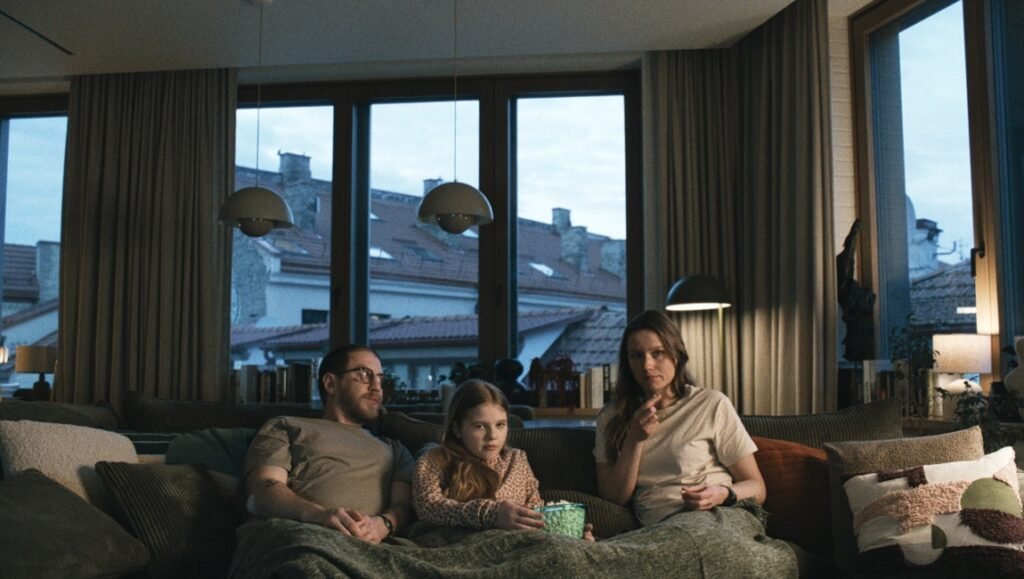
AB: Wow, I never thought of it this way. For me, this physical act of what he did, I think it’s very obvious that he never did it before. It is a first-time [event]. And what I was thinking about it is actually what Marija says later: that he is a loser. This was a crazy idea that popped up somehow into his head because he couldn’t do anything [about the situation]. I think it also shows what stage of his life he is at. Five years ago, probably, he wouldn’t do anything like that. But at this moment, he says that he’s losing everything. Another important theme in this film is gender roles. In Lithuania, there are still patriarchal attitudes [about] how men should be stronger and things like this. And so, there is the pressure of the traditional man who comes with money and should be strong. And he is the total opposite of everything [he is supposed to be, according to these patriarchal standards]. He is a household man, he is taking care of a daughter, he is cooking, he is cleaning the house, and he is not contributing financially at all. And so, this was the thing. I wasn’t thinking about it as a metaphor.
JP: She says she feels she is “suffocating,” at least in the translation, and then it triggers his response.
AB: Exactly. It is. But still for me, I don’t know if it is a metaphor for me.
It was a trigger for him. “Okay, you are saying that you’re [suffocating], then I will grab your neck.” It’s the lowest point, I think, of that character. Even with everything [that happens] later, it is still that point that is the lowest.
And still, what is very interesting, I found out from the [audience] reactions, is that until we see that he goes to the sex worker, everybody is with him. More people, it seems that they’re with him until the sex worker. I wanted this suffocation moment for the audience to go a bit more into Marija’s side.
JP: To get a little bit more into the look of the film, to me it is simultaneously reserved, which we see a lot in the car scene, but also poetic. I’m thinking of the scene where they’re having an argument and the camera is motionless, resting behind a bush. The bush is obfuscating the view of the two leads. What were the most important considerations for you and Narvydas Naujalis in crafting the look of How to Divorce During the War?
AB: Well, when I shoot in this kind of a style, there is one special rule for me: there should not be any image that repeats. Every image is used one time, and we don’t cut it back into that image. This was rule number one.
In the beginning, the editor [Anna Johnson Ryndová] wasn’t very impressed with this idea, but then she realized that she agreed with me. We wanted an observational perspective that we, as viewers, are in a room or somewhere outside. We are observing the moments of real life. At the same time, the only character who has closeups, real closeups, is the daughter. She knows much more about them than they know about each other. She is basically in the same position we are as the audience.
This idea came from my life because I remember when I was a kid I knew so many things about my parents, and I know that they didn’t know. Maybe 15 years ago, my father told me one secret of his, a secret I already knew when I was 11 years old. I knew already because I was very sneaky. Kids generally are very sneaky. They want to know everything [in order] to understand life, to understand how their parents live.
This was our approach regarding the colors. In February and March, it is very dark in Lithuania. It is very cold and wet, and it is like [what we see in the film]. Another thing: it was emotional, of course, because at that time, we were waiting for the war to start, and it was really dark. It was really dark outside, and it was dark inside of us. When the war started, it seemed that everything just went even darker. [The darkness] was a very simple choice in a way.
JP: Did you see Renovation before filming?
AB: No, no, no, I didn’t, but I read the script.
JP: Have you seen it now?
AB: Yeah, of course.
JP: There are a lot of similarities. Žygimantė Elena Jakštaitė stars in both, and she is a woman in a committed relationship with a man who strays from that before ending on a reunion of sorts. But aesthetically, they are so different. You used the word “cold” to describe How to Divorce. I think that Renovation is a very warm film. I was just interested if you had seen it before filming.
AB: It premiered in Karlovy Vary, and we wrapped our shooting two months before their premiere, so there was no chance for me to see it.
I read the script because Žygimantė told me, “Maybe you should check it out just in case, because I am in a relationship and in a separation in both of the films.” When I read the script, I realized they are totally different. Even the context of the war, I think, is very different because, in our film, it is very straightforward. It really impacts the story and characters really straightforwardly; theirs is more a context for characters’ change. For us, it’s really straightforward because they’re going to protest, they’re supporting [Ukraine], taking refugees in, and everything really makes a very direct impact. I think they are different even in this regarding messaging or themes.
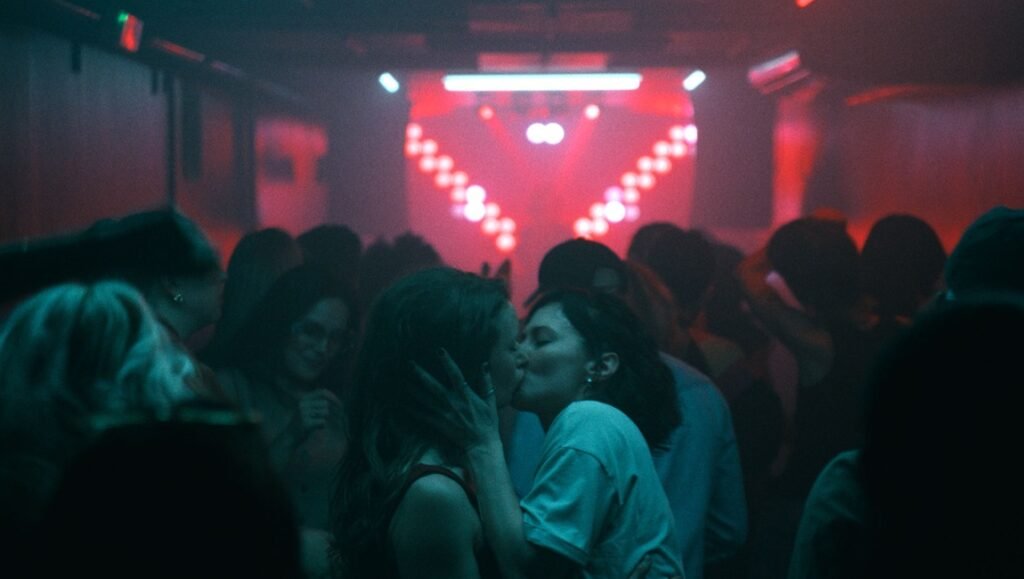
JP: I recently interviewed Žygimantė. We talked about her character’s bisexuality and the way that the gender of her paramour is unimportant. It could have been a man just as much as it ended up being a woman. What can you say about the attitudes of queerness in Lithuania to readers who are not as familiar? And also, what did you hope to accomplish with Marija’s queerness?
AB: For me, the most important thing is just to show it in a film in a very normal way and not to make it important somehow. I don’t know how to even describe it. In our lives, there are just so many queer people, and it is totally normal. But in the films, you don’t see it as a normal thing. Because, in my opinion, Romas Zabarauskas, if you know about him, he is doing queer cinema.
JP: I interviewed him, and we talked quite a bit about queer cinema in Lithuania.
AB: Maybe he has very different opinions. We [still] don’t have civil partnerships [for queer couples], which is crazy. But in ordinary life, especially for younger people, there are just so many cases like [in the film].
I was counting how many women I know who had a very similar story: a woman who left or got separated from a man, and then they had a long-lasting relationship with a woman. For some reason, I just know one guy who had a wife and then went into a relationship with a man. It is just everywhere all around us. I wanted to show it somehow in every film of mine, but somehow I didn’t find a natural way of doing that in other films.
In this case, I just realized that it made sense somehow. There is a fear, and also the action was in Vilnius, the capital. It is very different in a provincial place of Lithuania; my first film was happening in a province, and it was almost impossible to show [queerness] somehow there.
I just want to show the way we are living, and that is it. It was a very simple thing. It is not represented in [Lithuanian] films, I think, in the right way. Because in Romas’ case, it is just totally different and it is a different genre.
When we had a conversation with a committee from the Lithuanian Film Centre, who decides whether or not to finance the project, there was this question. I realized just then — I’m probably very naive — that, for them, [this topic of her female lover] was me following some kind of artificial points from the European Union. It was nonsense. That I just wanted to check some kind of a box [to include queer characters], but it wasn’t that. This is the life I’m living: I have lots of friends who are queer. We need to change this representation. It should be normal and that is that.
JP: Did you feel pushback from the Film Centre?
AB: Well, the question wasn’t like a pushback. When we were thinking about the older generation in Lithuania, they were imagining some kind of agenda — that if you want to be successful, you need to show something queer in your film or just to make it queer. Then it will be easier to get into festivals, which is bullshit. There were three people in that committee. And from one person’s question, I realized that they were thinking this kind of way [about an agenda], but it wasn’t true.
I can’t say that it was a pushback because the Film Centre supports Romas’ films. There is no policy that it is forbidden. They are totally fine with that. It is the committee—those independently selected committee members — that are sometimes the problem. Not the Film Centre. The Film Centre, in this case, is great actually.
JP: Speaking of politics, your film invites the viewer to think about politics, the war, and personal accountability. What kinds of political conversation do you hope to hear following a screening of How to Divorce During the War?
AB: In Lithuania or generally? Because it is very different.
JP: Both.
AB: In Lithuania, we are in a totally different situation. I don’t know if you heard that intelligence from the United States [government], maybe the CIA, said that something can happen here in September from the Russian side. That Russia can do something. So it’s not fun.
With the way I portray that couple and the way people are receiving [the film], I just really hope that people will somehow see themselves in this. What I’m noticing is that people have this tendency to give support until some kind of a limit, and then when this limit is reached, we just go back [and return to our lives]. Okay, okay, it is not our business; it is your war.
I think this is because we are just drowning in our comfort in this richer part of the world. For example, the ending of the film, this last shot, this is not for me the hope of a new day. It is a peace before something horrible can happen.
Many people in the European Union, especially west of Poland, don’t think that it can happen to them. It can. I really think that it can. Especially for Germans. Russian politicians are saying really bizarre things. I just want people to think about themselves and about what they can do. There are people who are losing everything now in Europe. And of course, there are many other places in the world where horrible things are happening, and we need to do something.
It’s very simple and naive probably, but I really hope that people will think about [the war]. And they will think about how impossible it is and how sad it is.
JP: Congrats on the Sundance win. I know that’s huge for both you and your team. It is also huge for Lithuanian cinema. What do you think this means for Lithuanian cinema moving forward? What are you hopeful for regarding your country’s cinema?
AB: I will just say that 10 years ago — more than 10 years ago, actually — when we had our first film, and we were sending it to festivals, we had this possibility to check the screener link and to see [at what point] the viewer stopped watching it. We could check what was happening with festival submissions. Many of them didn’t even open the link. Some of them turned it off after three minutes. I don’t think you can make a [judgement] about a film, especially when I’m thinking about my first film, in the first three minutes. Three minutes is not enough to understand that this film is really that bad that you just don’t want to watch it until the middle at least. Now people are watching it.
10 or 12 years ago, we were a country that had just one director, Šarūnas Bartas, and everything else was nothing interesting. That was [the narrative]. Little by little, this is changing, and the people are noticing our films, and they are hearing about them. And those awards that Lithuanian films are getting in festivals, they are helping future generations. The most important thing I hope for is that people will just take a look at our films, and that is it. We are creating some kind of a brand for our country, in the filmmaking world, which is very important. And I think we didn’t have this 12 or 14 years ago. We had it in a documentary, of course, but not in fiction.
I just wish for Lithuanian films to be diverse, different, to have more queer cinema, more experimental [film], maybe even genres. We have new talents coming up, and everything will be good.
Comments are closed.