
“As Rotterdam burns, they study Sanskrit verb forms,” is how one iteration of the famous proverb goes. This version of the maxim targets scholars with their vitriolic blind eye to injustice. How to Divorce During the War, the year’s biggest Lithuanian film and Sundance award-winning drama, is a poetic response to this famous proverb — not in the sense that parsing verbs will put out the fire, but in that something as quotidian as grammar might occupy our attention in a time of war. Life moves on even when innocent eyes are met by the angel of history’s glare.
In How to Divorce During the War, life includes the titular separation, which begins when Marija (Žygimantė Elena Jakštaitė) tells her husband Vytas (Marius Repšys) that she no longer loves him. She lies about there not being anyone else, even though her sapphic paramour is more of a pressure valve release than marriage-breaking catalyst anyway. The next day, Russia invades Ukraine. But before that, something important happens in the car where Marija tells Vytas she doesn’t love him anymore while waiting for their daughter’s violin practice to finish. Crying, she confesses their relationship and the person it makes her “suffocates” her. As quickly as the codeword that triggers the Winter Soldier in the Captain America films, Vytas grabs her throat with two hands. She resists, and then he leaves the car, gets back in, and they air out more relationship issues. Marija calls him a little of this and a little of that, and neither of them address the abuse. Not in the car, not later. The closest the film comes to revisiting his abusive tendencies is in depicting his new hobby of breaking Russian car windows, but there is of course a fundamental ethical distinction between property damage and domestic abuse. The brief scene doesn’t ruin the film — and there is a fair metaphorical reading therein given Marija’s use of “suffocating” and a later scene where their daughter chokes on food — but it nonetheless builds a rather tall wall for audiences to overcome to try to empathize or side with this man in any way, which the film seems to want from its audience.
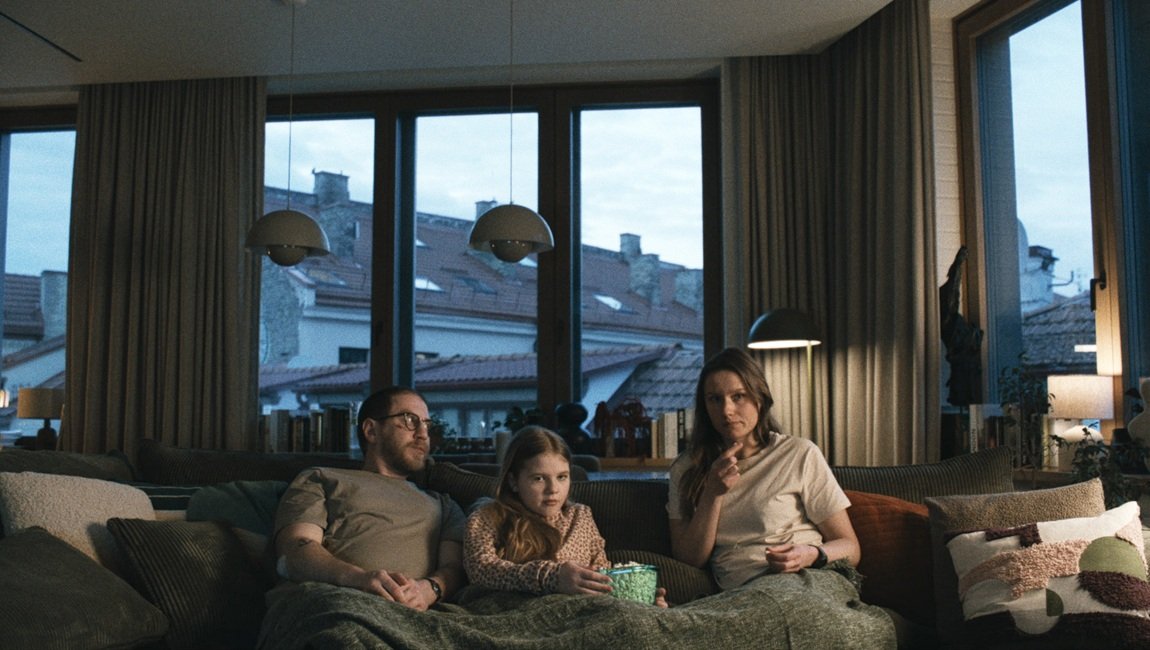
During this eventful talk, director Andrius Blaževičius positions Marija on the right and Vytas on the left of the car, with the camera centered on the windshield, and the negative space between them is tense enough to become noxious. After her practice, their daugher Dovilė (Amelija Adomaitytė) sits in the backseat, choosing the middle seat instead of either window option, putting her squarely between the faces of both parents for the ride home, the center in a game of tug-of-war. Cinematographer Narvydas Naujalis, who also shot the breakout early independence period-piece Southern Chronicles (which this writer originally thought was parodied in a fictitious in-world film that plays on television, though Blaževičius clarified in our interview that Southern Chronicles wasn’t available yet to be referenced), uses similar framing techniques to create visual divides between feuding characters throughout. Kicked out of the house, Vytas returns to his parents’ home where he finds himself unable to tolerate the Russian state propaganda they watch on TV: the width of the table separates Vytas from his mom, and the back of a couch to the right of the table adds another degree of separation between him and his dad. Later, the last shot of humans in the film is the three of them sleeping in the same bed; Dovilė is in the middle again. This time, she occupies the negative space fully and makes the group appear as a single unit. Their divisions fold onto the flat plane of the bed, an entire story told through the blocking alone.
But before we get there, more life. Marija’s lover is another woman, and in this narrative incident a prominent new title is added to the Lithuanian queer wave. While queerness in Lithuania is far from a Pollyanna experience, queer cinema has “an outsized representation,” as director Romas Zabarauskas put it. Marija’s wrecking of her own marriage — à la The Worst Person in the World — for another woman does, admittedly and unfortunately, give the impression of leaning somewhat into the evil bisexual trope, and her same-sex relationship isn’t framed as liberatory in any way relative to her marriage, even after the throat-grabbing. But the flip side is that — even if this shouldn’t be the case — it’s quite refreshing to have a queer film from the Baltics that doesn’t make a point of its queerness: closetry, mid-life sapphic awakenings, and socio-political obstacles are absent from How to Divorce During the War.
Likewise specific to contemporary Lithuanian film context, How to Divorce During the War will inevitably be compared to last year’s Renovation. And with fair reason, too. Both films star Jakštaitė as a woman in a committed relationship with a man from whom she strays while pursuing another during the Ukrainian war, and both end on notes of possible reunion (possessing varying degrees of hopefulness). There is an unshakeable déjà vu experience to watching Blaževičius’s latest, even if How to Divorce is bound to reach a wider public than Renovation given its recent success at Sundance where it won a Directing Award. Tonally, visually, and thematically, however, they are more distinct than their descriptions make them sound. For one thing, Blaževičius is much more interested in the obfuscation of Lithuanian politics than is Gabrielė Urbonaitė’s Renovation, and even complicates matters via the entanglement of economic complicity. The latter is warm and even sexy; Blaževičius’s film is cold and bitter. They do both end on ambiguously hopeful notes, but even this is somewhat unhelpfully reductive: Renovation’s finale in front of Bastion of the Vilnius Defensive Wall makes a metaphor of their relationship by alluding to Lithuanian history; the living room finale of How to Divorce does the opposite and narrows its focus to the domestic world rather than expanding it to the political one. The reunion isn’t as much romantic as it is pathetic. The cycle will continue; nothing has fundamentally changed between them. Vytas still tried to abuse Marija, and that skeleton, if it can be called that, sits still in their shared closet. The general frostiness of the film’s closing minutes bears out an awareness of the dissonance between the romance of their reunion and the anti-romance of their relationship, even if the film as a whole asks for more sympathy for Vytas than this viewer is willing to lend.
But to look beyond purely Baltic comparison points, How to Divorce might also recall for some viewers Yasujirō Ozu’s The Flavor of Green Tea over Rice, with both films depicting turbulent stretches in marriages that are ultimately capable of weathering the storm. There is even something Ozu-esque in Naujalis’s cinematography, which sees him shoot scenes from one or two vantage points in a room and holding the still shot while letting action run its course. Like Ozu too, Naujalis prefers a frozen camera and leaves open air in the top of the picture as he places the camera lower than most American moviegoers would prefer. Now, in fairness any relationship to Ozu is almost certainly incidental, but that doesn’t thwart the incredibly personalizing effect of the shot height, nor what How to Divorce During the War is able to achieve with regard to its characters through this approach: we are engulfed in their life stories.
DIRECTOR: Andrius Blaževičius; CAST: Marius Repsys, Zygimante Elena Jakstaite, Amelija Adomaitytė, Indre Patkauskaite, Gintare Parulyte; DISTRIBUTOR: Kino Lorber; IN THEATERS: August 21; RUNTIME: 1 hr. 48 min.
Comments are closed.