
“Consequently, Twenty-Four Eyes, which was made by Kinoshita Keisuke in 1954, is clearly a Japanese film,” says Nagisa Oshima, “but the Twenty-Four Eyes made in 1987, when the ‘Japanese film’ had already ceased to exist, was an exercise in futility.”1 In analyzing this quote, we can say that Oshima is not outwardly complaining of the gall required to remake Kinoshita’s classic Twenty-Four Eyes, as Yoshitaka Asama did in 1987, but that to do so uncritically is to create without purpose, to create nothing whatsoever.
It is not a crime to imitate better artists, as Asama did with Kinoshita. In fact, most artists highly recommend it. One certainly cannot fault, for example, Yukimitsu Ina, director of GKIDS’ recent adaptation of mangaka Machiko Kyo’s cocoon: One Summer of Girlhood, in his slavish imitation of Hayao Miyazaki’s wide-reaching oeuvre. Ghibli is the house that Miyazaki built, much the same way Kinoshita was instrumental in the maturation of the Japanese cinema. To say that both of these artists’ styles are ubiquitous in film all over the globe is a truism by now. Everyone imitates Miyazaki, everyone yearns to make another Spirited Away, and cocoon certainly comes closer than most in that regard.
But one can fault the choice of influence. In the case of Ina, it is an especially important question, as the work he is adapting is already one of uncommon style. Machiko Kyo’s cocoon chronicles the lives of the Himeyuri students, a group of Okinawan high school girls trapped on the island during a U.S. invasion and the subsequent retreat of the Imperial Japanese Army. The story is told, both in manga and animation, in a slow crawl to its apocalyptic climax, with the toil of the young girls as they dig shelters, collect hospital supplies, and care for wounded soldiers given the ordinary, slowly deepening tragedy of a film like Twenty-Four Eyes. The girls play jokes on each other, talk about boys, shirk their studies, and otherwise commit to the thin film of normalcy over the island’s assault. But as the danger becomes impossible to ignore or gamify, the tone takes a sharp turn into horror, and the girls are forced to meet their exceedingly likely deaths head-on.
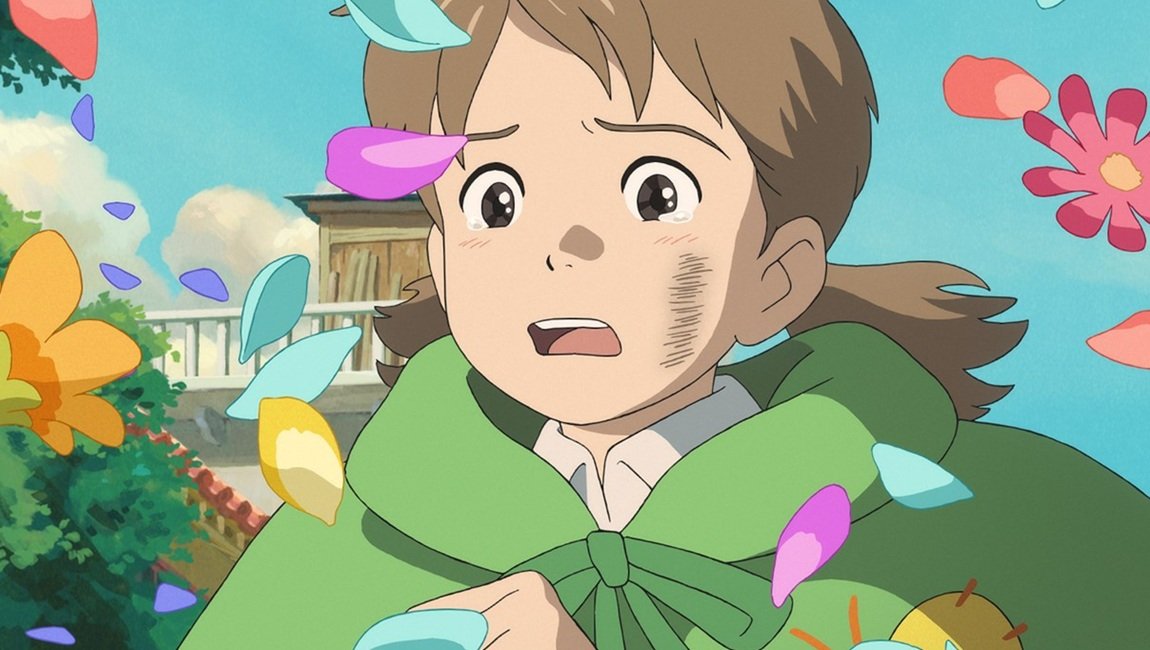
Kyo is a unique talent in the Japanese comics industry. Rather than joining rank with the ever popular meld of American superhero comics and the more classical “manga look,” she takes influence from European bande dessinée. In her sweeping, highly figurative watercolors, readers find the inexorable presence of Jacques Tardi and Herge more readily than the meticulous Miyazaki. Her work on cocoon, especially, is defined by harsh chiaroscuro and the distant, matter-of-fact violence. A gunshot wound on a little girl is no more than a few blots of ink, full-body burns a smudge on the pencil. Such eccentricities deepen the contours of its ordinariness, and earns the unerring horror of the narrative. Ina’s film takes a rather confused approach to Kyo’s original. The narrative remains mostly beat-for-beat with the manga, but the animation ignores its visual ethos and aesthetic, preferring the lush, painted backdrops characteristic of Miyazaki’s work, as well as the Ghibli-style character designs.
But Ina, ultimately, is not Miyazaki, and one can see the limitations of his style in the film’s first few minutes. He relies heavily on backdrops, digital shadow, dappled light; i.e., he uses elements that do not move to develop setting, while the character designs are woefully static. Miyazaki keeps everything moving in his films — call to mind the uncanny, crawling machinery of Ponyo that allows the painted backdrops an eerie sense of possibility otherwise intangible. Even in his lesser works, he is never satisfied by beauty alone. Ina is rarely able to match that frenetic energy, and appears satisfied to relegate his film to the realm of Hallmark postcards rather than building an actual narrative. Late in the film, when the girls run to escape a barrage of unseen soldiers in an abandoned town, Ina details their frantic escape in brisk, dramatic movements. Much like in the manga, the soldiers are never seen, and the gunfire mostly shocks of sounds, but Ina does stop to show the girls gunned down, flower petals spewing as blood from their stomachs. In the manga, that central metaphor is used sparingly, almost as parody of publishers’ rampant conservatism. In the film, Ina appears smitten with the image, and makes certain to halt sequences in order to stop on the floral morass. He commits a certain splendor and revelry to the deaths of the girls, the metaphor becoming a permittance for many sequences of callous spectatorship, all while the film continues to proclaim its sensitivity to these girls’ lives.
Ina’s ignorance of Kyo’s stylistic intent is not the point. Neither is, really, Miyazaki’s shoe-horned influence. GKIDS has long fashioned its founder’s pen as its de facto style, and cocoon only proves the dangers of studio policy. Ina’s film is offensive, not with regard to content, but rather due to the skin lazily applied on top. The Ghibli style is reduced to a collection of postures, common gestures, and a dismal emptiness; it does not exist. Oshima found Twenty-Four Eyes a similar effort, wherein the perceived attitudes of the postwar Japanese were lazily posited against the present ones, which would perhaps have resulted in an interesting footnote if either party had actually existed. Ina makes the same mistakes. He attempts to approximate the styles of both Miyazaki and Kyo, only to land firmly in “exercise in futility” territory.
DIRECTOR: Yukimitsu Ina; CAST: Marika Ito, Hikari Mitsushima, Yoko Hikasa, Rena Motomura, Chinatsu Akasaki; DISTRIBUTOR: GKIDS; IN THEATERS: September 4; RUNTIME: 1 hr. 25 min.
Comments are closed.