
Victims of bullying rarely find solace in the solutions of the school administrations that are meant to protect them and will often experience punishment for any retaliation that far exceeds the penalties levied against their abusers. Loud, emotional acting out catches the attention of teachers and administrators who must take all threats and visible action seriously, while the social torture of a larger group visited upon a pariah can fly under the radar and take elusive forms that are hard to define in words. Now that there is a video camera in every teen’s pocket, incidents spiral out of control even faster and spill out beyond school grounds to become sparking points for whole communities. Jannis Lanz’s Oasis is, on these counts at least, a sharp movie that intelligently observes the suffocating feeling of these dynamics on both personal and institutional levels. That it’s so recognizable is only part of what makes the film such a grueling watch.
Andi (Anton Petzold), awkward and heavyset in comparison to his unreasonably athletic classmates, becomes the center of controversy when a video circulates of him pushing another student and declaring to the gathered onlookers that he will “finish all of you off.” Unknown to school staff, another video — one that shows Andi naked in a gymnasium, his stolen clothes at the top of a rope he is not fit enough to climb — is circulating amongst the school population. Lanz never clarifies what makes Andi a target for ostracization, keeping the film away from sociological specifics that could prove thorny or, god forbid, unrelatable, but it’s clear that his unregulated emotions perpetuate his social station. Meanwhile, Lukas (Florian Geißelmann), the son of Andi’s teacher (Godehard Giese), is the outcast’s only friend, but while he is visibly distressed by his pal’s situation, he never speaks up, even when the other kids turn against him. Geißelmann’s strong facial features (large eyebrows, prominent chin) make him a memorable screen presence and complement his performance at the center of the movie, as he is able to convey complex emotions with just looks and facial gestures.
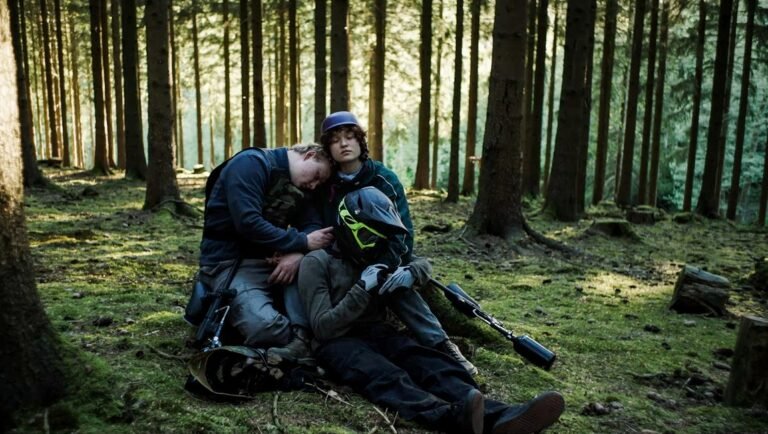
While the teachers and the parents’ association work out what to do with Andi in a series of suffocating meetings, the boys and their friend Maya (Mathilda Smidt), a student at a private music school and an implied past victim of bullying, find solace (or oasis) in the woods. They play paintball — the threat of gun violence hangs over the film like a heavy-handed specter, a shortcut to dramatic weight — and take part in strange bonding exercises, like biting each other’s naked flesh until it bleeds before hugging while the third person films on an old camcorder. The gentle, hesitant intimacy of these games is strange and precisely where Oasis veers from keen observation to strained healing metaphor that proceeds from the film’s formal austerity rather than informing it.
Lanz’s style belongs to the popular mode of European arthouse filmmaking that employs still frames and durational rhythms as a signifier of seriousness, cannibalizing the techniques of more revelatory movements (i.e. slow cinema) to studied, ordinary ends. Theoretically, these aesthetic principles aim to elevate the material, but in effect they contribute to Oasis’ dirge-like monotony. Whether Lanz is filming the trio in the woods, Lukas’ father in conferences, or the bizarre drills of the anti-bullying seminar the school implements in the wake of Andi’s threats, he does so with equivalent severity. If their ritualistic play in the forest is their escape from the strictures of oppressive society, why does it seem nearly as miserable? Sure, they’ve made a space for themselves and are very sweet to each other — even if Andi’s tendency toward violence flares up occasionally — but there’s no joy in it. Instead, these scenes suggest a black box theatricality that points toward artificial artfulness, and the affectation hampers Lanz’s more successful attempts at describing a social problem.
In fact, describe is about all Lanz’s film does, and though it’s effective on those terms, it’s hard to not question the point. Rendering the experience of being bullied, and that of dealing with harassment cases at the institutional level, counts for something, but it can only take a film so far. In Oasis’ final moments, Lanz opts for elision rather than a solid ending, a calculation that believes leaving a limited set of dramatic possibilities to the imagination will result in the desired emotional effect just as well. Maybe it works, but when contextualized by the preceding two hours, it plays as mere noncommital affectation.
Comments are closed.