
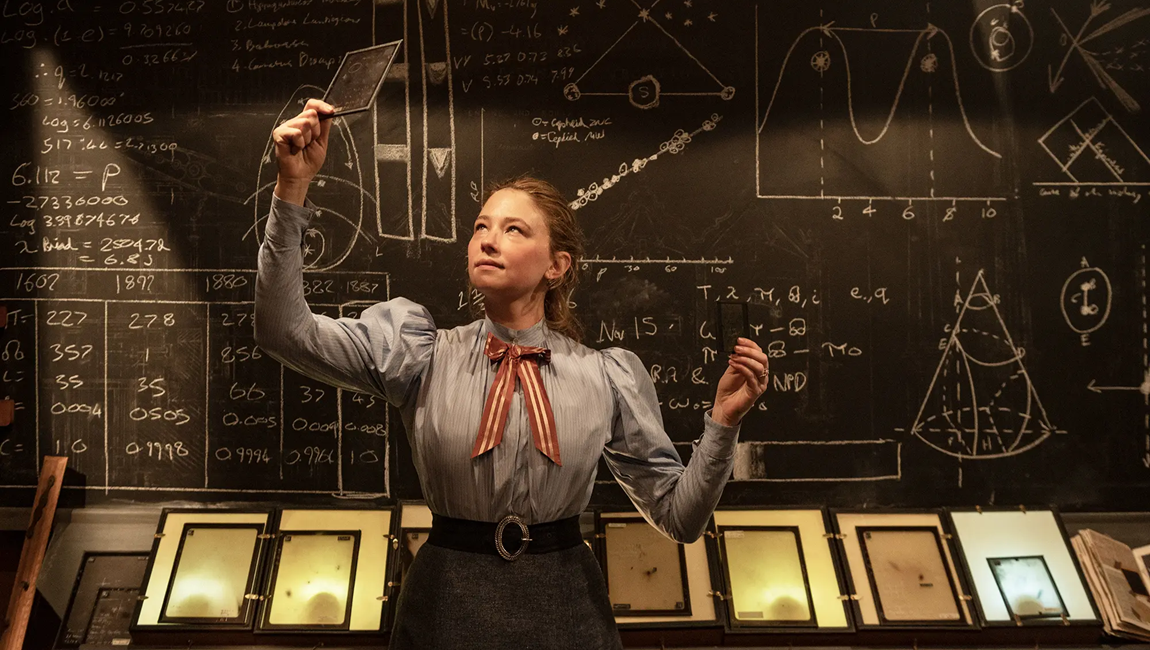
There aren’t enough filmmakers, perhaps, still afraid of Virginia Woolf. Tina Gharavi, whose film I Am Nasrine was smuggled out of Tehran before being nominated for a BAFTA, and who helmed Cleopatra’s portions of the controversial Netflix docu-series African Queens produced by Jada Pinkett Smith, has had her hands in projects with biting cultural and artistic relevance. Virginia Woolf’s Night and Day, a new adaptation of one of Woolf’s earlier novels, is sadly not one of them.
Night and Day is a sadly disregarded work of Woolf’s. Arriving before the form-altering revelations of her stream of consciousness style — which in Mrs. Dalloway, To The Lighthouse, and The Waves, radically shifted the trajectory of the English language novel — it seems to fall by the wayside, an anomaly that cannot readily be placed in the “canon,” nor into Woolf’s “mature” style. It shows rather strongly the author’s inheritance from Jane Austen, which, in later, highly masculinized discussions of “great” novels, would seem a hindrance. Woolf herself even called it “flat.” The novel deserves none of this, of course. It is a dense, wonderfully realized text that flaunts the idiosyncrasies of the 19th century against the perversions of the 20th. Night and Day is about love and romance, men and women, science and tradition, and much more. The moral and intellectual battles of the early 20th century, including women’s suffrage, queerness, and the scale of the cosmos, are set beside each other in an intoxicating blend. In short, Virginia Woolf’s Night and Day deserves to be reevaluated, and it also deserves a better film adaptation.
Gharavi’s rendition does little, arguably nothing, to set it apart from the recent cascade of other saccharine, mid-budget period pieces that bear a passing resemblance to Downton Abbey. A variety of obviously — dare we say distractingly — manipulative music carpets the film end-to-end; imagine a beautiful Edwardian home, rich in hardwood flooring, with faux-carpeting end-to-end. Scenes are lit, apparently, by lamp light, and that warm amber glow fills in as a signifier of age. Period accurate dressing bustles through the film’s compositions, yet the camera wheedles about, handheld, never seeming to find a commanding frame. And there is no sense of a pictorial age, a time in history when painting, the dominant European art, is being encroached upon by photography. This all leaves the impression that Night and Day is, at least in visual and sonical terms, a contemporary film playing dress-up.
None of this is helped by the fact that its dramatic intuition is also remarkably shallow. This is either a result of a poor reading of Woolf or a vapid desire for the sort of melodramatic highs easily legible to an audience satiated on BBC costume dramas and social media. The melodrama is, ironically, Woolf’s own. Her plot hinges upon the interrelations of a handful of young people, all thoughtful, opinionated, and lusty. Woolf’s tangle and tussle of love and science is a brilliant concoction which draws upon a tradition of elevated personal drama from Shakespeare to Jane Austen. The “prestige” adaptation, which trends toward smaller screens, either those at home or on the middle-brow independent circuit, has its own set of vapid expectations. Meager means satisfy meager ends. If the product looks the look, then it walks the walk. Virginia Woolf’s Night and Day does neither very well. Especially when compared to a work like director Marleen Gorris’ 1997 adaptation of Mrs. Dalloway, starring Vanessa Redgrave as Clarissa Dalloway, Gharavi’s film seems a pastiche. She appears strangely content to ignore the pulse of Woolf’s work, the interior life not only of her characters but of the text itself, while Gorris’ film takes big risks in attempting to encapsulate the tremulous prose of that other Woolf novel.
But one should take care not to chalk this up to a difference in source material. Mrs. Dalloway and its profound reflection of interior life is without question the bigger challenge for a film director adapting Woolf, but Night and Day is almost equally intricate, and just as finely tuned. Woolf was a master craftsperson, and adaptations of her work require mastery. One cannot simply chalk it up to budget, either. Mrs. Dalloway was a mid-budget film in 1997, earning in the ballpark of $3 million. It was released into a very different milieu, when off-beat projects featuring marquee names could garner genuine commercial praise. Gharavi’s film exists in a vacuum-sealed atmosphere of indie-film reciprocity. Its budget was likely modest, and its returns are expected to be less-than-modest, somwhere just north of nonexistent. It will screen to pleasant applause in a number of rooms which look vaguely similar. It will be followed by a number of question-and-answer sessions which prod nonchalantly at the subtler themes of Woolf’s omniscient work. Audience members may feel pleased with themselves, erudite, and yet they will have done themselves a disservice if they believe Woolf to have been so toothless, so milquetoast, as this movie. Take this writer’s advice: find a $5 paperback of Virginia Woolf’s Night and Day and forget Virginia Woolf’s Night and Day.
DIRECTOR: Tina Gharavi; CAST: Haley Bennett, Elyas M’Barek, Jennifer Saunders, Lily Allen, Jack Whitehall, Timothy Spall; DISTRIBUTOR: Quiver Distribution; IN THEATERS: September 4; RUNTIME: 1 hr. 35 min.
Comments are closed.