
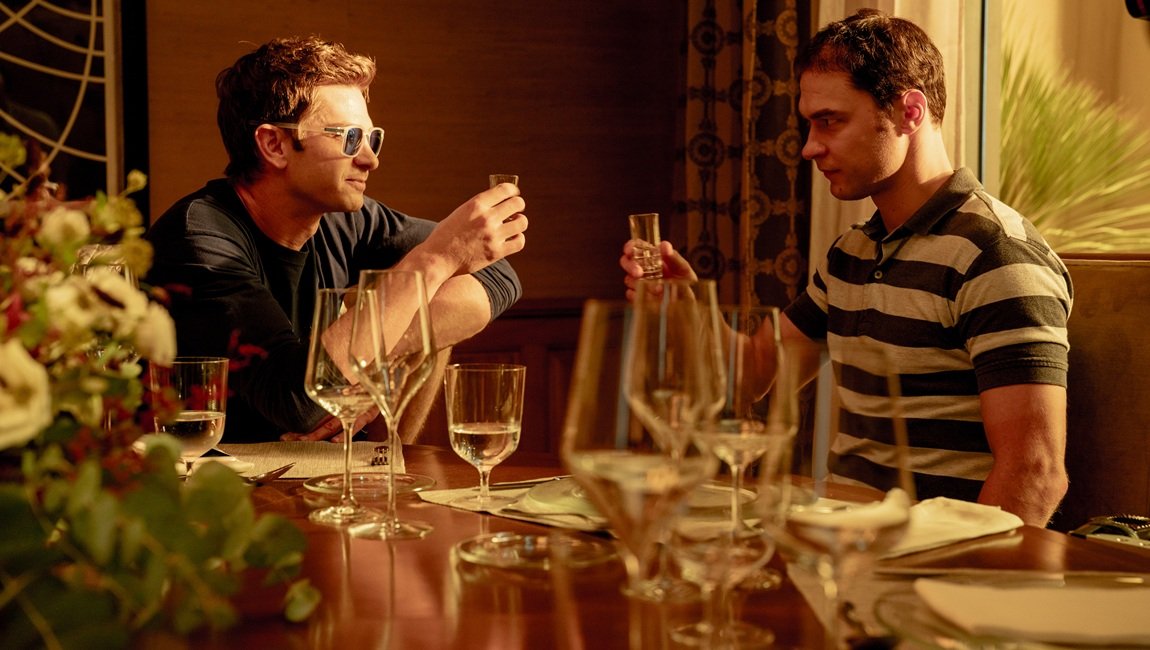
Luca Guadagnino’s neo-realist farce Artificial presents a parade of dipshits: 1) figuratively, as it introduces us to the careless architects of what many believe is our doomsday weapon, and 2) literally, as the main physical activity in a film based around constructing a digital tool on computers, is walking. Indeed, as directed by Guadagnino, the film offers up a neurodivergent spectrum of people gifted with brilliance but entirely without physical grace, resulting in a taxonomy of awkward gaits, a true cornucopia of people who simply suck at walking. They lope pigeon-toed through San Francisco and the vineyards in the hills outside it with stuttered steps, shoulders that expand and contract and bounce like they’re dragging heavy invisible bookbags behind them, as Damon Albarn’s brilliant 8-bit synths bloop and bleep while percussion clatters arrhythmically. What Guadagnino communicates is that this cohort of greasy geniuses who are on the verge of ending life on Earth as we know it struggle with the basic act of putting one foot in front of the other.
Simon Rich’s screenplay charts the birth of generative artificial intelligence through the company OpenAI, beginning in a humble University of Toronto office in 2012, where the unlikely union of a goofy, altruistic professor in his 70s (Mark Rylance as Geoffrey Hinton, the gentle voice of reason) and a 17-year-old Russo-Israeli prodigy (Yura Borisov as Ilya Sutskever) crack rudimentary AI. From there we make stops at Google and in Elon Musk’s private jet, ultimately arriving at Sam Altman’s futuristic karaoke palace with a survivalist bunker that looks like the inside of a product vending machine at an Apple Store.
As many critics have been quick to recognize, Artificial is animated by the same corporate intrigue and unraveled friendships that made its spiritual predecessor, The Social Network, the ur-text of modern American digital life rendered in cinema, but this film is less concerned with the dehumanized social element than the human-modulating technology. It asks the question not of who will control the company, but how they intend to wield the product at the center of it. If you’ve been following the news of late, even passively, you know that it hasn’t gone well, so you can guess the trajectory of the film walking in.
What you may not be prepared for is the filmmaker’s approach. Guadagnino has always spoken through his raw materials and what they convey. He is a lover, and filmer of fine things, people draped in quiet luxury eating rich (and rich) meals in tastefully-appointed rooms. One may not have expected this taste, and this eye, to be well-suited to the weighty world of this film, populated by candy-gobbling, unwashed shlubs crashing in incubator houses, playing video games against their creation night and day, but Guadagnino turns out to be the perfect messenger, without having to adjust his aesthetic a byte. He lovingly renders man boobs and tighty whities in slow-mo like Botticelli figures, or like Tilda Swinton on a villa balcony. In doing so, he communicates the heightened, funny, frightening feeling and message of this world that elsewhere Aaron Sorkin might need a sanctimonious speech or Matt Johnson a snarky joke and wink to achieve. Conversations are captured on indirect mics, and we often join them in media res, full of jargon most of us may not understand, and context we don’t have, but we don’t need it. Artificial has the quality of a National Geographic documentary with its anthropological look at a strange, secluded, insular cabal of several makes and models of inept future tech-titans you’d have to be forced at gun point to hang out with.
Chief among them is Sam Altman. It’s apparently the season for actors depicting humanoid freaks doing their best to ape our mannerisms and behaviors on screen, like Robert Pattinson’s Chris Hansen and Jeremy Strong’s Mark Zuckerberg. Andrew Garfield has bested them both, with a terrifying, fresh vision of a queen lolcow lit and technicolored like he’s being shot by Sirk. His Altman is the next model off a robot factory line that produced Zuckerberg, communicated by Strong in the The Social Reckoning as an endgame super computer who would take that characterization as a compliment. Altman’s replicant has gotten human vulnerability and empathy updates and is doing his best to fit in among us. He is overly touchy, sitting cross legged on tables with his shoes off and “connecting” with unsettling prolonged stares tinted by colored synthetic contacts, but is every bit as soulless as the next technocrat who values the profit imperative over everything. Second best in show goes to Ike Barinholtz, whose screen presence typically manifests via one-note dolts, but who here is brilliantly utilized as the human cartoon/richest person in human history, Elon Musk. It’s tough to remember an actor who has ever done less and made viewers laugh more than Barinholtz is able to manage here, with a simple grimace, head tilt, or distracted glance.
Altman was successful at branding himself as the face of OpenAI, and behind the scenes as the decision-maker who would keep the pedal down on marketable products and lead with what was best for the shareholders and corporate interests, which allowed OpenAI to divest from Musk’s seed money. In Artificial, as OpenAI grows, this work entails ignoring increasingly alarmed emails and deflecting concerns to push OpenAI past its competition and all logical and reasonable safeguards the team around him are trying to put in place before it’s too late.
But from the moment Sutskever barges into Hinton’s office, unable to measure the distance between knowledge and patience, it was too late. Artificial is yet another Frankenstein allegory based on a simple miscalculation. The well-meaning tech innovators behind GenAI believed they had a century to prepare and properly develop the next industrial revolution, a humanity-reshaping and perhaps -concluding technology, unaware it was more like a decade (and as Jason Schwartzman’s quasi-homeless, overeducated Nostradamus predicts in his single, terrifying speech, as children play below in Dolores Park, there are approximately five years left). The tragedy and folly comes in watching us make the same petty, venal, short-sighted, selfish decisions human beings have made for themselves, and against the future, since the moment we emerged from caves.
No matter how many times we’ve seen these events play out in our politics, or our financial markets, or in our living environments, it’s the same fucking story, one Guadagnino has added a brilliant new wrinkle to, in what may end up being his best work: no one in a position of power or opportunity pulls the plug or walks away, regardless of the collateral damage. Or, as Sam Altman puts it in the film, “Hey, Prometheus wasn’t afraid of, like, fire.”
Comments are closed.