
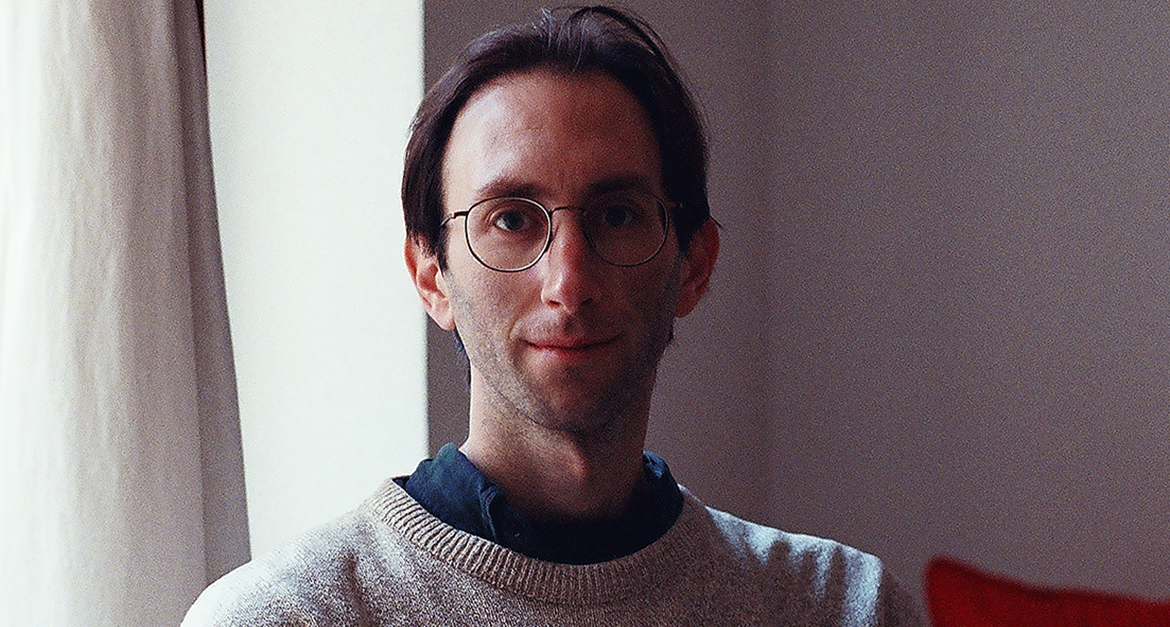
Ted Fendt’s films have always had a proclivity for the esoteric; analog film stocks, long takes, conversation amongst intellectuals, 20th-century novels. Yet they remain primarily works of relatability, not unlike a quiet stroll on an autumn day — at once stimulating and leisurely.
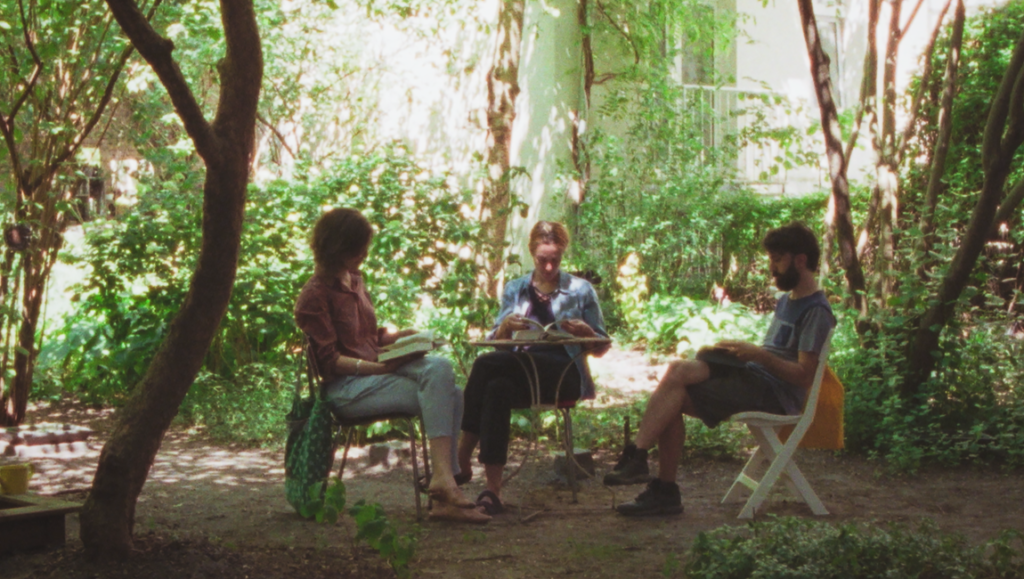
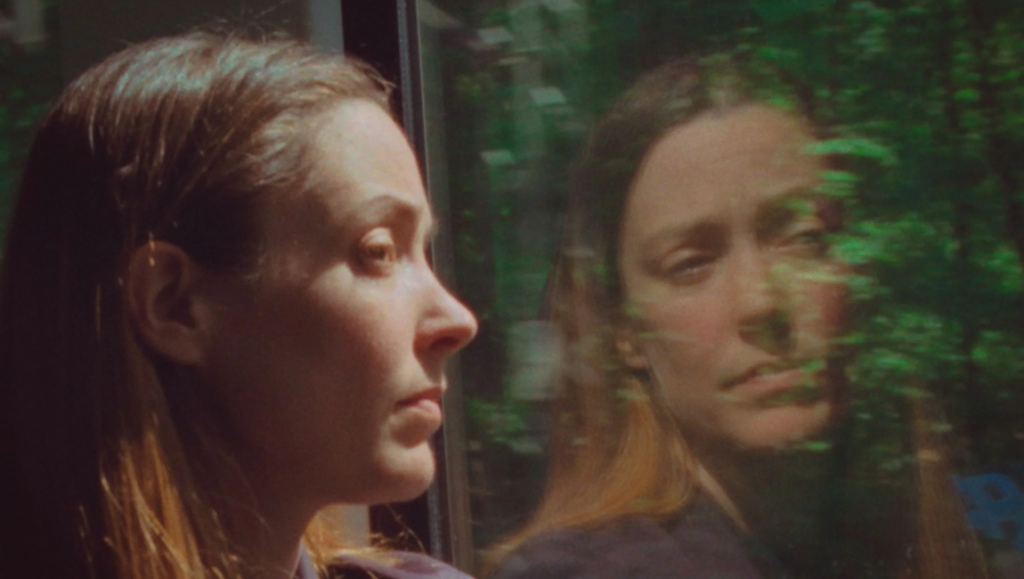
His newest film, Foreign Travel, is no exception, detailing a year in the life of Leonie (Leonie Rodrian, who also co-wrote the film), a Berlin-based translator whose occupation concerns the oeuvre of the late Italian novelist, Anna Maria Ortese. The previously mentioned autumn stroll metaphor is no coincidence, as Fendt’s camera follows everything from a late-morning city walk to an invigorating conversation with a fellow translator.
Following Foreign Travel’s recent screening at the New York Film Festival, I sat down with Fendt to discuss the indexicality of shooting on film, Éric Rohmer, making self-funded films, and more.
Joseph Dimacchia: I wanted to start off by asking about the title, Foreign Travel, because there isn’t any actual travel in the film. But it could be argued there is travel within the context of language — speaking in French and German, reading in Italian. How did you arrive at the film’s title? Was it due to the “travel of language,” as it were, or did it have something to do with your experiences making films in Jersey and Philly before ones that take place in a European milieu?
Ted Fendt: As a younger man, it was easier to come up with titles, and as I’ve grown older, I have struggled. There used to be a title maybe before I began making the film, and now the title comes very late. I open a notebook and kind of free associate, write down title after title after title, and eventually come upon something that feels right. And this felt right I guess because it refers — maybe obliquely — but it refers for me to the trips that the character has taken prior to the movie beginning and that she’s going to take after the movie ends; but also to maybe the trip out of the country that the second protagonist, Florian, should be taking in order to escape his father issues.
And then, of course, there are other associations like the immigration topic of Alejo moving from Argentina to Germany, which is someone with Italian roots moving back to Europe. And then for the reader of [Anna Maria] Ortese, one could connect it to her own migration — her family lived, for a period of time, in Northern Libya when she was growing up. I think when she was eight or nine, her father had a job there for the Italian government, and within Italy she moved around a number of times. And then the painter, El Greco — this is a very obscure reference — is a very important reference point for this book they’re reading at the beginning of the film, Il porto di Toledo. So, it’s a title with various associations.
JD: I’m really interested in Anna Maria Ortese’s writing, because it’s a kind of backbone to the film in a lot of ways. One of my favorite scenes was during the first book club, where they discuss inexpression, and how it can form a second, unreal reality.
TF: Yes.
JD: I don’t know if I’m misinterpreting, but I viewed that as the unexpressed within cinema, and I read that you kind of take after Rohmer in that you don’t want to show your characters working, but rather imply it. So I’m curious as to how much consideration goes into what is shown and what is not — the real reality, which is fleeting, and the unreal reality, which is eternal, as they say in the film.
TF: I had felt some… need in the past — maybe 10 years ago or so — to put into the film, to kind of clarify what the jobs of the characters were. And then at some point, I just felt like, screw that, I can leave that in the offscreen space. It doesn’t necessarily have to be implied that they’re just independently wealthy. They have some means of work that’s just not a part of the represented fictional world of the film. That way I could focus in on other sides of their lives and experiences, to put the emphasis on those character traits I guess, or to bring out character traits in non-work or non-labor situations.
Not to say that close reading is not its own kind of work, because it is, and most people who read a New York Times Best Seller are not doing a lot of work — it’s more of a distraction. This book they’re reading demands a lot of attention, and the passages they quoted — like one of the more theoretical passages in the book — lot of the book deals with an unrequited love for this Fascist soldier. A film is the filmed moments of time and space that are linked together. That’s the film, but then, in the kind of imaginary spectator, there’s also the blank that they can fill in about what else is happening in the character’s world and life. I want to focus on these other things, but maybe you need a follow-up question for this to be more precise, because I feel like I’ve given you two answers.
JD: No, that was great. [laughs] I mean, I bring up Rohmer because there are a lot of scenes where it may not show them working, but they’re just walking from place to place, and there’s also that chronological vignette style where it goes by in months. It reminds me a lot of A Summer’s Tale (Rohmer, 1996) or other films such as that — [Rohmer’s] film is in days and not months, though.
TF: Yes, that’s true.
JD: I read an interview where you mentioned that you consistently come back to a quote from Tag Gallagher’s book about Rossellini, and correct me if I’m wrong, but I think you were referring to when he writes, “What is nearly impossible in literature — virtually direct experience with another person — is the essence of cinema.”
TF: Yes.
JD: In the film, there’s a lot of discussion regarding realism. Do you think that the literature-focused nature of the film — that kind of intertextual approach — is a way for you to grapple with the direct connection of cinema? To create distance through literature?
TF: Well, I’m not trying to create distance so much, I suppose, as I feel like… with cinema — as Tag Gallagher talks about in this passage, which is talking about acting and nonprofessional actors in cinema and the way that, if you film a rose in cinema, the thing onscreen is that particular rose, whereas if you describe a rose in poetry, it has all kinds of associations for everyone that are different. So it is this concrete quality that puts you into a direct relationship to the person or the place that you have on-screen, and it’s in this intensified manner. And I want to try to get [that] back, which I think is the experience of early cinema.
There are certain passages which in the film are quoted — the characters talking about books partly as a way to generate conversation. And of course, the way they talk about the books will reveal character, and also the passages they choose to focus on will reveal something about character. I chose these passages because I feel like it’s really interesting that this particular writer, writing at that time — the books are spanning from being written in the early ‘50s through the mid-to-late ‘70s, but reflecting on the 1930s — that she has these things to say in a very bold manner. It’s a kind of self-reflective manner, but it’s not in a postmodern way, [and] more like the late 19th century novel kind of way. I didn’t want to necessarily apply or create a parallel with filmmaking with those passages per se, but to share those passages in this intensified manner of cinema.
So the question of distance wasn’t really on my mind — it was more showing engagement. The psychological reason would be, in Leonie’s case, that she’s trying to use it to repress certain things and escape issues, but then the topics of the books make those issues return to the surface. That was another reason we use certain passages I think.
JD: So [literature] has the opposite effect of distance then — it can bring you closer to the character in a way.
TF: I can certainly see how someone could be overwhelmed — especially at the beginning of the film — by the passages they’re suddenly quoting, and it’s maybe hard to follow on first viewing. It’s also for me, less important to understand the content of what they’re quoting per se and more of the way in which they engage with it, and the enthusiasm which they have. So that could be off-putting, but it’s not meant to be off-putting. When we were doing the sound mixing and I was watching the film a lot, I kept thinking, “I’ll be happy if one or two people get past this point in the film,” because it seemed a little challenging.
JD: I mean, a lot of your films have focused on intellectuals, or intellectual and theoretical conversations. What was it initially that made you so interested in this?
TF: Well that’s just me, you know. When I made Classical Period (2018), it was because this friend of mine said — he had seen this guy who acts in Short Stay (2016), Al — and he said, “Ted, if you ever want to put your literary interest in a movie, this guy would be the perfect subject for that.” And that was kind of it. I just wanted to explore those interests of mine. I’m a big reader. I mean, sitting in front of me is a gigantic copy of Ovid’s Metamorphoses [holds up book], which I brought to read on the plane. So that’s just a personal interest.
JD: You said something really interesting — what you mentioned before about the rose, for example, being in front of the camera. Earlier in that passage from Gallagher’s book, he also quotes Bazin when he wrote, “Cinema is the art of reality.” As it pertains to how you shoot on film stock, is it a way for you to construct that indexicality, which many say is not achievable through digital photography? Is it a stylistic choice as well?
TF: There are several things to it — it’s not just one answer I suppose. One is, I’m interested in engaging with film history. I’m interested in working with certain limitations, which are opposed by the form. Like, in this case, the 11-minute roll of film, and also the amount of film I can buy is limited. That creates a framework to work within, that creates a focus, as opposed to filming the endless stream of images that you can do with a digital camera. I think of the beauty of the material, and I think of the depth of the material. I like to film on 16mm because I still want to make film prints. I still am not convinced that digital projection looks nicer than a good analog projection. There’s an almost three-dimensional quality to a film projection that has to do with the shutter, and I want to have that as long as possible. So there are all these elements.
When I started film school, we still had courses where you shot on 16mm and edited on 16mm, and showed the films on 16mm. I found that very satisfying. I was living through the transition to digital cinema during this time too, and I was not convinced — still not really convinced — by the cameras. I can understand plenty of reasons why people would shoot digitally, and certain projects that make more sense to I suppose, but I like to work this way, and I still do it. I was about to give an example of something but I don’t know if it’s actually that relevant. [laughs]
JD: No, no, go ahead!
TF: I had this great experience three years ago. I was at the Austrian Film Museum, and they have this cyclical program of experimental film history that’s every Tuesday. I was there for the program — a Lumière Brothers’ film of the Vienna Opera House, which is directly behind the Film Museum, and it was filmed in like 1901. Then they showed Tom, Tom, the Piper’s Son (1969) by Ken Jacobs, then they showed — three times in a row — this Lumière Brothers film again. Then you go out of the cinema, and you’re like, I can literally walk to the spot where this movie was shot 125 years ago. This was somehow very impressive. The whole experience of watching the film heightens your awareness and your sensitivity to the environment and what’s going on around you. To some degree, I’m trying to do this. There are different layers to the film: the character study, but also showing the place, and doing that in the specific manner of analog cinema, which has a history. I mean, the Lumière film is also one-minute long, or shorter, because that’s the only known filming for the camera, and they worked within that framework. So a tangential footnote that may be relevant to what I said.
JD: Do you think that was something that arose from your days as a projectionalist? That you gained an appreciation of film stock from that experience?
TF: Yes and no. I think I was very much inspired, when I was in my late teens and early twenties, with like… I mean, Rohmer — there was only film stock then — but he also had no money. There’s a story about how they filmed, I think La Collectionneuse, with starting the scene before they started the camera, because they didn’t have enough film stock to even have slates. They really needed to be super precise with shots, and there was only one take, and that’s a budgetary reason. And then they didn’t even have the money to print in color, so it was printed in black-and-white and edited that way.
So I was inspired by these low-budget filmmakers to begin with, and this method of working within limitations. So yeah, I’m filming with low amounts of film stock. I think the last three features I did, I had a bit more money and I didn’t think so much about it because the kinds of performances I’m going for are not ones that require 20 to 30 takes. I was always shooting only three takes or four takes. I earn less money now. I was earning less money when I made the film… so it was a minimal amount of stock.
It was also the reason we shot the movie over the course of a year, and it was also the reason we shot the movie only one or two days a month. The idea was initially: How much money can I afford to put aside to buy the film stock, and pay for the processing? How many shooting days can I afford? So it was kind of like trying to get in harmony the form and the content. So that was taken into consideration.
The other thing is, there was an important moment in 2015, when I was working in Lincoln Center during the New York Film Festival. We did a full Nathaniel Dorsky retrospective, and it was like 48 films on 16mm shown in like, one week. It was four programs a day. It was rather crazy, but I projected most of it and had this very focused, intense experience with the films, which often deal a lot with depth, and spatial depth. They gave me this new appreciation… yeah, these specific formal qualities of film material and the projection of it. Also, seeing a table full of that many prints was inspiring.
JD: You bring up La Collectionneuse — I remember I watched that film for the first time and instantly tried to look up what film stock was used. I’m curious — and it’s a bit more technical — but have you stuck to one film stock or are you experimenting, trying to find different 16mm stocks that you like? In this film, it’s a bit of a softer look, and I wouldn’t say it is as overtly grainy as some 16mm stocks can look.
TF: I have regretfully only shot on Kodak. I could’ve shot on Fuji back when it still existed, but I didn’t. I pretty much shot all the movies on 500 or 250 or 200 ASA film stocks. Basically, the Kodak stocks kind of all look similar, but you can go from no grain to very grainy, and I filmed this one almost only on 250D, which we used on the last feature film as well. I really liked it, because it’s not that grainy and you can use it inside or outside.
When I was like 21, 22, the first short films we made and Short Stay were all mostly shot on 500 as I was really into more grain then. And then I got into slightly harder lighting on Classical Period, and if you have harder lighting, the grain is going to be a little less prominent. The last two films we shot on mostly 250 ASA film, which still has some grain — it’s not smooth, but it’s not as chaotically grainy as 500. It’s interesting; it has a different quality if you print it. If you print the 500, it kind of softens it a little bit. If you digitize it, the grain almost feels like it’s sitting on top of the image, whereas if you print it, it has a slightly softer quality — the grain is less in your face.
I’m curious too — I’m hoping to have news by tomorrow or Monday at the latest of the first 16mm print, which the lab in Berlin is making now. It will have a slightly different grading, because it’s being done by a different person, and then I’ll digitize that print to make a new digital copy from that. I’ve always wanted to film on 50D, but I haven’t done it yet. It’s the one stock that I think looks a bit different because it has a much higher contrast, and it looks a bit more like reversal film when you print it. I have one thing that maybe we’ll shoot sometime next year which I would maybe do it with.
JD: I think what you’re getting at is that film stock, for all the beauty you get out of it, it’s also kind of limiting, which it sounds like you prefer to work within those kinds of limitations.
TF: Yeah, for sure. This was also the reason I prefer analog printing, because you have three colors you can control, and you can make it lighter or darker, a little bit more red, a little bit more blue, but you can’t decide everything, you can’t control everything. I think it’s an illness of contemporary film that people can control everything. Why I don’t like sound in 99% of movies today is because sound designers — which is a position that didn’t exist 20 years ago; it used to be sound editors, and now there’s a sound designer who can do everything — they put a sound for every fucking cricket in the background of the shot that you don’t see. Every little thing that moves by in the background gets its own unique sound, just so that they can have some ego satisfaction that they did something. It’s the same with color graders I think. They can alter every pixel, so they can overwork everything, and people start to look animated or computer-generated. I think the films of the 1930s where they couldn’t do any sound editing, are much more interesting.
I was rewatching some of the early ’30s films of Jean Renoir, and I was listening to an interview with him. He was talking about how, in this period, there was no sound editing — the sound was actually optically recorded on the film, and you had to plan the shots to hide the sound edits, knowing that it wouldn’t really be possible to hide. They were making these films within this limitation, and it leads to these very sculpturally blocked films, in a way, where each shot is like a chunk of stone and you see them join. I think that’s so nice, and much nicer than the world of contemporary moving images we’re now living in. So I think all art needs some kind of limitation. When you can do everything, then the result is somehow less compelling.
JD: It seems like you’re also describing what we talked about earlier, that indexicality — we’re losing a sense of the human imprint within the film, or the imprint of the actual reality of what is being shot.
TF: Right. Obviously, an argument could be made that everything is somehow and to some degree manipulated, that what you’re seeing is not a stand-in for being there. Still, you can try to obfuscate that, or you can work to try to preserve that, and I may be less compelled by the obfuscation. I was having a sort of similar conversation last year with a friend of mine about Westerns and how he couldn’t imagine: “What if they took the gun shot sound effects out of the Western? It wouldn’t work anymore.” And I was saying, like a Budd Boetticher Western… it’s a very limited amount of gun sound effects compared to today, where you’d also have a fake wind, fake foot steps, clothing sounds. Everything gets on sound, and it’s kind of overwhelming. It ends up being kind of… it gets too close to animation, and too far away from what’s imprinted on the film or on the soundtrack at the moment of recording.
I mean, something that Rohmer — we can just keep coming back to Rohmer; he’s a good reference point. There’s something that he does a lot which I think is really fascinating, where within a shot reverse-shot sequence, he’s cutting between the fictional character you’re looking at, and the actress or actor on the screen. It’s kind of this dialectic between these two which is inescapable in film. There’s the image of the person, or there’s also our projected fiction or fantasy on the character, which comes out of the context of the film. You can very well create a tension between those two aspects, and I think that’s more interesting than someone who just puts the emphasis on the fictional side, which may be a more spectacle-oriented production.
I don’t know if this makes sense as a reference, but what comes to mind is the Christopher Nolan movie, Tenet, which is the last Christopher Nolan movie I saw. The first 20 minutes of the film I thought were quite interesting because you have no idea what’s happening. It’s just like bodies moving around and action, and then they start talking about plot and it doesn’t make any sense and there’s this overly complicated idea about time travel or something. I didn’t understand it. And then it becomes awful. When it was just people moving around and action sequences, I thought it was kind of interesting, and then it just totally lost me when it became this fictional construct layered on top of that.
JD: As that relates to writing, too, when the ideas for your work first come about, are you trying to resist that notion of spectacle and artifice by relating it back to personal experience? Because I know for this film, you’ve done work as a translator. I don’t want to speak for you, but I’d imagine that was the impetus — or one of them — for writing the script in the first place with your co-writer.
TF: The cinema which has always attracted us is not really spectacular per se, although I also love Westerns, but I wouldn’t necessarily say I love them for their spectacularity. In the past, I would cast somebody I knew and then construct the character around certain elements of their lives and character traits. Over time, I realized that I was selecting things that I related to, indirectly telling about myself. So in this film, I was trying to be more direct about myself in a way. There’s a lot of myself in both the main characters — kind of divided between them, between Leonie and Florian. For me, something filmed and projected is spectacular enough, like this Lumière film I referred to earlier — that is enough for me. I don’t need a crane shot, though I don’t have anything against crane shots myself. Yeah… I’ll leave it at that until you have a follow-up. [laughs]
JD: Yeah. [laughs] In that regard — though I wouldn’t say your filmmaking is concerned with spectacle, especially not in the same way someone like Nolan, for example, would be…
TF: Yeah.
JD: It’s not only indexical, but it is an act of translation in itself. Would you agree with that? You’re translating your own personal life in some way — your own psychology, rather — the psychology of your actors. And then, in this case, you’re also, in a sense, using literature to translate character pathology to the audience. As we talked about, they can read a passage and that may or may not tell us something about them.
TF: Yes, well one thing I wanted to add to my previous response was just that, to me, I’m trying to get back to — in my small contribution to this — a shot of somebody crossing a street in a city should be exciting enough. The location sound of that moment and people walking around a city is spectacular for me because the cinematic apparatus makes it that way. I believe in that, and the things that have moved me the most in the cinema are simple. There’s a great reading group scene — which there’s nothing spectacular about it per se — in the [Frederick] Wiseman film, Belfast, Maine (1999). It just cuts to a group of middle-age people discussing movies in a living room, and it’s very simply filmed. That’s all sufficient for me in terms of spectacle.
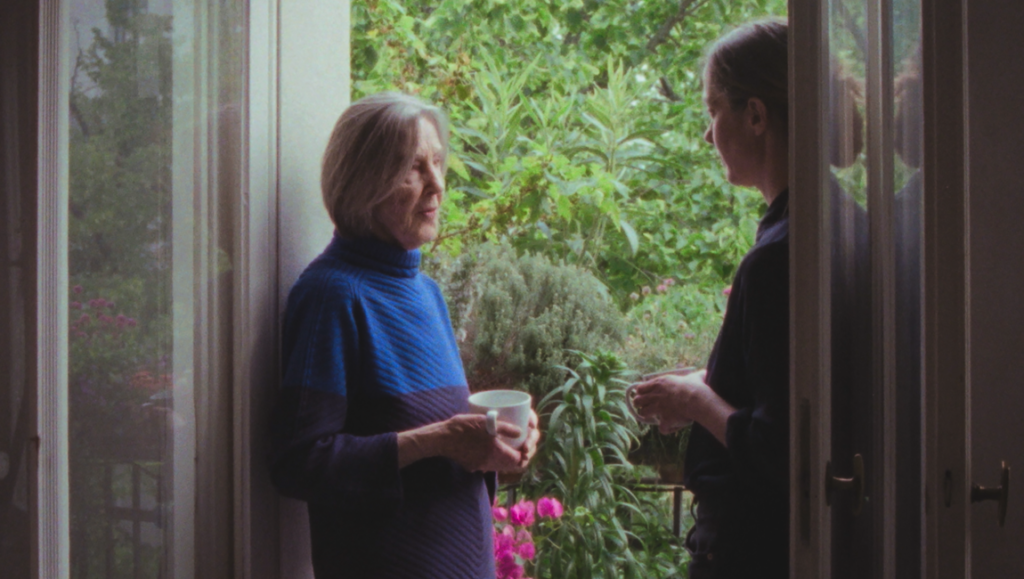
There are things in [Foreign Travel] that just coincided with, were timely with life. I saw that there was this new revised translation of this book coming out and I thought, “Oh good.” I liked the book. I had read it in English and I wanted to see this new version, this translation, and I would be interested to know what that experience of revising this translation was like for this translator. Are they still alive? Where do they live? And I found out that she lived close to Berlin and was happy to discuss the book with me, and agreed to be in the film, had interesting things to talk about and shared experience. That was something of interest to me.
Leonie found it of interest too, and that’s how that wound up in the film. Of course, it’s different if it’s Leonie discussing this with this woman rather than me in the film. It makes it more dimensional. It gives it more of a nuance than if I had acted in the film myself because it filters it through her own experiences as well. There are autobiographical elements prominently in the film, but it’s also mixed with other stuff — hers and the other characters. I think this is probably the case in any fiction writer, bringing in their own experience then creating characters out of that. I think [Gustave] Flaubert and Madame Bovary, you know, “Madame Bovary, c’est moi” is accurate.
JD: I think that’s a great way to put it, that it’s not so simple, that it’s nuanced and multifaceted in a number of ways. Especially the conversations that regard literature — the book club conversations, for example — would seem more scripted than conversations such as Florian discussing his apartment struggles, [and] are not only relatable but very naturalistic. Because of the self-funded nature, which can engender a kind of guerilla methodology of filmmaking, to what extent are these scenes calculated as opposed to circumstantial, left up to chance? You mentioned that you’re shooting over the period of a year or so, and I read that you took February off, for example, because of a number of different reasons.
TF: Everything was written within two weeks of when we shot the scene, and then everyone got the script pages three to five days before we went to shoot it, and they were very diligent about learning their lines. Everyone was allowed to modify the text to their vocabulary, but usually I would write a draft and then Leonie would correct it to get the grammar, get the phrasing to sound more natural. If it was her own line, she would modify that with her own thoughts more or less depending on the case.
One thing that was interesting, because we were filming piece by piece, initially I didn’t know what the film would be about. I only had the first three scenes on day one, and it was only after we filmed the first book club conversation that I had a sense of the rest of the movie. But I was also editing too as we went along, so if we shot something and edited it, and it didn’t feel right or it seemed out of place, I could remove that. Also, in one case, there was something we shot where it was going to be the start of a kind of side story, parallel digression that would have had maybe two or three other scenes shot over the following two or three months. But the first scene, while good, was in such a different tonality than the movie, that it didn’t fit at all. I was also projecting it in the cinema as I would edit the parts, so I watched it with a friend of mine — she watched all the cuts and gave me feedback — and we both thought, “Wow, that does not fit at all in this movie. It’s a different movie.” So I removed it, and then I didn’t shoot the other parts I was brainstorming.
In a normal movie production, you would shoot all those and then only three months later in the editing room realize that you didn’t need any of that and cut it all out. In some ways, it was more economical, and now we can already see if something didn’t work, we can remove it and not film more of it. That’s the case with only two sequences. There was a sequence we shot on day two, which I cut down a lot — it’s just two shots now, but it was another sequence that would have tied into something else.
JD: To call back to something we’ve already talked about, the scenes you didn’t shoot are that kind of second, unreal reality that Gallagher’s book talks about.
TF: Yeah, but I saved some of the sequences. I don’t have a large apartment, and my films… some of them are under the bed and the negatives are in the archive, and the archives won’t take the rushes, the unused negatives. So I get rid of that usually, but I did preserve one of these sequences. I made a reel of that — it’s like six shots. Maybe I’ll do something with that one day. I’ll print it and show it once as a silent movie or something. It had like a Griffth, early cinema quality. I think it could be interesting as a lost work.
Comments are closed.