
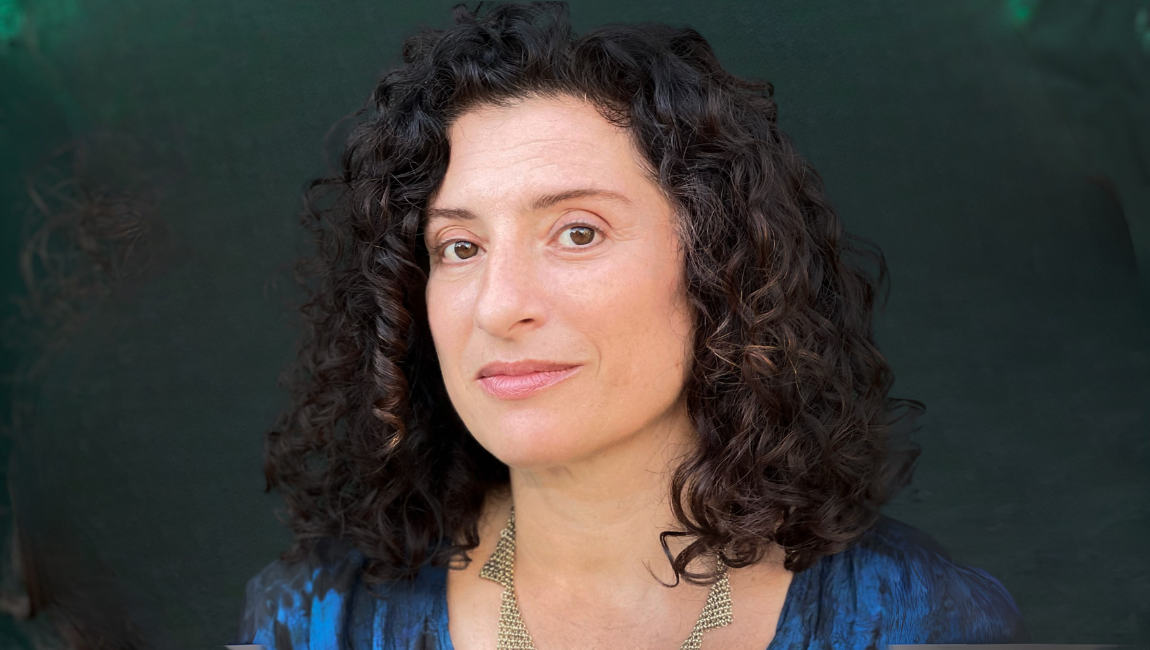
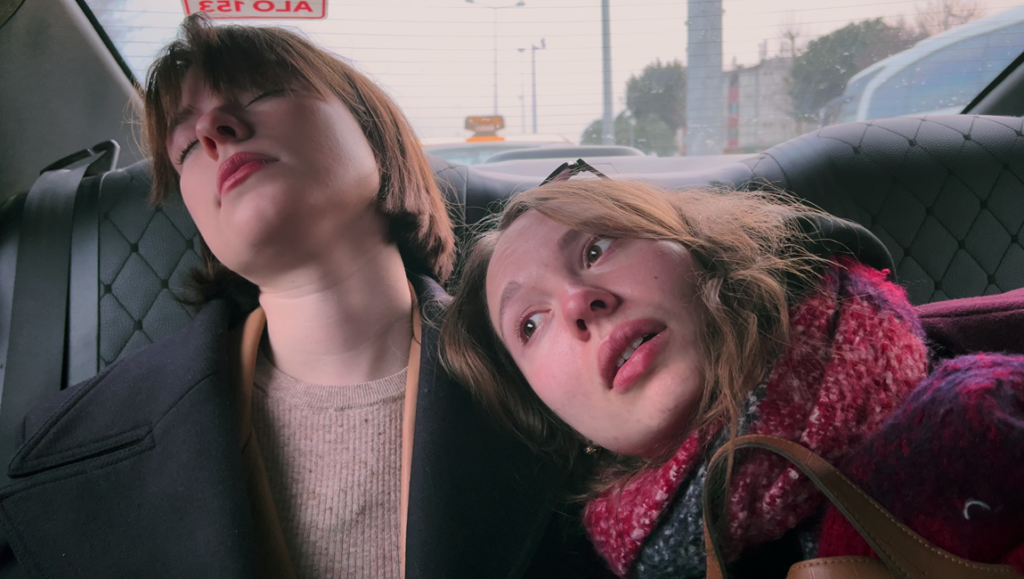
My Undesirable Friends: Part 2 – Exile picks up right where Par 1 – Last Air in Moscow left off: Russia is a little over a week into its full-scale invasion of Ukraine, and there is a massive crackdown on independent media covering the war and subverting the Kremlin’s narratives, forcing the journalist protagonists of Julia Loktev’s doc to immediately flee the country. While Last Air in Moscow reaches an inevitable point of implosion, Exile disperses outward, following the protagonists in their hasty exits, like with Lera (Valeria Ratnikova) and Ksyusha (Ksenia Mironova), who are forced fly overnight from Moscow to Istanbul just suitcases in hand and cash in their pockets, while Ira (Irina Dolinina) and Alesya (Alesya Marokhovskaya) have to escape from the front and follow their Important Stories editor to Prague. One of the most high-profile journalists Loktev follows, Lena (Elena Kostyuchenko), tries to stay and report on the horrors found at the front for as long as she can, until it becomes clear that her life is very seriously in danger. But even when they are physically out of Russia, the protagonists never escape precarity and, admirably, never waver in their commitment to their work.
Meanwhile, Exile’s global scale presents a trickier dramatic balance for Loktev compared to the clear impending collapse of the first film. There is a temporal difference, too, in a 2024 recounting of events from the end of 2021 and into early 2022 than one which can lead all the way into the present. The question becomes when to stop filming, and how much to limit the scope, because even in a nearly six-hour film, there isn’t time for everything. Loktev, instead of trying to cram the runtime with information, instead let’s character drive the narrative, and only switches to archival material when further context to the action is needed, like the absurd way in which TV RAIN loses its broadcasting license in Latvia. By centering the film on people, by letting them live and breath in duration, Loktev crafts a prescient documentary that is not just intellectually effective, but emotionally affective, and serves as a filmic attempt at combatting the cruelty, inhumanity, and oppression that My Undesirable Friends’ protagonists bravely shed light on through their work.
After screening My Undesirable Friends: Part 2: Exile at NYFF64, I caught up with Loktev over Zoom to discuss her sprawling yet focused epic.
Alex Lei: Exile starts two days after Last Air in Moscow. How did the logistics of the shoot change once you had to leave Russia?
Julia Loktev: It changed a lot. In Last Air in Moscow, everyone was a subway or an Uber ride away from each other, and suddenly people were constantly moving countries, not knowing what country they were going to next. [Exile] takes place over 12 countries with different characters in different places. It completely transformed into this open-ended shoot. It’s a very different sense of time, it’s a different sense of space.
I was shooting the first week of the full-scale war in Moscow and then, as the characters fled, I followed them. I often wouldn’t know what country I would be going to in two days.
AL: With the second film’s more global scale, did you ever need to recruit local camerapeople? Were there times where you weren’t able to be there? Or did shoots only happen when you were physically present?
JL: The main thing that I had to have [was] somebody [able to] shoot basically on two-days notice — and we knew it was going to happen on short notice, so I couldn’t reach Moscow anyways — Ksyusha went to Moscow to see her fiancee be sentenced to 22 years in prison. Russians have a tendency to use — sorry, I’m forgetting the word — when the verdict is announced, is there a word in English?
AL: Sentencing?
JL: Well, the sentencing is when the judge announces the sentence. Russians use these words interchangeably because there is some 99.6 — I’m going to make a mistake on the point part, but you know — conviction rate. So really, the verdict was being announced but they referred to this as the sentencing because the thing you don’t know is how long is he going to be sentenced for. In the end, he was sentenced to 22 years.
She’s the only character to step foot in Moscow since the first week of the full-scale invasion. I actually used a former TV RAIN person who had shot for Sonya and other characters to shoot Ksyusha in Moscow because there was no way of getting there in time. Also, I was not at all certain I would be let back into the country because they did question me at length on the way out.
AL: That sequence is one of the only times where the camera gives a character privacy. As [Kyusha] is walking away, someone says “Leave her and the family be” and the camera does stay behind as she walks away.
JL: Yeah, I probably wouldn’t have [shot it like that]. Sorry, that sounds terrible. I’m glad that he got a lot of what I would want, and also he got a little bit of her close-up. But I would probably have shot much more extensively and stuck closer to her. I’m really grateful that he was able to be there, but I can notice that difference.
It’s really crazy that she went in, because it was definitely a risk. She went in and out for two or three days. The reason she went was that for the entire proceeding — almost two years — the only place she could see him was inside a courtroom where he’s in this glass cage. That was a last chance, and she went in. That’s it. After that, nobody’s gone to Russia.
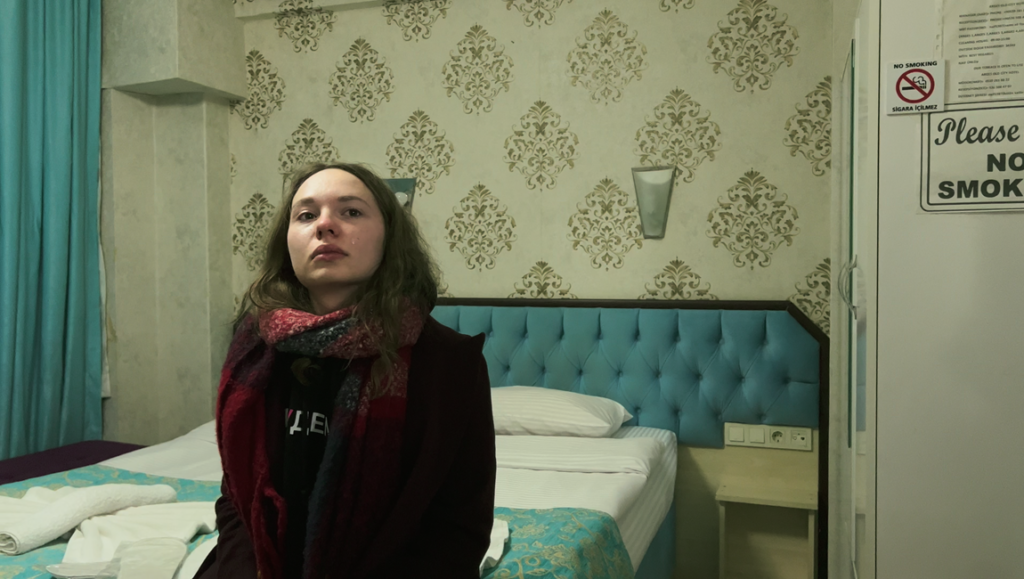
AL: On the question of distance from the protagonists in a different way, at the end of Last Air you start interfacing with the protagonists a lot more. There’s the part where Sonya even asks you for a charging bank for her phone. When everyone was scrambling in Exile, did you ever feel like you needed to help them out at all?
JL: I try to help in ways I can, but of course… look, if you’re filming somebody, you’re a human being, this is a very basic thing. You’re filming a shot: they’re trying to buy a plane ticket out of the country and they turn to you and are like, “Can I have a charging bank?” You stop filming and you give them a charging bank. Come on! That’s just not being an asshole. These are friends of mine now. I wouldn’t be like, “No, I’m sorry. I’m busy filming now, I’m not going to give you my charging bank.”
AL: I guess it’s a question about your form being more intimate than journalistic.
JL: It is, yeah. Honestly, I have no journalistic background. I’m not a journalist, and I would never think of myself as a journalist. My education is not in journalism, my education is in cinema history, in filmmaking. That’s where I come from, and I hope it shows in the film. The truth is, in terms of helping, I can’t help with the Big Things. I can’t stop the war. I can’t help them go back to the country where they will be arrested. There’s nothing big that I can solve for anyone, unfortunately. It’s the real stuff [where] I’m of no use, sadly.
AL: Well, you made the film.
JL: Yeah.
AL: These films seem, to me, to be designed to speak to a Western audience, particularly an American one. In the two years since the first film has come out, you have probably noticed how they have been received, and I am wondering if that has changed any of your approach in post-production on the second film?
JL: I don’t think they’re designed to speak to a Western audience in that way. I have this kind of insider/outsider perspective: I was born in Russia, I left when I was nine, grew up in the States. I wanted it to speak to people who don’t really know very much about Russia and maybe didn’t care about Russian.
From the start, I wanted to speak to people from different places. For example, I got contacted the other day from someone who was translating the film into Farsi. So, there’s an Iranian audience. There’s also an underground club in China that is showing the film. I think it’s much more international. I think it’s very reductive to think of it as a Western audience. Absolutely not. It certainly wasn’t designed to speak to an American audience specifically, it’s just that life happened. The world happened.
When I was making Last Air in Moscow, for example, we were deep in the Biden era. We had no idea how much it would speak to an American audience! It wasn’t designed to be prescient — we were thinking it was a film about Russia, we wanted it to be legible to people from the outside. Of course, I was having people who had experiences living in an authoritarian country who were like, “Oh my god, this is about us!” But we had no idea how relatable it would become to Americans.
It is not by design, it is more by the force of history. I wasn’t specifically designing it in that way, I just wanted it to be penetrable to people who weren’t from inside this world, and I think that’s important. At the same time, I have to say that it’s been really important to me, because this story reflects not only these characters, it reflects so many people who left after the start of the full-scale war — one million people left Russia. I’ve had so many people come up and say, “Thanks for telling my story.” So the fact that it resonates with people about whom this story is about is also important. I just wish it wasn’t so relatable to everyone. I liked it better when it was just a film about this country over there and has nothing to do with us. But sadly, it has become very relatable.
AL: Subsequently, since the first film has come out, it has become more relatable in that way. There’s more right-wing governments globally, there’s the ongoing genocide in Gaza, the petrodollar is collapsing. How do you manage the scope when the film becomes more dispersed?
JL: I tried to focus it on these particular characters and what they’re going through. But, of course, they are constantly touching the world, these things are around them. One of the main characters [Ksyusha] moves to the U.S. She decided she wanted to go film on Inauguration Day in D.C. which, honestly, was the last place I wanted to be. But you just kind of have to go with it. By the time we’re filming at TV RAIN in very late spring, the Iran War is happening and this is the context of what we’re dealing with. I didn’t broaden the scope, but we’re all permeable and the world is seeping in.
There’s what’s in the film itself, and then there’s the other kind of resonances around the film. I’m been a lot about NAZA, which I think is a tremendous film, and the kind of reactions that the directors are facing now for speaking about their country’s war crimes and genocide, and are facing the possibility that they may not be able to go back. I think they are incredibly brave. Of course, it hits me because I’ve been following characters who can’t go back to Russia because they’ve been speaking about their country’s war crimes. Again, I wish this was an isolated incident somewhere. Seeing it repeated just makes it worse.
AL: When you’re filming with Anya [Anna Nemzer, who was Loktev’s first point-of-contact with this class of Russian journalists and serves as both films’ co-director] in Israel, that’s the only place she can get a passport that’s not Russian, and she feels very ambivalent about taking refuge and hospitality there while also being critical of their government. I believe that scene was filmed in 2022, and I’m sure that feeling has only become much worse.
JL: This was before October 7, before the genocide in Gaza, but, obviously, after years and years of [Israel’s] occupation [of Palestine]. The film briefly is in Israel, and she is trying to get out of there as soon as possible. There is this question for a lot of people who left Russia: if all you have is a Russian passport, you take any passport you can get. But living there is a different story.
AL: There is a very interesting editorial decision you make in the “Our Army” chapter of the film. There’s all the fallout from Alexey Korostelev’s remarks on TV RAIN — which ultimately leads to them losing their license in Latvia — but you don’t actually show the remakes and instead show the discussion around them.
JL: Well, technically, they lost their license not because of his remarks — that sort of triggered it — but they lost their license due to a number of other violations, and the one I chose to focus on was “our army,” which was not what he said but what Anya said and a number of other people. There is no way of clarifying the original comment, which was a gaff, as I understand. If you saw the clip, it would not make anything clearer, it would just make you more confused. There’s no way to make sense of that.
The thing was [TV Rain’s] anchors, including one of our protagonists, Anya, repeatedly said the words “our army” on the air. I actually find that fascinating. For them, it was a way of taking ownership and responsibility. It was very much a conscious decision. It was not a gaff to say “our army.” It was not a slip of the tongue. It was something they were saying to emphasize this to a Russian-speaking audience — primarily in Russia — that this is “your army” and “my army,” the idea saying that like we have to be accountable for the horrors that our army is committing in our name. I think that is a very important way of thinking.
As Americans, its something we’re not used to. We’re used to detaching ourselves, like, “I didn’t vote for him! Not my president!” My tax dollars are now funding ICE raids and deportations. My tax dollars are also funding bombs in Gaza. It’s my tax dollars — I don’t often say this, we tend to say “American tax dollars.” There’s this kind of psychological distantiation where we don’t often look at this as a moral responsibility. But I think [my protagonists] are people who are very opposed to the war who also understand that they will be accountable for it and they don’t want to wash it off their hands.
AL: Is that part of that a cultural difference between Americans and Russians? I know Lena, for instance, frames her journalism through a patriotic love for her country, just not her government or its state.
JL: I mean, I don’t know, it’s a good question. I think it probably is, and then it’s also, on a personal level, the characters feel different degrees of that. Like [Lena] published a book called I Love Russia that was one of the best books of the year on The New Yorker and TIME, and I Love Russia is about her country’s turn to fascism. She speaks very clearly about Russia becoming fascist and how to reconcile that certain love she has for her home to which she cannot return. She dreams of returning one day, but none of the characters can go home. It sounds like, “Okay, yeah, you can’t go home.” But if your parents get ill, if your parents die, you assume that you would be able to go and be by their bedside. And you can’t. Because all of the people know that the minute they step foot in Russia, they would be arrested.
For many of them, they have been convicted in absentia, which means that they can’t step foot in about 50% of the world; in India and Vietnam, they could be arrested. At the same time, they all keep working. They all keep reporting on the war in Ukraine. They keep doing their jobs in exile for the benefit of this country that they may not return to for decades. And I find that really fascinating and inspiring.
I don’t want to make it sound like… we’re talking about the film like it’s just good for you, like it’s a spinach film. Because all the while they’re actually witty as hell — they’re funny and have a lot of inappropriate humor. It’s a film that takes place in people’s lives where their lives are falling apart, they’re trying to keep them together, but it’s about real people going through this.
AL: They’re talking about swiping on Tinder right when they get to Riga. In the first one they talk about Harry Potter all the time.
JL: Exactly. It’s war crimes and then you go home and talk about Tinder. They are very young people who are trying to do their jobs, trying to live their lives, figure it out. People fall in love, people get divorced. Kids grow up, parents die. Normal shit happens all around.
AL: Most of them are surprisingly young. In the first film, many are in their mid-20s or even early-20s.
JL: A lot of them were 23 when I started filming them. Some are older, but there are a lot of very young people in the film.
AL: Do you feel like you saw them grow up in the process of making this?
JL: Some of them talk about this, definitely. Ksyusha, who was 23 when I started filming, she talks a lot about how much of her life I’ve captured and how she’s no longer the young girl she was now that she’s five years older. She’s 28 now, which she considers to be terribly old. There was a Q&A [last year] where she said, “I was so young when Julia started filming me, and now I’m almost 30.” You’re 27! What the hell!
AL: One last question: I’ve been reading this book called Everything Was Forever, Until It Was No More [The Last Soviet Generation by Alexei Yurchak], are you familiar with it?
JL: Mhm.
AL: I think — not Russia specifically, but the Russian Empire and Soviet sphere of influence — there is that mentality of [the status quo] feeling completely permanent, but at the same time totally primed for collapse. And it seems to me that there is almost a recurrence that happens. People felt that way toward the end of the Russian Empire, where even Lenin at one point said that there would never be a revolution in Russia. Then, when the Soviet Union collapsed, everyone was simultaneously shocked and not surprised. It seems to me a similar thing happened here, with the war in Ukraine and everything getting shut down in Russia.
JL: I don’t think anyone thought that the state that they were existing in before the full-scale invasion was forever. They had a sense of tremendous precarity. If you look at Last Air in Moscow, it was a sense of like, “Oh my god, can we hang on another day?” “Is this going to collapse tomorrow?” “Did it collapse yesterday?” “Was I supposed to leave yesterday?” or “Can I still stay another day?” That’s a very different situation.
But I really do hope it applies to the current situation. That’s where I want to think about that phrase. Right now what’s happening in Russia does feel eternal, interminable. And I can’t wait until it’s no more. It’s hard to imagine Russia being any other way, it’s hard to think your way into the future. All of the characters can’t go home, they can’t go back to Russia. We do talk about it, you know, should the power structures ever change… I don’t know how to describe it, because it’s not just Putin dying; much more has to change if we want to make a Part 3. I’m excited about that film, but I’m also just excited about that happening. I hope that happens sooner rather than later. But for the moment, we’re still in the “everything is forever.”
Comments are closed.