
NAZA is a film so powerful and so utterly terrifying that it should be watched by everyone. And still, it would feel wrong to slot this documentary into the you-have-to-see-it-to-believe-it category. One at least hopes that Yuval Abraham and Rachel Szor’s follow-up to the Academy Award-winning No Other Land (2024) will be neither the first nor the last film to challenge its viewers to come to terms with the horrifying scale of Israel’s genocidal campaign. If common sense has not already brought most people to that conclusion, then the meticulous work of a UN commission, reputable human rights groups, and Palestinian, Israeli, and international scholars should have established it as a truth all of us know by now.
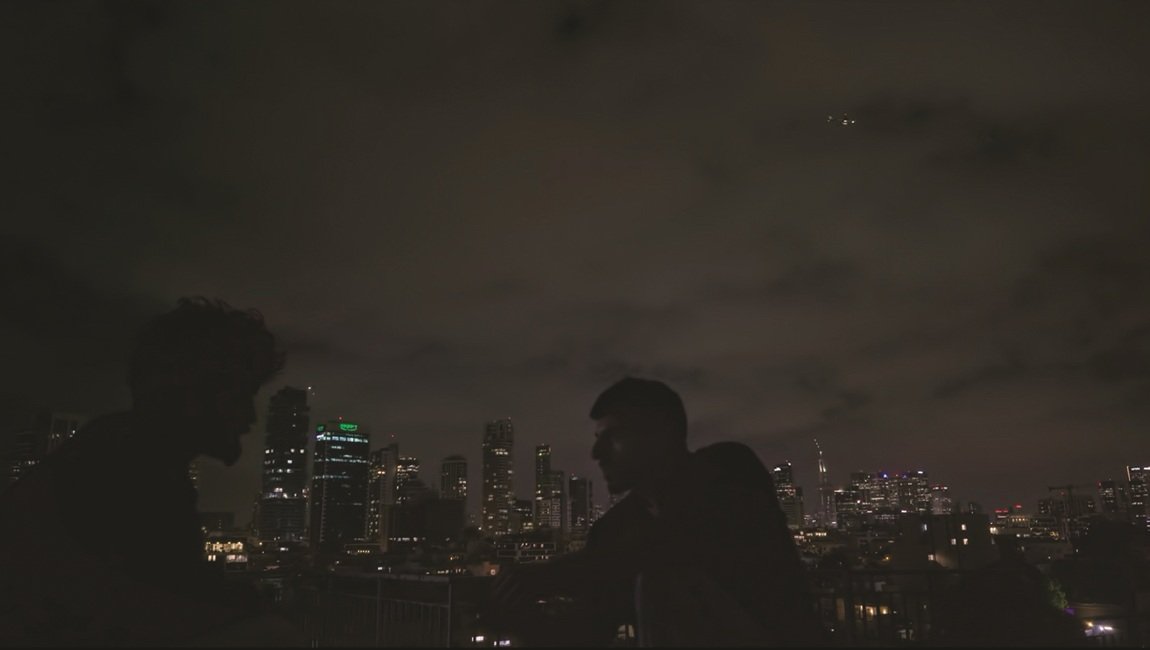
So what makes NAZA stand out is the way it wields its formal rigor, intellectual lucidity, and unwavering humanity to conscientiously peel away layer upon layer of the systematic destruction of Palestinian people on Gazan soil. The Israeli directors have done this over the course of three years, conducting interviews with 24 IDF soldiers from the semi-public vantage point of a Tel Aviv rooftop. A mere 60 kilometers north of Gaza’s ruins, these operatives — all shrouded in anonymity under the nocturnal sky — illustrate, step by step, the procedural systems put in place to advance the Israeli war machine.
It might come across as lazy to throw around hyperbole in the face of a film so humanely conceived and so carefully measured, but it would be a waste not to say it bluntly: NAZA is one of the most important documentaries in the history of the moving image. Indeed, it’s a work that, as becomes clear later in the film, even dares to challenge how Claude Lanzmann’s monumental Shoah is (mis)remembered as the gold standard for non-fiction cinema bearing witness to humanity’s most destructive tendencies. Like Lanzmann’s reckoning with key figures and minor players in the Nazi Holocaust, Abraham and Szor collect the testimonies of Israeli soldiers who actively partook in, or still contribute to, the onslaught on Gaza. Their granular accounts sketch out a cynical and hyper-aware lust for blood, one that completely refutes the misguided notion that the mass killing of Palestinians in Gaza is a tragic byproduct of the war against Hamas. The documentary derives its title from a military acronym in Hebrew, euphemistically translated as “collateral damage.” And every interviewee corroborates that the permitted NAZA — the civilian lives factored in when the IDF bombs the suspected location of a Hamas operative — keeps climbing. One intelligence officer even confesses that he has signed off on strikes with a NAZA of over 200.
That the soldiers plainly confirm the genocidal intent of their military activities on camera is already staggering. What makes the film all the more impressive is the calmness with which journalist and filmmaker Yuval Abraham listens to their stories. Assisted in the editing suite by Guardian correspondent Harry Davies, Abraham and Szor perfectly mete out the critical information these soldiers reveal across years of recording, either in dialogue or by sketching the outlines of their hyper-digital intelligence apparatus with pen on paper. The film first establishes the principle of NAZA, then traces how the military AI system “Lavender” processes data harvested from Gaza to identify which target to strike next. Although some soldiers wrestle with their individual contribution to the genocide, the overall sentiment is one of thoughtless surrender to an all-encompassing system entirely indifferent to the war’s moral toll, let alone its civilian cost. If the computer, or your superior, tells you to bomb a family of 12, there is no question that you will do so.
Abraham patiently listens as soldiers recall how they spy through the phones of Palestinian children. They hear a child call out to their father as he arrives home, which confirms for the Lavender system the location of a Hamas operative and prompts a remote security officer to sign off on a missile strike against the family residence. The director stays silent long enough for one soldier to reveal the glee with which he and many of his colleagues commit such atrocities. “It is fun,” the soldier repeats. It is fun to complete the mission and then hit Tel Aviv’s nightlife with colleagues and friends.
Another IDF soldier stresses that these security operatives belong to the upper strata of Israeli society. They are the “tip of the spear”: highly educated, upper-middle-class, left-wing Israeli citizens working in the most desirable units of the IDF. Given that they relentlessly spy on every phone in Gaza, it is only fair that Abraham and Szor peer back through the windows of affluent Tel Aviv apartments. NAZA plays like a voyeuristic thriller, peering from the rooftop at a society that prides itself on its rich culture while insistently painting itself as the sole victim of the war after the massacres of October 7. It instills a sickly feeling, especially when Holocaust Remembrance Day arrives with a Lanzmann retrospective, suggesting that most members of Tel Aviv’s petite bourgeoisie are wholly unable, or unwilling, to apply the Holocaust’s parameters to the contemporary genocide carried out on their behalf.
One can’t help but think of Jonathan Glazer’s The Zone of Interest (2023) while witnessing the comfortable lives of Tel Avivians, as Israeli missiles keep landing 60 kilometers to the south. And it is surely no coincidence that the English filmmaker is credited as an executive producer on NAZA, since he has explicitly linked his unsettling portrait of the Höss family living just outside the gates of Auschwitz to the dehumanization driving the present war. An equally notable name among the dozens of anonymous contributors listed in the end credits is that of Laura Poitras, one of the film’s consultants. NAZA extends Poitras’s own line of politically charged cinema at the intersection of documentary and dread-instilling thriller. A subtle yet powerful stylistic trait comes from musician Mica Levi, who wrote the nightmarish score for Glazer’s Holocaust exegesis and now lends a hypnotically disturbing sheet of drone music to the quiet menace of NAZA.
NAZA expands its visual register further by incorporating archival material that reveals the narrative constructs the city of Tel Aviv rests on. Supposedly “dug out of the sand” at the onset of the 20th century, the city is revealed here as the opposite: a metropolis that could only be erected on the ruins of evicted Palestinian villages. It is this repeated historical erasure that NAZA sets out to combat in the arena of moving images, making plain the price paid in blood for this metropolis to continue to thrive to this very day. One soldier, for instance, laments how the evacuated northern stretch of Gaza has turned into an “annihilation zone” that had to be razed to the ground. First, the IDF kills most of its inhabitants; then it comes to obliterate every building, in the process destroying every family album, photograph, diary, or other sign of life that would remind future historians that this land was in fact populated by real human beings.
No single one of NAZA’s unsettling testimonies offers genuinely new information about the logistics of genocide and displacement. But the patient recording of Israeli accounts of the war amounts to a heroic exposé of a dizzying crime against humanity that shows no sign of ending anytime soon. It makes one weep for the abysmal state of the world, mourn the countless lives lost at the hands of a country operating with near-total impunity, and, somewhat miraculously, still feel humbled by the power of documentary cinema to take it upon itself to give a dignified response to such unspeakable evil.
DIRECTOR: Yuval Abraham & Rachel Szor; DISTRIBUTOR: The Guardian; IN THEATERS: September 30; RUNTIME: 1 hr. 20 min.
Comments are closed.