
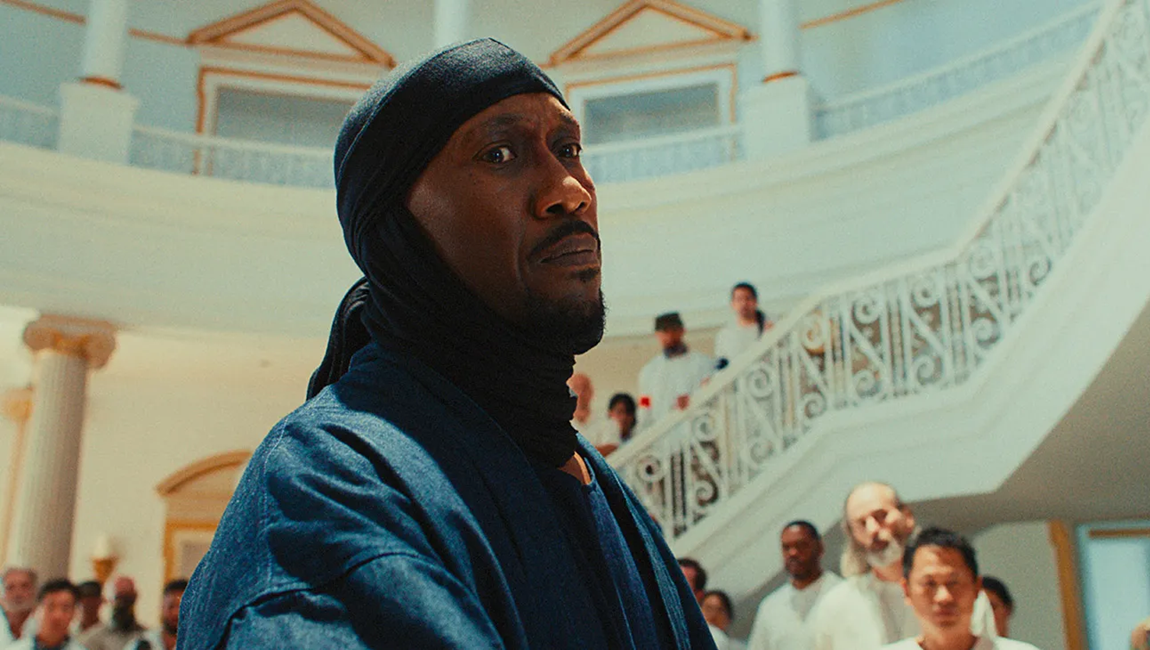
Escaping from the claws of corporate homogeneity and shared cinematic universes is Bassam Tariq’s Your Mother Your Mother Your Mother, almost certainly the strangest film to ever begin its life as a Marvel movie. Starring Mahershala Ali as a devout Muslim contract killer in Texas whose weapon of choice is an Arabian blade, the film cannonballs into the deep end of the culture wars. Your Mother Your Mother Your Mother asks audiences to empathize with a scary-looking Black man with a sword who prays to Mecca five times a day (the character is even derisively referred to as “Black ISIS”). What’s so intriguing about the film is not that it asks us to see the humanity in the character — that’s table stakes for any protagonist — but that it does so through an accumulation of quotidian indignities that demonstrates the character at his wits’ end. Sleep-deprived, weak from fasting, and heartbroken by the recent passing of his wife, Ali’s Latif is first and foremost a beleaguered father of three who’s desperate to get his colicky newborn to eat while trying to shield his older children from the corrosive influences of the modern world. In a film featuring lactating strippers, Christian nationalist militias, the specter of sex trafficking, and even furry porn, what’s so surprising about Your Mother Your Mother Your Mother is both how earnest it is and how sincerely it interrogates what it means to actually walk a righteous path.
We first encounter Latif in medias res: brutally murdering an unknown man in a public restroom. Pop culture has conditioned us to view the sort of person who does this line of work as unflappable, yet Tariq’s film upends expectations right from the outset as Latif takes a phone call from his panicked teenage daughter, Fatiha (the mononymous actress, Adia), who relays that Latif’s unnamed wife — and her mother — has died out of the blue. A flustered Latif is briefly paralyzed, inconveniently so, as the dead man still lies at his feet and Latif’s hands are covered with incriminating evidence (in a nice touch that underscores his domestic obligations, he wipes blood from his sword with a baby’s diaper he has in his satchel). Abandoning the body and returning home in a haze to oversee traditional funeral preparations, Latif throws himself into the upbringing of his children, particularly trying to secure a steady supply of breast milk for his infant daughter who’s allergic to formula. Already registering as a stern taskmaster, Latif becomes increasingly sullen and demanding toward Fatiha and his young son Qadir (Jahleel Kamara), trying to preserve the household his wife built for them but finding himself short on patience with his children and with himself.
For much of its first half, Your Mother Your Mother Your Mother plays as much like a gritty social realism drama as it does an exploitation film. With the supply of banked milk in the freezer steadily dwindling, Latif is forced to set aside his pride and go hat in hand, throwing himself at the mercy of his local mosque and the WIC milk depot (who demand a doctor’s note to ensure that Latif isn’t merely a pervert). Despite his best efforts to leave his sword-for-hire profession behind, Latif is ensnared in the gravitational pull of his longtime handler Mike Mahmoudi (Laith Nakli), whose nitwit nephew Hatty (Abubakr Ali) has run afoul of gun-nut preacher and internet personality, Hwan Yoon (John Cho, behind a ridiculous-looking grill and wearing custom outfits emblazoned with tiny crucifixes). A born-again who survived an IED in Iraq, Hwan Yoon and his flock of zealots would see the world rid of pornography (with extreme prejudice), which puts Hatty, who produces “halal-certified” Bang Bus-style videos, in their crosshairs. If Latif kills Hwan Yoon — who’s been taking over local strip clubs and adult bookstores and converting them into ad hoc churches — for Mike before he kills Hatty, Mike will look the other way on Latif’s botched hit. And, as an added bonus, one of Hatty’s lactating sex workers can nurse Latif’s hungry baby. Needless to say, John Wick never got up to anything this freaky.
Conceived in the aftermath of Tariq being dismissed from Marvel’s Blade, which was also meant to star Ali before the film was delayed into oblivion, the similarities between the two films presumably begin and end with a “badass with a sword.” Although Ali does get a handful of opportunities to show off his extensive combat and weapons training, the least impressive parts of the film are typically those where Latif is given the opportunity to break his foot off in several someones (the film’s climactic action sequence suffers from the same disorienting spatial geography as The Death of the Suitors scene in The Odyssey). The film is more successful in calling upon the two-time Oscar winner’s quiet intensity and innate moral authority as a man whose faith allows him to compartmentalize the violence which allows him to provide for his family — like many a movie killer before him, Latif operates by a code which dictates that he conveniently only punish the “wicked.” Ali plays Latif as unyielding and antagonistic toward his own family, most notably Fatiha — whose adolescent sexual curiosity rubs up against his conservative worldview — and Latif’s secular younger brother Talib (Tramell Tillman), who carries himself with the resignation of a person who’s been lectured to his entire life. It’s a performance that’s difficult to wholly embrace, only softened by Ali’s palpable terror at becoming a single parent overnight and the way his death grip on his religion betrays creeping uncertainty.
Tariq (Mogul Mowgli) recognizes how incendiary the film’s premise is and how weighted down his imagery is with societal anxieties about Muslim men, what’s discussed inside mosques, and religious fundamentalists employing violence to “cleanse” the world based on their interpretation of morality. (As an aside, at the film’s recent premiere at Beyond Fest in Los Angeles, Tariq partook in the festival’s tradition of firing a T-shirt cannon at the crowd, but not before mischievously yelling “Allahu Akbar!”) But the film doesn’t shy away from confronting how dogma poisons faith, how absolutism and certainty can harden your heart, and finally how devotion can be weaponized against outsiders. Perhaps the most provocative idea in the film is how much Hwan Yoon’s holy crusade to eradicate sin — with his expressed desire to prevent sex trafficking serving as both a fig leaf for bigotry as well as a poke at the Pizzagate crowd — recalls U.S. escapades in the Middle East, with a buffoonish, Evangelical Texan justifying his efforts to take dominion over Muslim spaces under the auspices of spreading Western values. The film places Latif and Hwan Yoon on a collision course that has the former putting his life on the line to defend an amoral smut merchant while the latter thinks nothing of harming innocents — in a chilling reminder of recent global events, he threatens to “IDF” Latif’s family — in service of a self-appointed mission from God. The resolution that Tariq arrives at is a little too “have your cake and eat it too,” but there’s real resonance in the idea of two men of faith witnessing something they can scarcely comprehend and briefly forgetting why they’re trying to kill one another. Your Mother Your Mother Your Mother is a film about belief that ultimately offers no concrete answer while allowing the characters to be humbled by signs and wonders that exist outside their worldview. There’s power and grace in the shared uncertainty.
DIRECTOR: Bassam Tariq; CAST: Mahershala Ali, John Cho, Giancarlo Esposito, Abubakr Ali, Laith Nakli; DISTRIBUTOR: Amazon MGM Studios; IN THEATERS: September 25; RUNTIME: 1 hr. 51 min.
Comments are closed.