
Summer is closing. The weather remains warm, but the chill of autumn whispers its hello with a breeze that reminds us of time’s passing. It would be the perfect opportunity to catch a new John Carpenter movie, wouldn’t it? Too bad he’s been keeping himself busy writing graphic novels and making music. Even his most promising acolytes have mostly hung up the mantle: Adam Wingard, who during the Carpenter boom in the 2010s made the best of the lot with The Guest in 2014, has been hiding out in the IP bushes ever since. The Guest proved both of its moment and totally prescient as it stared down the barrel of a post-Iraq, perpetually at-war America and charged ahead with mischievous glee into its throwback style — the nation descended into a tailspin of weaponized nostalgia shortly after its release. Maybe Wingard made the smart play by choosing to wait out the madness until it subsided.
It never did, though, so he’s returned to the Carpenter well after 12 years with Onslaught, a movie for anyone who thought The Guest was too subtle. It opens with the Carpenter font and a Carpenterish score, it brings Carpenter’s (typically latent, and better off that way) biting fatalism to the fore with an imposing countdown, and it’s got Carpenter in its characters to the marrow, turning its protagonist into an ersatz Snake Plissken by way of gruff demeanor and a covered left eye. Carpenter here, Carpenter there, Carpenter everywhere. But to what end? Unlike, say, a Jean-Francios Richet, Wingard can’t claim he’s just in it for the yuks; there’s clearly stuff on his mind. In the opening credits alone, he traces a direct line from the present to America’s fascist roots by way of Watchmenesque time travel through major moments in the country’s history. Yet he’s not quite an elephant artist, either. Rather than subvert the formula from a place of revolting self-awareness, he finds meaning from within the visual and narrative tropes by embracing them.
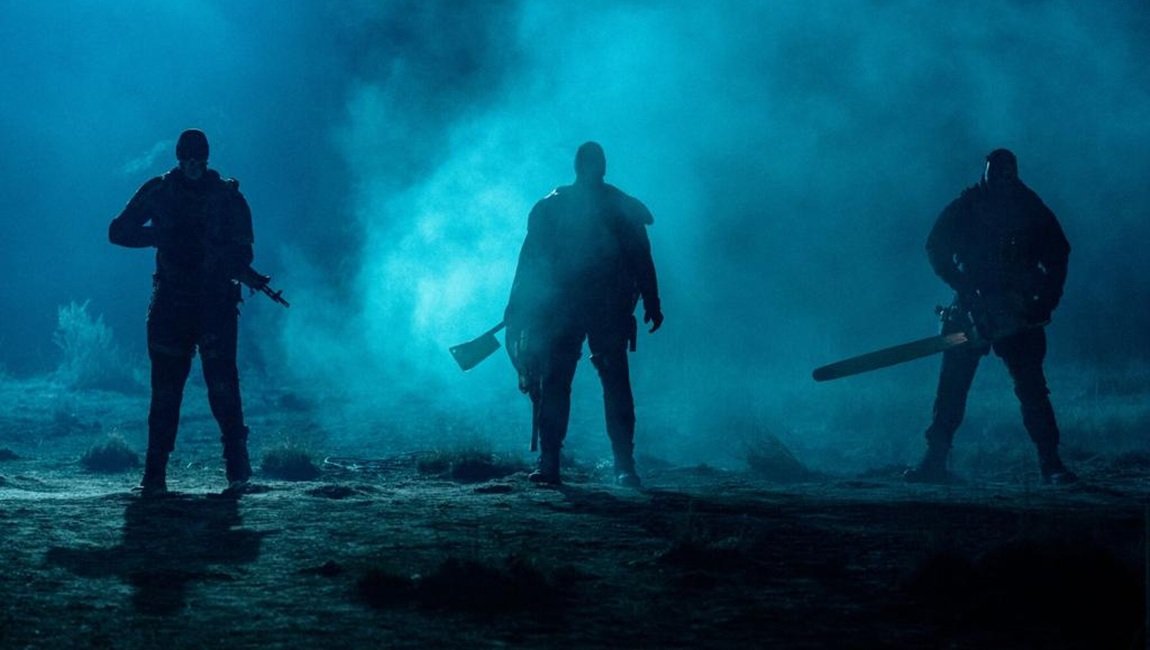
And the tropes in Onslaught are built Ford-tough. Celeste is a combat veteran-cum-trailer park manager and part-time mother whose daughter is foisted upon her for the weekend by her ex. They hop through the day collecting rent from Celeste’s tenants and fixing things around the park (an opportunity for Wingard to build some Hawksian camaraderie among his characters, wasted.) Meanwhile, Nazi scientist Dr. Hans Kammler (Dan Stevens) experiments on dead soldiers in a top-secret military base, where soldiers are reanimated prematurely because the anonymous board funding his passion project grows ever more impatient with Kammler’s ceaseless tinkering. Following a brief demonstration of their brutal death-bringing power, Dr. Kammler loses control of his monstrous creations, and the factory-made supersoldiers are unleashed upon the unsuspecting small town nearby. Onslaught is fluid and well-paced, and it treats its genre foundations with due respect.
It’s also inelegant. Created to kill anything and everything, the Death Bringers are deflating antagonists. Without a clear raison d’etre or any identifying qualities beyond their merciless attitudes toward death, they’re just soulless, anonymous machines endorsed by the American government. And it’s not novel to merely criticize the government anymore — we’ve known about the blowback from unchecked military privatization for decades. Moreover, government corruption is pretty much out in the open now, and Wingard would need to make a truly powerful argument for Onslaught’s conspiracy-oriented thinking to distinguish itself from the sea of likeminded TikTok commentators.
He doesn’t. Wingard has too much pent-up creative energy to integrate ideas with style. He should have made ten of these in the 12 years it took him to make one: Lord knows how long he’s been waiting to deliver that German-language “Paint it Black” needle drop, utilize the orange-and-blue color scheme Nicolas Winding Refn popularized (and ended) with Drive, or cast action movie legends Michael Biehn and Reginald VelJohnson in supporting roles. And while the aforementioned Carpenter influence is all over Onslaught, there’s also Fassbinder and Cavani and Tarantino; Wingard is scratching itches in places hands shouldn’t be able to reach. When one of the Death Bringers turns a corner and smoke billows under the moonlight and his dark eyes shine with the gleam of an unquenchable murderous instinct, it’s no doubt very cool, but it doesn’t really tell us anything about the military industrial complex or America writ large.
The closest Onslaught gets to touching America’s gun-crazy zeitgeist is during a grisly massacre at a gas station, wherein the score dies down and the soul-deadening quality of fluorescent lights is ratcheted up, in a manner that closely resembles Gus Van Sant’s mundane and hypnotic Elephant. Otherwise, the film is stuffed with sophomoric swipes at trauma and remembrance typified by flashbacks to Celeste’s time in combat shot with histrionic black-and-white shadings. It’s frustrating to the degree that one begins to wonder if the likes of A24 holds hostage any filmmaker who wants to work with them until said filmmaker relents and checks corporate-approved boxes of what they think resonates thematically. Do you remember Roddy Piper in They Live because he has a carefully orchestrated backstory that gives him a good reason to go after the aliens subjugating the human race? Hint: no.
In this way, Onslaught disappointingly undermines the productively irreverent relationship to the American Way that Wingard established in The Guest. Sure, the song still sounds good, but playing the hits on repeat eventually wears thin. It’s both pointedly obvious and hopelessly muddled, a jock’s idea of what it might look like to make a smart movie. What he may not realize is that American cinema could use a few filmmakers who aren’t afraid to be jocks. That’s what made The Guest so special: Wingard struck lightning without realizing it. With Onslaught, one can almost see him grasping, helplessly, at what made that earlier film great. “Your everlastin’ summer and you can see it fadin’ fast,” Donald Fagen sang on “Reelin’ in the Years,” “so you grab a piece of somethin’ that you think is gonna last.” There’s a reference Wingard would appreciate, and a word of warning he would be wise to heed.
DIRECTOR: Adam Wingard; CAST: Adria Arjona, Dan Stevens, Eric Wareheim, Reginald VelJohnson, Michael Biehn; DISTRIBUTOR: A24; IN THEATERS: September 4; RUNTIME: 1 hr. 32 min.
Comments are closed.