
Coyote vs. Acme’s journey from Warner Bros. tax write-off to Ketchup Entertainment theatrical release is well-documented. What the three-year-plus saga illuminated, more than anything, is how deep a corporation will dig its heels in, despite public opinion, even common sense, urging the opposite. Immediately post-pandemic, Warner Bros. endured a fallow run at the box office, but by 2025 it was the highest-grossing studio releasing movies. It was also on the verge (and still is) of being sold to Paramount, a monopolistic power move that will only hurt the film industry and line the Ellison family’s pockets. Upon Coyote vs. Acme’s completion in late 2022, its editor, Carsten Kurpanek, tweeted that the film was a “David vs Goliath story” that tackles Wile E. Coyote’s persistence in the face of the Acme Corporation’s “cynical and casual cruelness of capitalism and corporate greed.” Man, meet mirror.
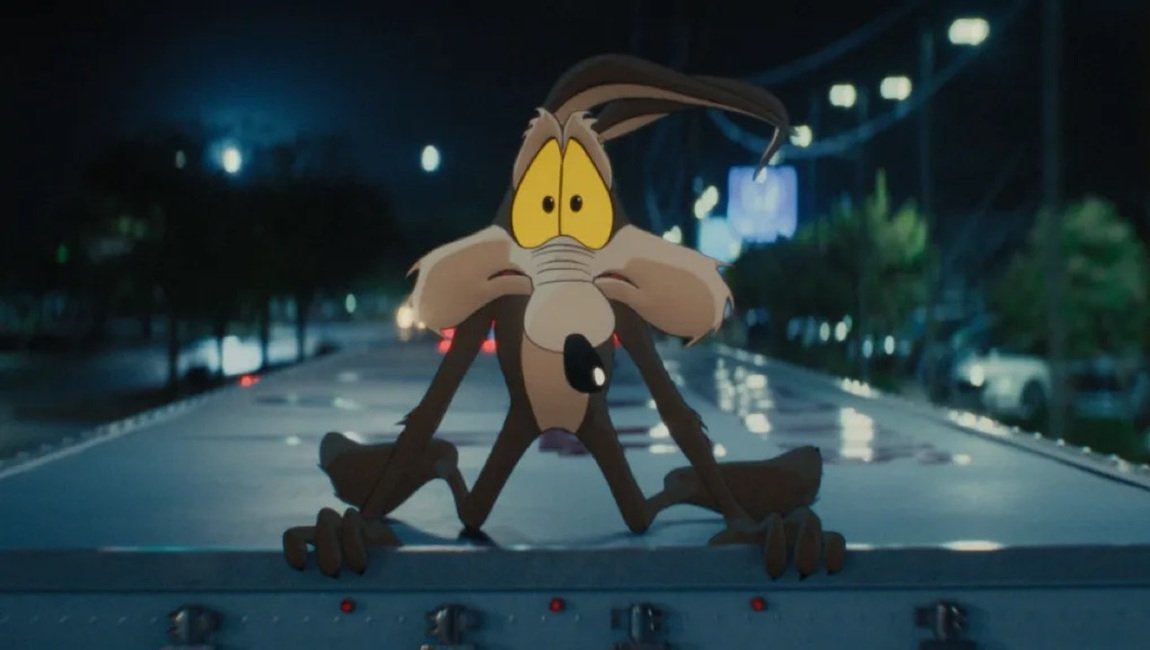
Wile E. Coyote has been trying to capture the Road Runner for decades, not merely putting but launching his elastic, seemingly impervious body through the wringer only to fall to the ground, be flattened, or blown to pieces just short of his unflappable target. He’s also a notorious heel-digger, but with a Sisyphean fate; armed with an insatiable desire for feathered flesh, he knows no greater pleasure than that of the chase. But when we meet him at the beginning of Coyote vs. Acme, he’s nearing the end of his tolerance. His body is as durable as ever, but his spirit is resoundingly chopped, pounded, and fried. His most recent dance with death came at the hands of some faulty rocket skates and a fickle magnetic glove, hurling him up, down, and sideways across his Monument Valley home. Only a podunk personal injury law firm’s television commercial, conveniently catered to his habitual bad luck with Acme products, seems to give him hope at his lowest point. Maybe the failure of the gadgets he uses to hunt down his supersonic prey is not due to user error.
The rinky-dink law firm of Avery, Jones & Maltese is down on its luck and low on morale. Not even Wile E.’s literal mountain of Acme evidence, sprung from his bindle like Mary Poppin’s purse, can revive Kevin Avery’s spirit. Played by Will Forte, a capable if unconventional everyman, he and Wile E. don’t realize how similar to each other they are, both stung by defeat as if it were one of Acme’s own faulty products, bottled and sold to any desperate fool; though where Avery has long-ago accepted defeat, it powers the masochistic Wile E. like fuel. Only Avery’s spunky, idealistic intern and niece, Paige (Lana Condor, her chipper demeanor more at home in a Disney cartoon than the rough-scrabble world of Looney Tunes), can see something sinister swirling conspiratorially underneath Wile E.’s stockpile, which he brings to them in a plea for help. It will take some serious persuasion, and a phone call from a nameless whistleblower who sounds just like Bugs Bunny, to convince Avery that Coyote’s case is anything but isolated and thus worth pursuing with more than the bare minimum effort he’s grown accustomed to giving.
The film operates as half-mystery, half-courtroom drama, the delineations between which become increasingly thin as Acme’s sinister maneuverings come under more intense scrutiny. While this premise doesn’t sound primed for gags, the world of full human/cartoon integration — not unlike the more biting Who Framed Roger Rabbit? — that it inhabits is swollen with hidden potential, of which director Dave Green and screenwriter Samy Burch take respectable advantage. A motel room Wile E. calls home during his trial against Acme becomes a lab, overflowing with zapping wires and anvils; Avery’s law office endures all sorts of violent mishaps at the expense of Wile E.’s powder keg temper and Acme’s wrath (while Paige attempts to decode Bugs Bunny’s cryptic tape, a company hitman throws a massive bomb through the office window which she hoists back outside without much effort).
Most of the wider Looney Tunes gang also gets a guest appearance: Tweety Bird as an Acme good guy turned unwilling stooge; Daffy Duck as an Acme test subject literally turned looney; and Foghorn Leghorn as a species-betraying Acme board member, moving and shaking behind the scenes. It may be fan service, but in a minor key. That your favorite cartoon has a crucial role to play in the twisted world of humans forces each appearance to add meaningful color to a world poised on the precipice of a never-ending joke. And this all leads to the gang’s eventual discovery of a decades-long Acme conspiracy, first uncovered by cartoon Peter Lorre in the film’s 1992-set prologue, to deliberately produce faulty cartoon products as free test cases for their human counterparts, which casts the whole film in a new light. Suddenly, Coyote isn’t merely a victim of bad luck: his Sisyphean quest to kill the Road Runner is part of Acme’s grand capitalist design to hold all forms of life under its fat thumb.
Burch’s screenplay understands these fundamental truths about the all-consuming, class-betraying power of profit, while Green’s direction smooths their edges to a sweetly palatable curve. This is, first and foremost, a children’s movie. Scenes breeze by along logical narrative paths and gags unfold to expected ends, but even so, it’s a relief to know that, in a world oversaturated with power-fetishist superhero films and money-hungry franchises, a film (admittedly also based on preexisting IP) that prioritizes even mild anti-big business storylines has such simple and obvious appeal.
It’s not a real betrayal to say that Coyote doesn’t really win his case. The forces of big business endure; what else do you expect when the Senator overseeing the late-film Senate hearing is Elmer Fudd? What is more important, however, is the film’s intelligent and moving recognition of Wile E. Coyote and the Road Runner’s eternal bond. As a late-breaking witness, the honking bird should be the key to Avery’s victory, and indeed he does acknowledge that he’s witnessed Coyote’s suffering at the hands of Acme products. But he also wants his friend, his kindred spirit in unabated enthusiasm, back. One doesn’t come into Coyote vs. Acme looking for an affirmation of the unbridled joy of doing for doing’s sake, and that to not do would entail a boring and lonely existence. But there it is.
It’s no surprise that a company on the verge of completing one of the most insidious media monopolies in human history would have no qualms burying a film about the insidious actions of a mega corporation on human (and cartoon) life. But it’s also hard to say the degree to which Warner Bros. was actively avoiding releasing an anti-monopoly, anti-big business film just before it dominated the news for being merged into one of the world’s largest media conglomerates. Still, even if the shelving didn’t reflect a conscious, pointed plan, the timing is cosmically bad. And while the Acme Corporation in Acme vs. Coyote is manifested more like an Amazon or Walmart than a distributor of visual media, the parallels couldn’t be more unflattering.
So rarely does a film arrive in theaters with as much hype as Coyote vs. Acme, simply by virtue of existing. It’s no surprise that the relatively tame treatment of its material and its occasionally clumsy integration of animation with live action means it doesn’t entirely live up to that hype. Nevertheless, it’s a pleasant boon to the human spirit that the film that now gets to see the light of day is the predictable and familiar story of the little guy triumphing (at least morally) over an evil corporation.
DIRECTOR: Dave Green; CAST: Will Forte, John Cena, Lana Condor, Eric Bauza, P.J. Byrne; DISTRIBUTOR: Ketchup Entertainment; IN THEATERS: August 28; RUNTIME: 1 hr. 41 min.
Comments are closed.