
The sitcom was never meant to be real; its unreality was its greatest attraction, peering back through the façades of modern suburbanity at an audience eager to heighten their earthly lives with scheduled broadcasts of make-believe normalcy. Unlike films or even television shows proper, which follow an ostensibly irreversible trajectory of events, the sitcom is Nietzsche’s eternal return summed and canned for mass consumption. It resets the day, its characters dwellers beneath the studio lights, fresh and ready to impart 20 minutes of comic relief, or 40 minutes of saccharine wisdom, time and again to the spectral, all-feeling viewer. Spin off the sitcom, and you get various hybridized media forms, either to proselytize general knowledge (the province of infotainment) or to instruct on matters of monetary value (the infomercial’s endpoint). One can imagine a further suspension of reality in the children’s show, which naturally seeks to entertain, educate, and tout a product or 10 for the responsible parents to better oversee their progeny’s holistic upbringing.
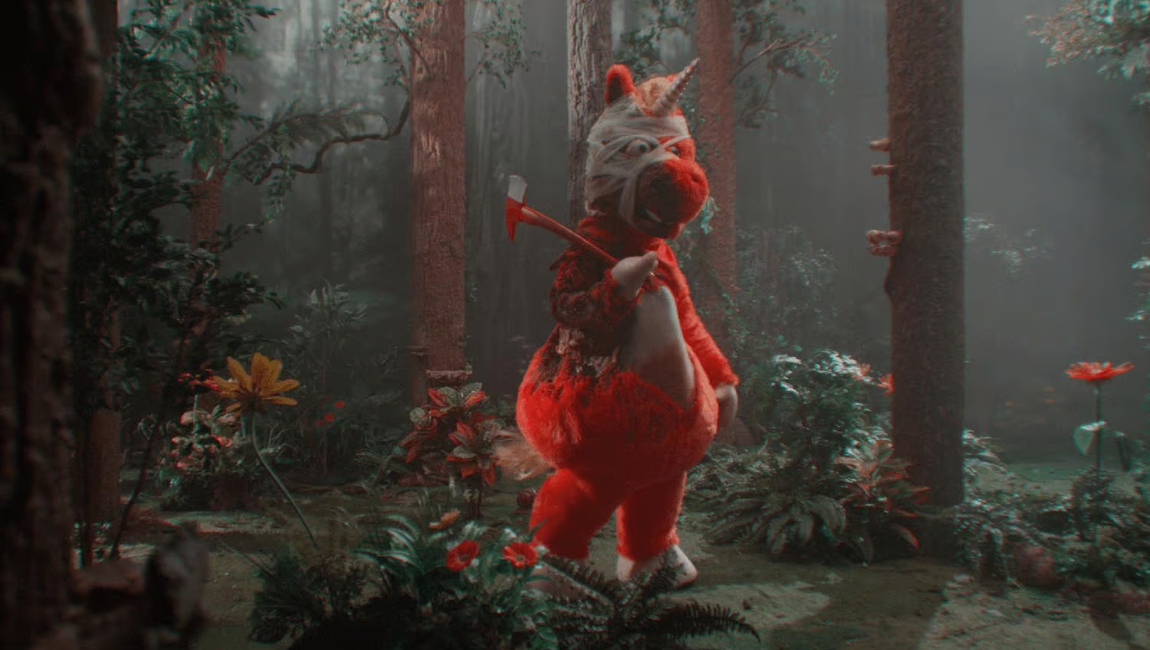
If the likes of Barney & Friends exemplify this cheerful refutation of the vagaries of real life, then equally gleeful is the hand that satirizes them. Much can be mined from the cloying grotesqueries of children’s television, not least the ugly conformity lurking beneath their candy-colored jubilation, and it is this realization that informs and invigorates Casper Kelly’s mean-streaked feature debut, Buddy. Effectively a wholesale parody of the widely lampooned Barney (whose eponymous purple dinosaur proved so casually unctuous that it spawned a reactionary and overtly homicidal brand of humor), Buddy leans into the former’s uncanny theatrics, less for mocking effect than to flesh out, as it were, all the id’s repressed undercurrents. In the perpetually sunny wonderland miniature of its in-film show, It’s Buddy, a group of preteens frolic around the show’s star mascot, an orange unicorn, who presides over them as the “king of fun and games” and pledges to teach them — through the merriment of song and dance — right from wrong.
Except that Buddy, who for most purposes is presumably a flesh-and-blood guy in a fur suit, isn’t the kind to take no for an answer, much less have his moral authority submitted to prepubescent scrutiny. For the unlucky Josh (Luke Speakman), he finds this out the hard way when refusing Buddy’s gentle suggestion to show off some dance moves; the illusion of Buddy’s overwhelming benevolence holds just a tad longer, with some degree of offscreen and therefore plausible deniability on the horned mascot’s part. But his totalitarian tendencies soon swing into full force as the other companions, especially Freddy (Delaney Quinn) and Wade (Caleb Williams), begin to suspect something amiss. As things eventually reach a point of no return, involving gruesome murder and the smoldering of bright flesh, the children flee the confines of their little sanctuary for the world beyond where, it is rumored, a Diamond City lies: a panacea for their wounds, their worries, and possibly their questions about how or why they all got there in the first place.
Known primarily for his work with Adult Swim, including its Infomercials short Too Many Cooks, Kelly chiefly imbues the bizarro simulacrum of Buddy’s ’90s-set television hellscape (complete with clubhouse, nurse’s office, and a host of googly-eyed anthropomorphized creations) with his distinctive brand of violent, bracingly ironic surrealism. In this vein, viewers accustomed to the antics of Adult Swim’s weird, witching-hour programming will be primed to expect the same irreducibility to well-tempered reality in Buddy, whose menacing quality shines through not so much in its villain’s axe-wielding form as in what it represents. The blank-eyed expressiveness of Buddy’s costume suggests authority run afoul, a whole subtext of parental narcissism and abuse married to the sordid consequences of child stardom, with many a tale of assault and relentless control by the industry’s underbelly reflected in his terrorizing of Freddy and her friends. Interestingly, it also echoes the vitriol and aversion to the antiseptic, all-encompassing niceness espoused by Barney and his vacantly upbeat expressions. As the children escape their pleasantly lobotomized routines and proceed to manufacture dissent, the show’s ultimate taboo, the mirroring of Barney and Buddy — one an extinct species, one mythical but absolutely, frighteningly corporeal — steadily entrenches itself.
Buddy, however, overplays its hand with its attempted digression into the real world proper, as a suburban family, completely apart from the cartoonish universe of It’s Buddy, begin to experience tremors of unease. Convinced of the show’s nefarious nature (although largely unable to prove its existence), anguished mother Grace (Cristin Milioti) sets out in a search for the elusive unicorn, only to stumble into the sitcom’s infinitely recurring loop, bewitched by its perpetual logic. The two storylines, one centered around Buddy’s would-be victims and the other around Grace’s primal and unresolved trauma, conjoin somewhat clumsily in a third act belatedly given to the textured worldbuilding that marked Kelly’s best work. “Our intuitions are more perceptive than our conscious minds,” one character tells another, ironically spelling out the film’s crux and excusing its indiscretion in pointedly foregrounding the real world’s existence over the show’s. For the most part, however, Buddy’s lore remains enticingly legendary: rumblings of a chthonic dimension inhere in the testimonies of those previously targeted by Buddy, while the film’s closing minutes leave open several doors. Do any of these doors lead anywhere? As with its doe-eyed protagonists, the film dares you to head in and find out.
DIRECTOR: Casper Kelly; CAST: Cristin Milioti, Delaney Quinn, Topher Grace, Keegan-Michael Key, Michael Shannon; DISTRIBUTOR: Roadside Attractions/Saban Films; IN THEATERS: August 28; RUNTIME: 1 hr. 35 min.
Comments are closed.