
“The old world is dying, and the new world struggles to be born.” So begins Kamel Laaridhi’s debut feature, The H@llow Man, with a quote from Italian Marxist philosopher Antonio Gramsci. This declarative introduction of cultural hegemony is becoming for a film that serves to reconcile a certain political and technological malaise pervading contemporary society — all the more appropriate that it is set 33 years in the future. The year is 2059, ten years after a great catastrophe that wiped out 80 percent of the world’s population. Human beings receive mandatory biochip implantations that suppress memory and emotion. It’s ironic that for a film so inventive as The H@llow Man begins with such an exhausted premise — one that is more or less running on fumes after once-groundbreaking pictures like Alphaville (Godard, 1965), THX 1138 (Lucas, 1971), and many others.
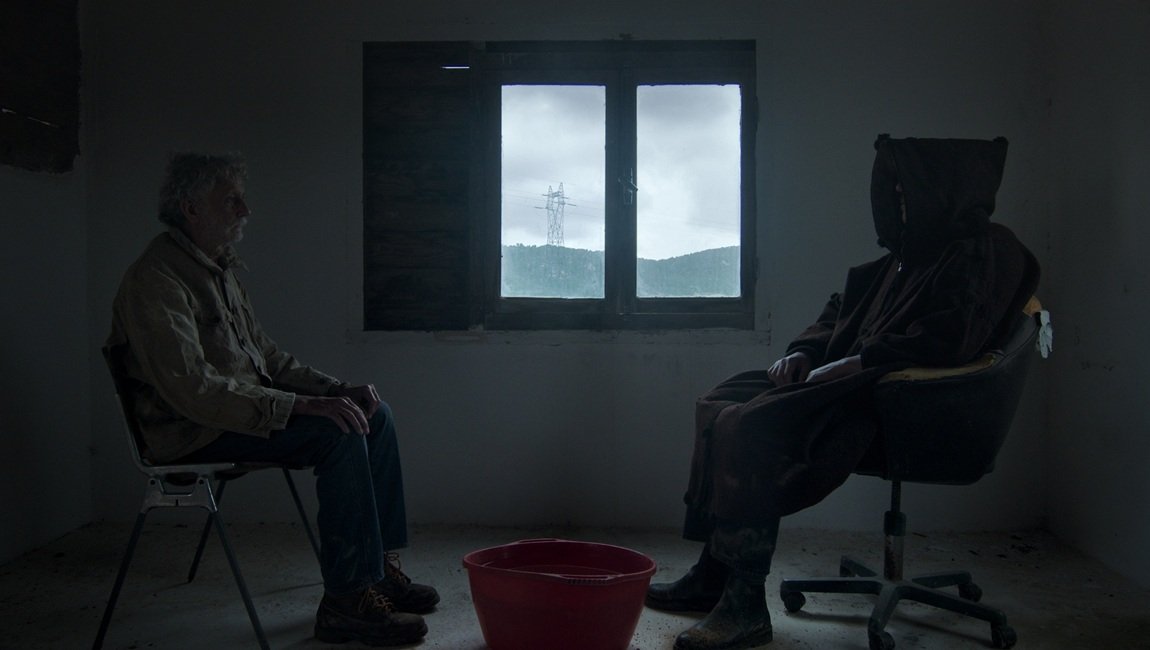
But it takes mere minutes to realize that Laaridhi’s film will carve a new tradition, just as Godard and Lucas did before him. And like Godard’s Alphaville, there is hardly a setup to The H@llow Man’s post-apocalyptic diegesis. We open on a cloaked man, Taha (Mohamed Hassine Grayaâ), a pathos-smith who uses poetry to evoke emotions in his dissociated clientele. The film’s title derives from T.S. Eliot’s poem of the same name, which Taha recalls reading recently at a party. The title of Laaridhi’s film, though, as one may notice, is stylized with an “@” symbol in place of the letter a — a trick that can appear ornamental before one harkens back to the Gramsci quote which opens the film. In The H@llow Man, as with our reality, the old world of Eliot is dying, and with it the new world of digital automation struggles against humankind to be born. Therein lies the film’s primary struggle: both a people’s government-induced absence of humanity and the advancements which aid in such a process. For Laaridhi’s futuristic world, the only way for humans to regulate both memory and emotion is at the hands of a hypnotherapist. Thus, Taha begins the film by slipping into hypnosis, wherein he treks through a forest before settling at a sordid, bug-infested home.
For much of the film’s remainder, we watch the inner workings of the household as if hypnotized alongside Taha. Its inhabitants are a man and two women who are planning an attack by suicide bomb, which is to be carried out by the home’s youngest dweller, a pregnant woman played by Nesrine Bani. The moments leading up to the film’s conclusion are rather unadorned, inasmuch as Laaridhi’s visual style is not one of ostentation. The H@llow Man moves at an intriguing meander — closer to the so-called “slow cinema” of Lav Diaz than to the breakneck speed of a modern blockbuster, but only until the concluding portion of the film, in which Laaridhi changes tune from a distant humming to a heavy-metal score. As Taha comes to a realization regarding his hypnosis, the suicide attack about to occur, images begin to flash across the scene in a digital mosaic of memories and code. The sequence points to a certain practice of the cinema — that it must reflect rather than merely portray its subjects. Consequently, Laaridhi fashions a frenetic montage worthy of Isiah Medina or late-period Godard, definitively upending the parameters upon which his film had sat heretofore.
The H@llow Man, in this regard, argues effectively for a protean cinema, and one that does not adhere to a narrative/experimental binary, but rather, a succession from one form onto another within the same film. Within the freneticism of the ending, however, exists a new binary of human and technology, the influx of images simulating the succession of forms within these new grounds. The sequence begins with human imagery, ultimately progressing into digital scatter that jumbles and contorts around the frame. In other moments, the human and the digital are stacked atop one another through superimposition, which is to say, both of the aforementioned successions of form — narrative-to-avant-garde as well as human-to-digital — strike one as Laaridhi’s way of demonstrating that the old world of essence and poetry may be dying, yet the new world offers no adequate replacement. Within the desire for efficiency and automation, there lies a fight for beauty and verisimilitude — a human fight, perhaps, to resist obsolescence.
Comments are closed.