
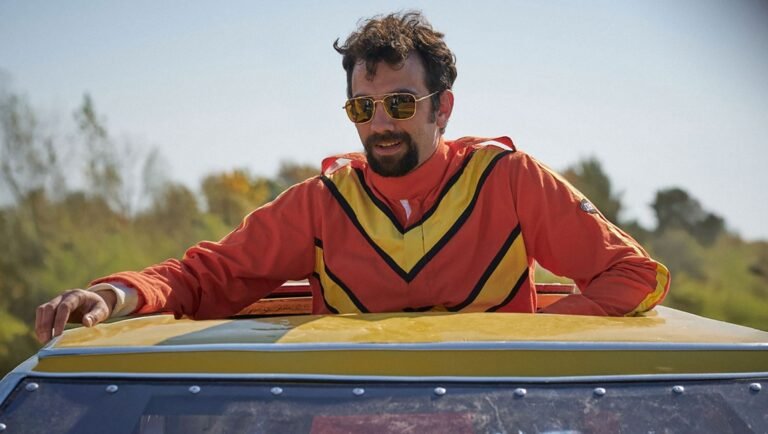
Director Michael Dowse is no stranger to the rough-edged antihero, but perhaps he’s a bit less in touch with the management of thematic conciliation when beset by a character whose pride, masculinity, and vigor all must contend with a sympathetic gaze and the lives of those whisked into the storm that he not only creates, but maintains. The Stunt Driver is a biographical portrait of Montrealer Ken Carter, Canada’s most notorious stuntman, as he administers the build-up and fallout of a stunt even Evel Knievel had called both impossible and stupidly dangerous. Ken is played by famed Canadian Jay Baruchel, whose performance here feels akin to his stilted and overly affected embodiment of Mike Lazaridis in Blackberry, where any plausible emotional insight into the character — and this is certainly a failure of the screenplay, too — is lathered instead in a grunting rigidity, one without any semblance of vulnerability or fear. In fact, fear only extends into existence when the script demands it, with characters looking at, pointing to, and giving expression to the danger in front of their faces, as if to emphasize that now is the time to be thinking with a clearer head. Everything is as indexical as possible here, which becomes a bit confusing as we try to glean some essence or substance that the film is trying to offer as a reflection on its subject matter.
Shot between handheld 4:3 and classical wide anamorphic, The Stunt Driver ping-pongs between an “objective” view of these absurd circumstances, where Kent intends to jump the St. Lawrence River, and a verite reenactment of the footage that one can find in Robert Fortier’s The Devil at Your Heels, an NFB documentary produced alongside Kent’s momentum to commit himself to this extraordinary feat. This back-and-forth structuring, unfortunately, comes to offer very little perspective beyond the more pointed reflexivity extrapolated from Carter’s character here as a man all-in for the spectacle. Indeed, it is spectacle to which he bends the knee, marginalizing all else in his life: family, friends, peers, and even himself. Naturally, the cinema is a perfect space to consider such a dedication to the image of oneself as a spectral extension of one’s pride, and one’s capacity to become even bigger than one’s pride. Unfortunately, Dowse doesn’t have the intrigue or patience to hone in on these most fascinating of elements, instead defaulting to the most sentimental, milquetoast reflections on how these faculties of one’s character might ruin intimacy in one’s personal life. This writer has yet to see the Fortier profile on Carver, and so will instead direct all readers to John Bolton’s documentary about the circumstances surrounding the jump, 2016’s Aim for the Roses, a film that understands how to concern itself with the design of spectacle, and the way spectacle lives on, takes new forms, and reshapes itself across the years and decades in a way that separates the contemporary from its archive.
Where Dowse further missteps is in this Western need for storytellers to find a vague point of lamentation for their antiheroes. In this tendency, there is a failure to consider the impact these people had on those they hurt in their pursuit of exceptionalism, a failure to contend with the damage they caused in their escapades toward legacy, and a failure to deny the presumed importance of a protagonist who himself veered from the headlines of his own story, never reconciling the way spectacle operates as a function of the job and how it eats alive everyone who vies for an ascendancy toward its abstracting nature. The dramaturgy is rudimentary, often at odds with the tale of failure as depicted here, unsure how to compensate for the reality of anticlimax, and so instead Dowse manufactures one that carries with it none of the emotional weight the film very explicitly organizes through the second act. Over and over again, we are thudded by a hammer, a tool so committed to classical structuring wherein everything comes together tidily. But when the circumstances of this particular narrative fail to provide easy access to a legible beat sheet, Dowse reduces the complexity and tension at the heart of Carter’s failures and flattens them into digestible biography. Come the end, all we have is aimless contradiction upheld by mediocre craftsmanship. The Stunt Driver is a structural analog to the ramp Ken Carter had built for his impossible stunt, and once you see the film, if you do in fact end up seeing it, you’ll very immediately understand the metaphor. Or, you can just find a picture of it through a quick search engine inquiry and intuit most of what The Stunt Driver is after.
Comments are closed.