
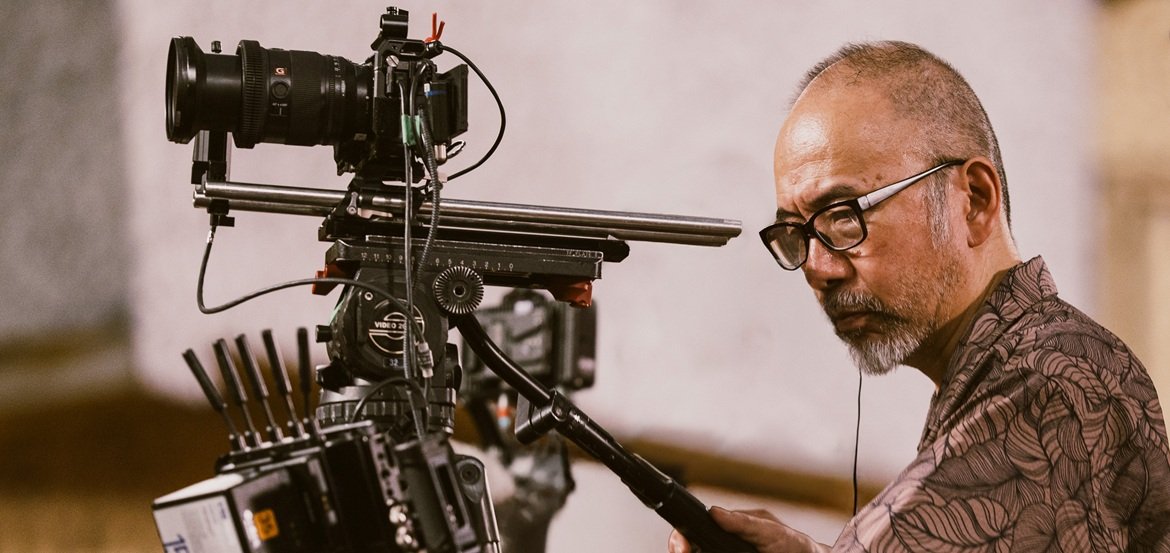
Japanese director Shinya Tsukamoto forged his legendary cult status with ultraviolent, psychosexual Japanese films like Tetsuo: The Iron Man, Tokyo Fist, and A Snake in June. His DIY body-horror and severe stylized melodramas eschew easy genre classification, but always feature invasive, intimate brutality: Gemini is a historical tale about demons; Kotoko is a disturbing domestic drama about a mother’s mental decline; the short film Haze sees himself trapped in a vent shaft-like concrete maze.
Given that, an English-language biographical drama about a Black veteran of the Vietnam War who turns to anti-war writing to process his PTSD sounds like a departure for Tsukamoto, but in fact Mr. Nelson, Did You Kill People? is in line with his recurring themes of being brutally molded by one’s environment. Allen Nelson (Rodney Hicks in his postwar years, Mark Merphy as a youngster) joins the Marines to escape an impoverished childhood and discovers how readily American soldiers embrace becoming agents of dehumanization and slaughter, first on the training base in Okinawa, and then on the battlefield in Vietnam.
Just as he did in his previous war films, 2014’s Fires on the Plain and 2023’s Shadow of Fire, Tsukamoto renders the carnage of conflict with explicit, gory detail, giving a shock to the system of anyone who thinks they know what to expect in a Vietnam vet drama. Tsukamoto’s now trademark frenetic, up-close-and-personal digital camerawork feels productively anachronistic in the film’s otherwise handsome period drama trappings. Even though his biopic adopts a more traditional narrative arc — where Nelson is guided through his recovery by his withholding Veterans Affairs counselor, Dr. Daniels (Geoffrey Rush) — with a higher degree of earnestness than Fires on the Plain, Tsukamoto is just as devoted to depicting punishing psychological subjectivity.
In real life, Allen Nelson’s memoir and speeches were popular in Japan, and his criticism of proposed reinterpretations of Article 9 of the Constitution — which renounces war to resolve international tension — struck a chord with the director, who cited the worrying shift in war attitudes when promoting Fires on the Plain. As the film makes it North American premiere at TIFF, I spoke with Tsukamoto — with the help of an interpreter — about brutal, purifying honesty, the ethics of stories about repentant killers, and how participating in Martin Scorsese’s Silence impacted the production.
Rory Doherty: I was surprised how much Allen Nelson’s story had resonated in Japan. Why do you think this is?
Shinya Tsukamoto: I believe that his story resonated with Japanese audiences because right now in the world there are a lot of wars happening, unreasonable wars. There’s a lot of anxiety in people’s hearts, especially in Japan, because Japan seems to be rushing toward becoming a country who can engage in war. There are some people in Japan [who think] when it happens, maybe we need to be involved. My stance is no, that’s not the answer, and there should be a way to avoid having a war.
I never met Allen Nelson in person. When I discovered his nonfiction book, he had already passed away, unfortunately. So I didn’t know him personally, but his recollection of the story was so personal and vivid and very descriptive, to the point that it was so honest, it was shocking. At the same time, I felt that this needed to be told through film because it’s an important story.
RD: The Vietnam veteran story has now become a classic type of Hollywood film. How conscious of specific films from the genre were you when making this? Did you want to give audiences something they hadn’t seen before?
ST: Personally, I am afraid of war, and that feeling started when I encountered a Japanese manga called Barefoot Gen. It talks about the atomic bombing of Hiroshima in World War II. Similarly, there are many Vietnam War-themed U.S. films that don’t talk about war in a heroic way, and I’m definitely influenced and inspired by that as well. But even in those films, the main characters are portrayed in a way where the audience wants to root for them. But in Allen Nelson’s recollection he talked about the sins and crimes that he committed in the unforgivable war in a brutally honest way. To try to tell his story from that perspective, to be brutally honest, would be a completely different type of film compared to any Vietnam war-themed film that has been produced before.
RD: I read some of Allen Nelson’s writing, and I was surprised how many moments are faithfully portrayed in the film. When you were writing the film, how important was this faithfulness to his testimony?
ST: I made sure to incorporate all the important moments and beats that were described in Nelson’s nonfiction book, such as what triggered him to enlist in the war in the first place, his first kill, and the fact that he was involved in horrific violence — and definitely the witnessing of the birth. That was the moment he realized that our enemies are human as well.
RD: Scenes where Nelson witnesses a Vietnamese teenager give birth in the heat of battle, or a schoolgirl asks him if he ever killed anybody, have an intimate power to them. They weren’t overly sentimental. How did you balance the story’s emotions?
ST: My purpose was trying to faithfully reproduce the stories that Allen told us in his books. For example, the moment the girl asks young Allen [the titular] question, he confesses to his crime, the children’s reaction afterwards is really them trying to console him. It was a very delicate moment because they’re not trying to console him because he’s sad that he had to commit a crime. I didn’t want that scene to be about, “Well, as long as you’re repentant it was okay that you committed a crime.” It was not about that. Yes, there are tears, but there are reasons much deeper than that. I think the audience was able to catch that message. I’m happy with how it came out.
RD: The scene where the soldiers arrange and count the dead bodies of Vietnamese villagers struck me as this macabre, unpleasant death ritual. It made me think: what role did spirituality or the lack of spirituality play in this film?
ST: I’m not sure if I can answer this question correctly, because the religious and spiritual aspect wasn’t on my mind as I filmed this. At the same time, the instincts that people have about what is good and what is evil, that idea that [what] people instinctively have in themselves gets revealed brutally when you’re on the battlefield, right? When I did Silence, it was about God, and on the battlefield, God is silent. He doesn’t talk to you. That’s what came to my mind as I heard your question.
RD: I’m glad you brought up Silence. It’s my favorite film, and your performance in it is terrific. Did you draw on anything from that experience for working with non-Japanese actors and crew members?
ST: Because I’m not fluent in English, I asked Hollywood veteran Tim Monich to be our language consultant and dialect coach. When I worked with him in Silence, he coached the Japanese actors on English accents; with this film, he also taught all the Vietnamese actors about accents and speech. He is brilliant in making sure that the language aspect of it was perfect.
RD: I noticed in the credits, there were production units in Japan, Thailand, and New York. You can feel a real difference between some of the domestic interior sets and those battlefield exteriors. Can you talk through the work done in different locations?
ST: I had the pleasure of working with such passionate teams in each location that we filmed. I had the main crew in Japan that has worked with me [before], and then in each location we had a Thai team, New York team, and even a team in Okinawa as well. We had this main general art director [Takashi Sasaki] who worked on the film, but in each location, we had the local art director who was really terrific, and they each had their own local team. We had a very clear line of communication so that aesthetically and historically, everything we see on the screen is correct. This wasn’t just for the set — it was the same for the wardrobe and props. There was a passionate, amazing team in each place.
RD: In the scenes between Geoffrey Rush and Rodney Hicks in the therapist office, I was struck by how hands-off and removed Dr. Daniels acts. Allen has to do much of the talking and discovery himself — it frustrates him. Can you talk about directing these scenes?
ST: It’s based on what Dr. Daniels actually did with Allen. I think what he intended to do initially was just allow Allen to talk, give him the room to say whatever he needs to say. Then Dr. Daniels noticed that talking about the experience seemed to heal him and help him recover. So Dr. Daniels was able to help Allen find these feelings lurking at the bottom of his heart and shed light on that. I was just following their lead.
RD: I was reminded frequently of your film Fires on the Plains, especially because they’re both about a soldier in a foreign campaign and their overwhelming, disorientating experience of war. When you’re making a war film, do you find that disorientation is a fundamental visual tool to convey that experience?
ST: For both films, I was very particular about only showing the perspective of the main character. For example, in Fires on the Plain, the soldier Tamura [played by Tsukamoto] wanders in the jungle, and suddenly the bullet appears, suddenly the explosion happens. We didn’t do any switching the camera to the perspective of the U.S. soldier because I wanted the audience — for both films — to subjectively experience the war themselves, so I made sure the camera only captured the perspective of the main character.
Comments are closed.