
Ideology is the backbone of cinema. Or, at least that is what Jean-Luc Comolli and Paul Narboni posited nearly 60 years ago in their joint manifesto, “Cinema/Ideology/Criticism,” wherein the two critics brazenly wrote “every film is political.” Political, meaning a product of politics, of a political ideology, and hence, of a political system. Their words presupposed a link between apolitical and hyper-political as enmeshed, one and the same, insofar as they both reflect political ideology, but what of cinema now? What of contemporary political cinema? What of the “eat the rich” satire, which has proliferated endlessly, it seems, in the wake of Bong Joon Ho’s ultra-successful Parasite?
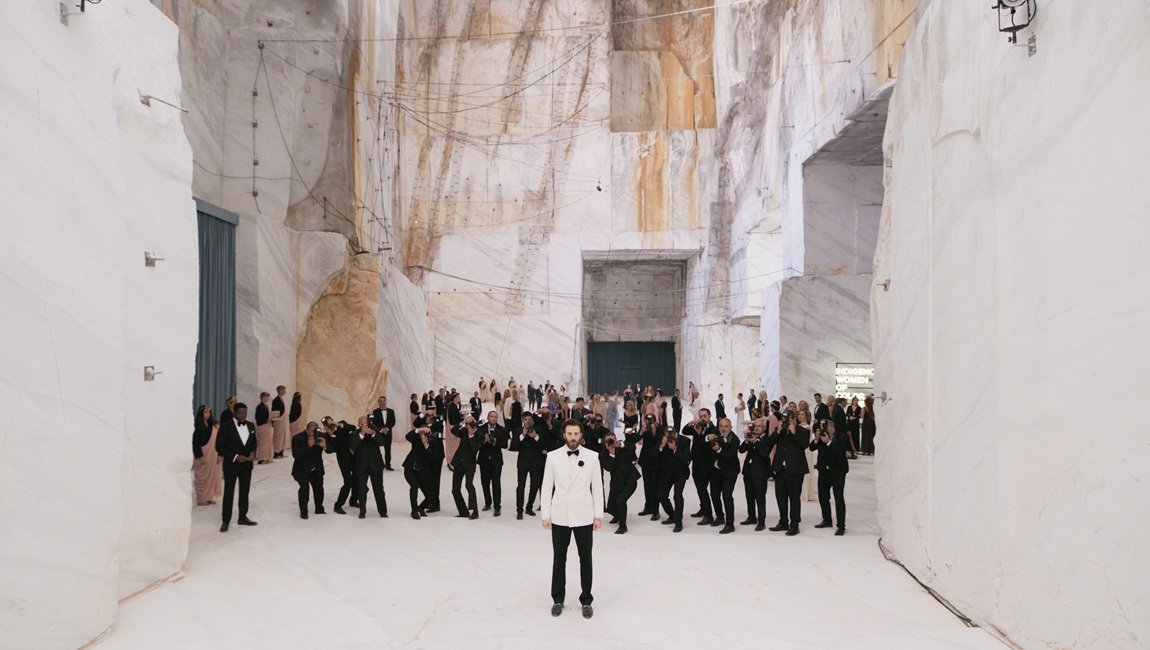
Fundamentally, these appear to be the questions Romain Gavras’ recent film, Sacrifice, interrogates most directly. That is, questions not of the actual politics per se, but of politics within film, of the notion of a political film itself, though one wouldn’t know it from its opening moments. Sacrifice begins with former superstar actor, Mike Tyler (played brilliantly by Chris Evans), en route to a climate change gala hosted by billionaire Ben Bracken (Vincent Cassel) at a mine in Northern Greece. It soon becomes obvious that Tyler is not particularly well-liked; his initial career fall-off arose from a manic flamethrower incident that occurred at a recent film premiere. Luckily, though, he has spent time off living in a monastery, spiritually refueling for his second-wind stardom.
Tyler’s hopes are fairly short-lived, however, as a group of fanatical soldiers — including siblings Joan (Anya Taylor-Joy) and Arthur (Yung Lean) — hijack the party in search of three subjects, whom they plan to sacrifice to a volcano in hopes that it will not erupt as scheduled and end the world. After the violent severing of a hand, a Charli xcx cameo, and general, widespread hysteria, the soldiers complete their task, taking with them Tyler, Bracken, and a singer from the event.
Such an introduction — in all of its blatant absurdity and metatextual references — serves as Gavras’ feint jab, wherefrom Sacrifice eschews the artistic redundancy of its subgenre and looks inward. Similar to its genre bedfellows, though, the film works toward a central ethos through humor, and Evans’ Mike Tyler is perhaps the most apt surrogate for doing so. It is not merely that Tyler is a humorous character, but that he wholeheartedly wishes to be adored; by fans, by wives (courtesy of a running joke in the film), even by his own kidnappers. Thus, Tyler becomes embroiled in the world of the aforementioned radicals and soon understands their convictions; namely, that the relationship between the group and the volcano is a spiritual one, marked by a number of various pseudo-religious practices, such as putting one’s ear to the ground to speak to the volcano. Even still, the latter half of the film is hardly concerned with the inner workings of the militia, as seen most obviously in the throwaway nature of John Malkovich’s short scene, in which he plays Joan’s scientifically-inclined father. On the contrary, this portion is about Tyler and the home he has found with his hostage-takers — he is a star yet again. Thus, it is ultimately through Tyler — and the extent to which spectacle is intrinsic to him — that Gavras structurally diverts from typical anti-capitalist film signifiers.
It is noteworthy to mention, though, that Sacrifice is not a work concerned with hypocritically dealing in class struggle, but rather with posing existential questions which, ironically enough, are central to the capitalist system which it ostensibly imposes. Purely within these various ideological oppositions does the film become intriguing, as perhaps only a medley of ideas this preposterous could reflect our current political moment. Perhaps the questions of Sacrifice or of Comolli and Narboni are no longer if cinema is political, but of the limits to this politicization. Perhaps it is only through sacrifice — of typical signifiers, of staid manners of filmmaking — that something new is born.
DIRECTOR: Romain Gavras; CAST: Chris Evans, Anya Taylor-Joy, Vincent Cassell, Salma Hayek Pinault, Charli xcx, Yung Lean; DISTRIBUTOR: Netflix; STREAMING: October 16; RUNTIME: 1 hr. 43 min.
Comments are closed.