
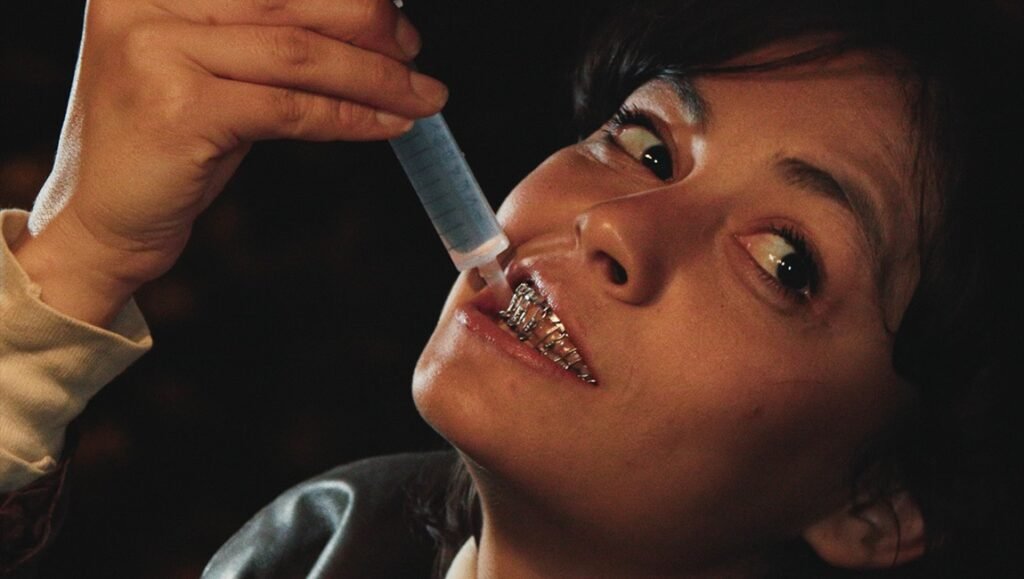
After a night on the town, her two guy friends, Mitch (Colin Burgess) and Noah (Kevin Grossman), try to take Rayna’s (Blu Hunt) keys so that she doesn’t drive home drunk. They’re not very successful. Cut to a few weeks later, and Rayna has her jaw temporarily wired shut because of her car accident, and Mitch has become her kind-of-maybe-not boyfriend while helping her recover. They try to get back out, but a party Mitch thinks is fun is not Rayna’s speed, especially as she’s going in sober. Noah recommends an alternative to the boring function: a magic show. The trio soon find themselves with Robert (Nick Corirossi), a cocksure mentalist whose show feels located somewhere between genuine telepathy and a douchey stand-up set. Noah leads them to believe there is an afterparty back at Robert’s house, but when they arrive to find it is only Robert and his artist wife, Cleo (Ally Davis), an awkward night of escalating hilarity ensues.
In her debut feature, director Sabrina Greco expertly weaves a cutting comedy with Lockjaw, where whenever characters try to avoid each other, there is always the last person they want to see waiting for them around the corner. Even when someone is ostensibly alone, there is (in a Rules of the Game-like construction) always someone peering at them through the window, judging (often misjudging) them in a way that can only make the whole situation worse. In a film so explicitly about communication — that is, about people who are bad at doing it — the most terrifying thing that can happen is to be confronted by someone that already knows what you’re thinking. In every successive moment, Greco twists the knife, while also never missing a chance to sprinkle a little sugar in with the salt. Part of what makes Lockjaw so effective is how much it loves its pathetic boyfriends, creepy magicians, self-important artists, and a woman who literally can’t say that she doesn’t have her shit together.
I caught up with Greco over Zoom after seeing the film at a raucously fun screening at New/Next Film Festival.
Can you tell me about how you got the idea for Lockjaw?
The movie started as a short film that I was writing. I wanted to make something that was a little bit of a longer short, maybe around 20 minutes or so. The main idea for that was that I wanted to make something where someone has to go out despite having this hindrance to them in some way, whether that was going to be a broken arm, a broken leg, I wasn’t sure yet. Then I came up with the idea of the mouth, and I really liked how that meant that the character could use their full body and could act in very specific ways that actually weren’t that limited, but there was still something that was really making their experience from everyone else so different.
As I was writing the short version of that, I realized that what I was most interested in with this movie was getting these characters to places where they can be acting really big and having a lot of fun. But within a 20- to 30-page limit, it felt like it was all really random and kind of happening for no reason, and nothing felt earned. So I decided to make this a feature. I’ve been wanting to make a feature for a while, but this felt like the most natural script to do it with.
I imagine just having most of the action take place in a single location probably made it a little bit easier, right?
That kind of made it possible. It’s a micro-budget movie, most of it was self-funded. So things had to be very contained, or we wouldn’t have been able to get it done in the very short amount of time that we had. We shot the movie over 11 days, mostly at that house. I think we were at the house for 8 days, and then we had 3 days where we bounced around a little bit. One full day was at that bar that the magic show was at. But yeah, the house was key to making it all work, and luckily my wonderful producer, Abbie Jones, got that house for us. It’s owned by these artists, Marnie Weber and Jim Shaw, and all of the clowns in the house are Marnie’s actual artwork that she let us use. They also let us use the house for free. If that did not happen, the movie would have been either way more expensive, or we would have had to significantly cut other corners.
Let’s go back to the magic show. Tell me about how you came up with the character of Robert.
He kind of started off more as a normal scummy guy, and then as I was writing it, I kept feeling like I wanted to give him a more fun gimmick or job or something like that, and for some reason magician was calling to me. There was a more normal version of him, where he did a more normal style of magic. But then as I was thinking about who I wanted to cast in this role, I was thinking about Nick, who plays Robert in the movie. I was like, well, if Nick’s gonna do this, I really wanna lean into his sense of humor. He’s very goofy, and I thought that I wanted to kind of write it more for him, so picturing him in that role got me excited about it and made me make way more fun choices. Once Nick was actually signed on to the movie, we worked together to make the character even more fun.
Having a mentalist-type figure in this movie where everybody is trying to conceal what they’re actually feeling adds so much tension to it.
It’s a fun device, especially because the movie is about communication, and Rayna has her mouth wired shut. It feels like a very obvious thing, in a way, that this is what the movie is about. But because Nick is there in that role, he can literally say, “Oh, this is what it is,” and it gives a little bit more of awareness to knowing that this is a metaphor that we’re playing with.
I think it’s funny, too, having the mouth wired shut be the central conceit at first, and then once the movie really gets going, you almost forget that that’s actually what the movie’s about. Like, you have two characters interacting over here, two over here, and then it’s like, oh yeah, she can’t talk.
It was fun to build those characters around that. Blu is a powerhouse in this movie. She’s giving a real, full-body performance. But in order to make that work and make the mouth feel like more than a gimmick, everyone else around her really needed to be balancing that out and also really fun in their own right. That was a really fun challenge at first when writing it, but then once I had the cast together, we all would meet up in these pairings that exist in the movie. Like, I met up with Allie and Nick, who are Robert and Cleo, and then I met up with Colin and Blu, who are Mitch and Rayna, and then Colin and Kevin, who are Mitch and Noah. But then Sally, who plays Annabelle, I would only meet up with alone because I wanted her to feel left out intentionally. The cast, both in the writing but also in their own interest in the movie and their own talent, really brought everything together and made it really mesh well.
Tell me about how you chose to film the interiors and exteriors of this house, because you’re always interested in staging something in the foreground and then having something happening outside in the background as well.
I wrote some of that into the script, but I always figured it depends on whatever house we use. We have budgetary restrictions, so I might not be able to get everything I want out of this through-the-windows thing. Luckily, the house that Abby found had tons of windows, so it worked out perfectly. The movie is kind of inspired by plays and teleplays, and so I wanted to use a structure where you enter a room and a scene starts, and when the scene ends, you exit the room. Then you go into a new room and there’s a new scene, so that it feels like a never-ending pile-on. In the movie, Rayna very rarely ever has any moments alone, because anytime she tries to leave a room to get away, there’s someone else there waiting to start something new. I thought that was a good way to build the tension and kind of keep her spiraling without giving her the space to reflect and try to get out of that crazy mental loop that she’s in.
You’ve worked as an editor before. How does that affect your directing process?
I think it’s helped a lot. When you prepare for a movie and have a shot list, there’s all these things that you want. For a scene, you might have 10 shots, and then when you get there you realize you have very little time to shoot. So it’s nice being able to play the scene in my head and know, “Okay, now that I’m actually in this room with the people, we don’t need all these shots.” I can only imagine myself actually using 2 or 3 of these with the pacing of the scene that I’m imagining. It helps you get the days done. But also, when you make a feature, you’re doing a lot of things out of order, and it can be a little hard to keep your bearings straight. I think having the editor brain can help you with that and it kind of keeps you grounded.
Was there anything that you were looking at in particular influence-wise to help you weave this together?
There’s one movie in particular that was a big influence, which is The Wife by Tom Noonan, which not a lot of people have seen and I would highly recommend people check it out, especially if you liked my movie. And then Forest for the Trees by Maren Ade was also a good reference, because that movie’s a lot about a character feeling constantly embarrassed and humiliating themselves to a point where they feel like they can’t escape it. And then Faces by John Cassavetes was a big reference, or Cassavetes just in general for making the performances feel really alive, but also feeling earned.
Cassavetes, he tended to shoot pretty loose. Did you experiment a lot with breaking from the script with the actors, and having them build the scenes a little bit?
We did a good amount of improvisation. Working with comedians, they know how to add jokes into the script. I’ve written the script with jokes in it, but they know how to maximize that. They know how to do it in a way more natural way. In these bigger group scenes, we used two cameras so that they could just riff and have fun. It was still structured — we still had beats we needed to hit, we still had a place where everyone needed to end up — but for the first few takes when we were doing the wide, I did a lot of letting them improvise. Once we found the groove, we stuck with that, and then there were only a couple little changes after that.
Neal Wynne shot this, who, at least from my experience with what he’s played at New/Next — be it The Trick or In the Glow of Darkness — he seems very able to shoot on the fly.
Very much so, yeah. He is very talented. We’re also married, so that’s also one of the pros. But he is very good at shooting fast. And, because we are so close and have worked together so often, he knows what I want without me always having to say it. We have a very good shorthand
Have you shot things together before?
We worked together in many different respects. I have worked on his movies, he has helped on mine in various ways. And then we’ve done projects with our group of friends a lot. We have a built-in set of similar sensibilities, so we kind of have a very good baseline understanding of how we would want things. We shot for 11 days and used two cameras. They were more documentary-style cameras, they weren’t cinema cameras — Canon XF605s.
Anything else you want to touch on regarding the movie?
The jaw-wiring prosthetic was made by this guy, Gary Archer. It’s a professional-grade movie prosthetic. He’s one of the few working prosthetic dentists in the world. I guess it’s a very small field, but because of that, he’s worked on really cool projects. He did Adam Sandler’s teeth on Uncut Gems, and he did Jonah Hill’s teeth on Wolf of Wall Street. He’s worked on all of these massive movies, and I was trying to figure out how we were going to make this work on a micro-budget. I figured I was gonna have to find some shitty fake braces and do some arts and crafts with it. I quickly found out that fake braces are actually illegal in the U.S. I don’t know why, but, if you look it up, you have to order them from England or something. And I wasn’t gonna do that, I wasn’t gonna do anything that would potentially either look bad or put the actor at risk, because I’m guessing if it’s illegal, it’s for a reason.
On a whim, I looked up who the prosthetic dentists are. I shot him an email in the middle of the night, basically as a last resort. “If this doesn’t work, I can’t make this movie.” Then he emailed me back right away and was like, “Oh yeah, I can do something like that,” and the price was within the scope of our feature film. I expected it to be over $10,000, but it was not even close to that. So he made the movie be able to happen.
Would you have Blu in the prosthetic all day during the shoot?
She could slip it on and off really easily. It’s basically a mouth guard with wires on it. She would take it out in between takes. But she did her own rehearsing with it, which I think was a lot of fun for her. She would go to bars and put it in, and then she would see how people would react to her when she tried to talk to them. Surprisingly, a lot of people just tried to pretend that it wasn’t there. Like they felt too bad for her so they were trying to ignore it and still have a normal conversation with her, even though they couldn’t understand what she was saying. That was good intel for her for this role.
Because Blu and Colin didn’t know each other before this movie, I made them go on a date to a diner with me there with a camera. I was directing their conversation a little bit, but just kind of let them have fun and let her see what it felt like to have to be around someone that can do things that she can’t eat and the waiter’s coming over and talking to them, and she doesn’t want to show that she has the mouth, so Colin has to tell her what she would want, if there’s anything that she can even eat.
What she said about how a lot of people just kind of ignore that she had that in her mouth, that seemed to apply to how a lot of the characters interacted with her in the movie, except for Nick’s character, who’s always trying to prod at it.
When we got the prosthetic a month before the shoot, we did a lot of work without it, but then you can’t really know what you’re gonna get until it actually gets put in her mouth, and it sounded a little different than I anticipated. Luckily, Blu did all that work to get used to it. I kind of reoriented the script a bit to lean into it even more, so even though it was a little bit surprising, I think we got a way better, more purposeful movie out of being surprised by what came from it.
That’s sort of the Cassavetes thing.
Yeah, you lean in.
Comments are closed.