
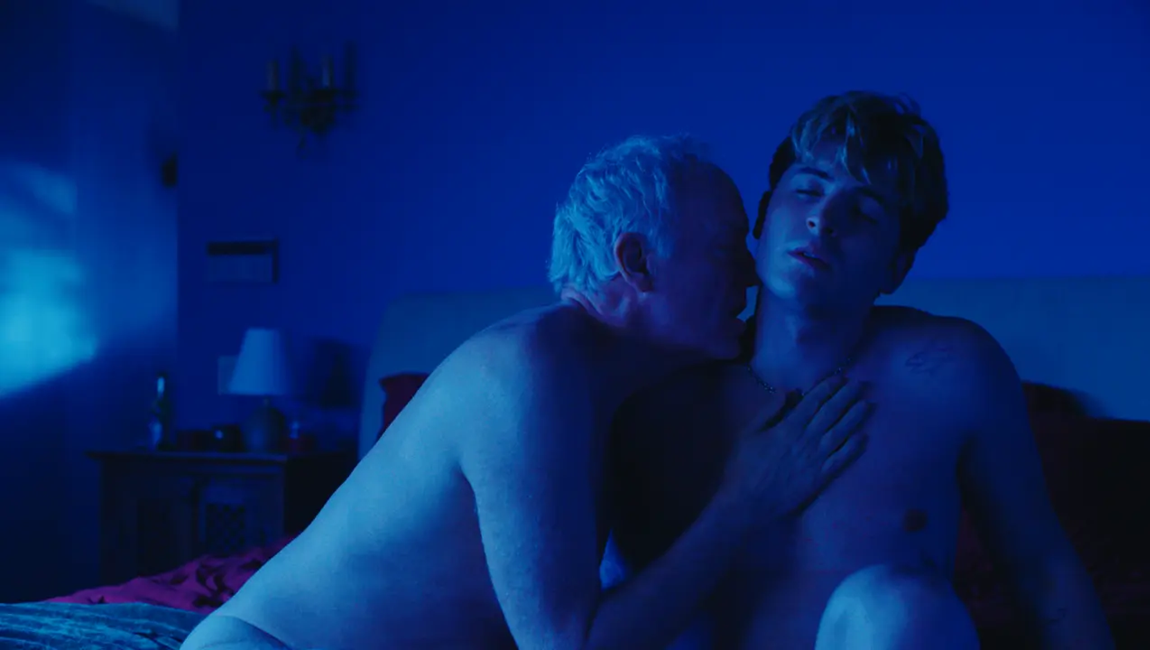
Elliot Tuttle’s sophomore feature, Blue Film, arrives hot on the heels of controversy — or so we’re meant to believe. It premiered last year at the Edinburgh Film Festival to favorable reviews and went on to screen at a number of reputable queer film festivals around the world, yet its marketing campaign has touted its underdog status, rejected by the likes of Sundance and SXSW as too controversial for their esteemed tastes. It’s a clever strategy that makes use of its provocative premise — wherein a brutish camboy spends the night with the pedophilic teacher from his youth who’s still carrying a torch — while perhaps burying the substance underneath it.
And it’s hard to blame anyone for that. The camboy in question, Aaron Eagle (a name whose origin gets its own violent, perverse story) is played by rising star Kieron Moore. Tall, handsome, and masculine, he’s cut from similar cloth as some of today’s more established Internet boyfriends — the Joshes, Pauls, Georges, and Callums of the world. Here, he’s a “findom,” or financial dominant, a role through which he squeezes exorbitant amounts of money from a slavish online contingent of gay men who will do his every bidding under the faint possibility that they might enjoy a slice of his attention. The film opens on such a scenario, as Aaron’s bulging, furry torso is unveiled from beneath a white tank top, the frame glowing in the softly pixelated fuzz of a simulated computer screen. Usernames flash by faster than you can read, while the chimes of digital transactions ping, the signal that faceless admirers are, that very moment, dumping their hard-earned money on his modest striptease and verbal bashing (as part of his persona, straight-acting and vulgar, Aaron throws around his fair share of “fags” and “faggots”).
These admirers are all anonymous until we cut to a man watching this live feed. He’s wearing a ski mask, perhaps the habit of a surveillance-conscious citizen of the 21st century. A few moments later, we discover it’s for identity protection of a more manifest kind. The doorbell of the man’s home rings, and Aaron Eagle, his back to us, vape fumes billowing above him, turns around. The collapse of time and space (physical and virtual) sets the scene for a chamber piece between two men whose histories and hangups go farther back than the viewer is likely to assume.
The man in the ski mask is Hank (Reed Birney), a shy guy of about 65. He approaches his very expensive sleepover — Aaron boasts to his live stream in the opening scene that he’s been booked for $50k — like a project, turning on a digital camera and recording Aaron on the couch, prying into his personal life with questions about where he grew up (Miami) and his tattoos (one above his eyebrow that says “DEABLO”). Under Hank’s still-masked gaze, Aaron’s normal bravado cracks ever so slightly, only to be recouped and reintensified in defense.
Aaron and Hank’s tete-a-tete will, in some ways, last all night, as long-hidden secrets about Hank’s pedophilia bubble to the surface and queasily articulated sexual desires swell and prod. But more than a test of audience tolerance for boundary-pushing subject matter, Blue Film is an exercise in understanding, particularly of the layers of emotional protection under which its characters have embalmed their true selves. This is a film about performance, where everything from Hank’s plucky, “aw shucks” demeanor and his newfound spirituality, to Aaron’s masculine bravado and alter-ego are taken to task. Tuttle accomplishes this by approaching every conversation about the violent and power-imbalanced nature of both Hank and Aaron’s sexualities with shocking frankness. No conversation is off-limits to either of them, so neither are they to us. Tuttle and his collaborators know you will arrive with your own specific feelings. Every topic that might trouble even the most taboo-acclimated viewer is given space to breathe, but is never tossed aside. As a result, there are very few cracks through which one can shoehorn blame or shame, but plenty for you to place yourself inside.
Hank has travelled all the way from Bedford, Maine to Los Angeles, not necessarily to sleep with Aaron, as the exchange of money and rented house suggests, but to find out whether or not he still loves him. Aaron, on the other hand, had no idea he was going to be confronted with the revelation that his middle school English teacher pined for him all those years ago, nor that he would be forced to unravel the mangled spools of protection around his still-broken heart. Their early confessions are manifestations of Tuttle’s preoccupation with facades and performance, because not everything they admit to turns out to be the whole truth. Hank didn’t molest a young student, Jeff, in the school bathroom, but it’s not because he stopped himself beforehand; and Aaron wasn’t molested by his aunt as a kid like he tells Hank in a moment of well-intentioned sympathy. His truth, as we find out, is of a less controversial nature, but no less painful. As the night wears on, they give each other grace, and let their layers of fabrication melt away until nothing is left to admit and nothing is left to hide.
Blue Film is not as salacious as its marketing materials suggest. This is a film about compassion, and the potentially offensive nature of its content has less bearing on audience engagement than how that nature is interrogated. It’s certainly not as queasily line-skirting as a film like Todd Solondz’s Happiness, though that film, too, is able to garner sympathy for a man committing the most abhorrent of acts not by staving off judgment, but allowing space for it without compromising its internal principles of comedy and depravity. That doesn’t mean Blue Film isn’t provocative. The production’s single-location conceit means you can never escape the elephant in every room, even if some of the characters’ change of scenery feels obligatory rather than intuitive. And the climax, for lack of a better word, thrills and disturbs because it functions as an attempt at joint fulfillment of repressed desire, dressed up again in layers of perverse performance, that necessarily fails for both when it fails for one. That lack of emotional and sexual catharsis is a refreshingly realistic approach on Tuttle’s part to subject matter that deserves to be taken seriously.
DIRECTOR: Elliot Tuttle; CAST: Kieron Moore, Reed Birney; DISTRIBUTOR: Obscured Releasing; IN THEATERS: May 8; RUNTIME: 1 hr. 22 min.
Comments are closed.