
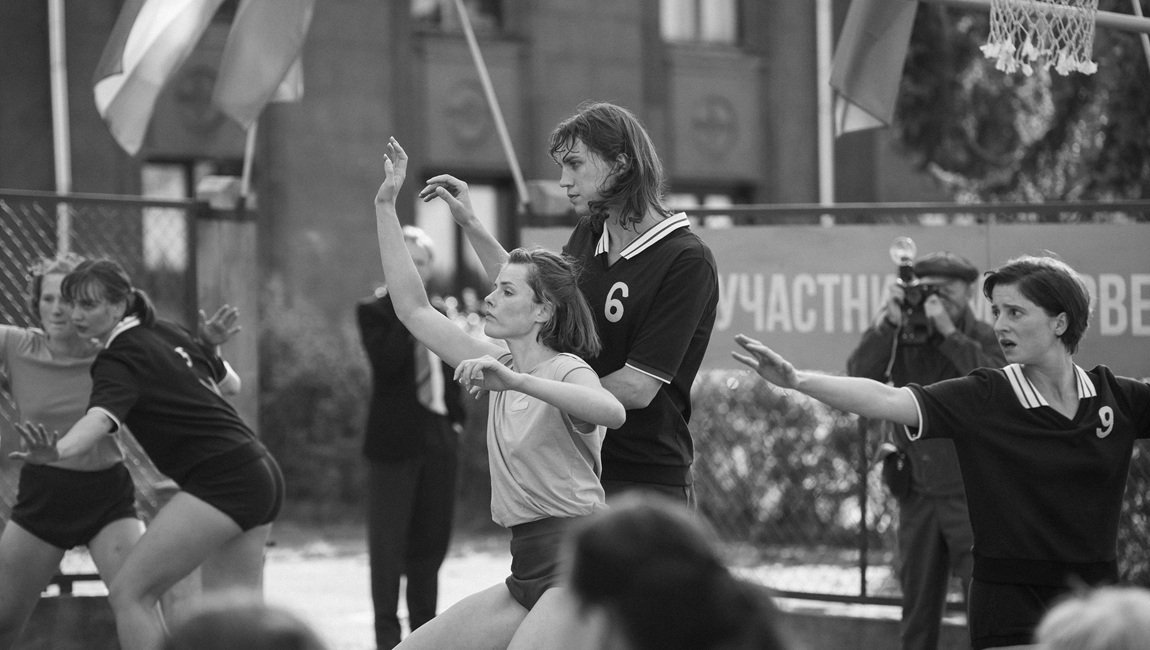
This past January saw the passing of Ulyana Semyonova, the Latvian basketball great who twice won Olympic gold for the USSR and whose seven-foot frame made her one of the most dominant centers in the game. Ulya, the new film from director Viesturs Kairiss, pays tribute to the legend with a small, off-kilter biopic focused on her earliest years as a basketball player. Played by cowriter Karlis Arnolds Avots — if this film receives much attention, the casting of a man will likely be a point of contention, not least because of the lip service paid to invasive and hateful policies of sex hormone testing in women’s sports — Ulyana is, at the start of the film, an extremely tall, shy young woman living on a farm among her community of Russian Old Believers. Her height attracts men from Riga seeking to recruit her to play basketball, and, when she goes with them after some consternation, she finds herself a social outcast in an urban world she doesn’t know much about.
Unathletic and perceived as masculine, she is not beloved by her teammates, who are jealous of the attention their coaches pay to Ulyana, who view her size as the key to her latent potential. Of course, she learns to play ball, and over time, the social tensions start to ease. But Ulya takes as its main subjects Ulyana’s loneliness and the pull between the poles of her old-fashioned, religious upbringing and the freer, more secular life that includes basketball.
Kairiss and cinematographer Wojciech Staron shoot Ulya in a grungy, black-and-white style common to severe Eastern European art cinema and even reminiscent of folk horror films. Indeed, before Ulyana leaves for the city — and again when she returns home for a stretch in the middle — life on the farm, among the religious community to which she belongs, is imbued with a nearly mystic earthiness. Ulyana enters the film dressed as a Christmas tree seen from afar, a giant of the natural world, and the camera frames her in the opening sections as a supernatural presence in her homeland. Though farmlife is an easy match for the dark, suffocating cinematography, once the film moves to Riga (and urban spaces beyond), Ulya‘s form starts to seem more unusual — for better and for worse.
Filming basketball in a style that forgoes the game’s kinetic, fast-paced aspects in favor of an austere approach grounded in Ulyana’s point of view offers a novel and compelling choice. Instead of an edit that cleanly follows the flow of the ball to the hoop and seeks to wring tension out of the back-and-forth scoring of the game itself, Kairiss focuses entirely on Ulyana, often seen towering over her opponents, awkwardly gathering the ball above their heads and putting it in the basket. The scores don’t matter; only her experience does. Out-of-focus flashes to an imagined crowd back home are intercut into some of the games to dig further into Ulyana’s interiority, and the woozy effect of the montage sets Ulya clearly apart from more pedestrian sports films.
But even with its relatively brisk runtime, Ulya eventually becomes a victim of its own dour atmosphere. Though form and content begin as an ideal match before becoming fascinating foils, at some point, we have to ask if this is actually all that serious. There’s no great tragedy in Ulyana’s life — at least not one within the film’s scope — and while the film’s main thematic concerns deserve to be treated with care, portentous gloom is a strained choice of tone for what is ultimately a coming-of-age movie about Latvia’s greatest hooper. It’s not that there’s no joy here, but those moments are scattered and never allowed to break through the surface fog of seriousness that ensconces the film. Though it is otherwise unique and perceptive, what the filmmakers of Ulya seem most interested in communicating is that… even legends of the court were once sad.
Comments are closed.