
For Steven Spielberg, the cinema is a rebuilding, again and again, of the childhood bedroom. There is some portion of prelapsarian bliss involved: a desperate, unending attempt from this wizened grey man to get his dead parents back together. To undo the formative divorce out of which, it appears, Spielberg came fully formed. The Fabelmans was the pinnacle of this cinematic obsession, in which he rebuilds his own bedroom, and relives that same breaking, understanding it as the motor for his artistic existence. It’s a film that makes itself, a film that describes its biological history while, at once, proving its thesis: it depicts a boy who must one day make The Fabelmans.
Disclosure Day is, in some respects, a return not to a dreaming childhood, but to angsty 2005: a Hollywood Blockbuster that feels entirely out of time, set in a world in which broadcast news remains the ultimate arbiter and in which images are trusted absolutely. It is the ultimate motto of the Spielberg picture: to see is to believe. The truism that circles Jaws is that Spielberg proved himself a subtle, effective filmmaker in his restraint: he knew when not to show the shark. But this is an exception that proves the inverse rule: Spielberg only held back on shark footage because he had no other choice. Elsewhere, his cinema is entirely based on spectacular realization. He will, as any talented dramatist, keep us in suspense. Close Encounters of the Third Kind (close kindred to Disclosure Day) is almost entirely composed of non-Third Kind imagery. But it is held back only to make the final, unobscured, Direct Light reveal of the last act that much more astounding.
We see this mode in miniature in Jurassic Park: the Brachiosaurus reveal is a masterclass in delayed gratification, in which the supreme majesty of the gratification is the purpose for such a skillful delay. Dr. Grant wouldn’t have believed it if he hadn’t seen it; we see his skepticism, we see it morph into astounding reality; then we see the dinosaurs ourselves, and we are astounded, and we believe. The wonder of a cinema of spectacle is holding contradictory premises in either hand: at once we know it is an illusion, and at once we will willingly suspend that knowledge. Disclosure Day makes much of this mode: it is perhaps the most restrained of all Spielberg’s science fiction films, waiting for the very final montage before revealing any more than a scrap of science fiction footage: and even then, delivering it in grainy, intercut splices.
But the context of Disclosure Day is to expand a cinema of spectacle into a cinema of empathy. Because the principle is not merely that someone will allow themselves to be astounded by a digital sauropod (or plastic shark); rather, that one will then grant to these phantasms genuine human feeling. The proposition of Disclosure Day is that any ordinary person, on seeing a non-human alien being tortured, would at once feel an intense empathy for the squirming grey. The proposition of Steven Spielberg is that any ordinary person, on seeing Disclosure Day, would also feel an intense empathy for this explicitly fictional being enduring a fictional torture. This is, of course, to describe, to some extent, the nature of all replicative art; but Spielberg is specific in his use of video, in his use of screen-representation, to deliver this message. To hear “they tortured an alien” is somewhat of an abstract proposition. Would the characters in Disclosure Day have been so moved by someone simply describing the existence of aliens, and then their maltreatment? Would the people of the world have been so universally compelled by the “disclosure” if it had been a meaty stack of text files, and not a dossier of film and video footage?
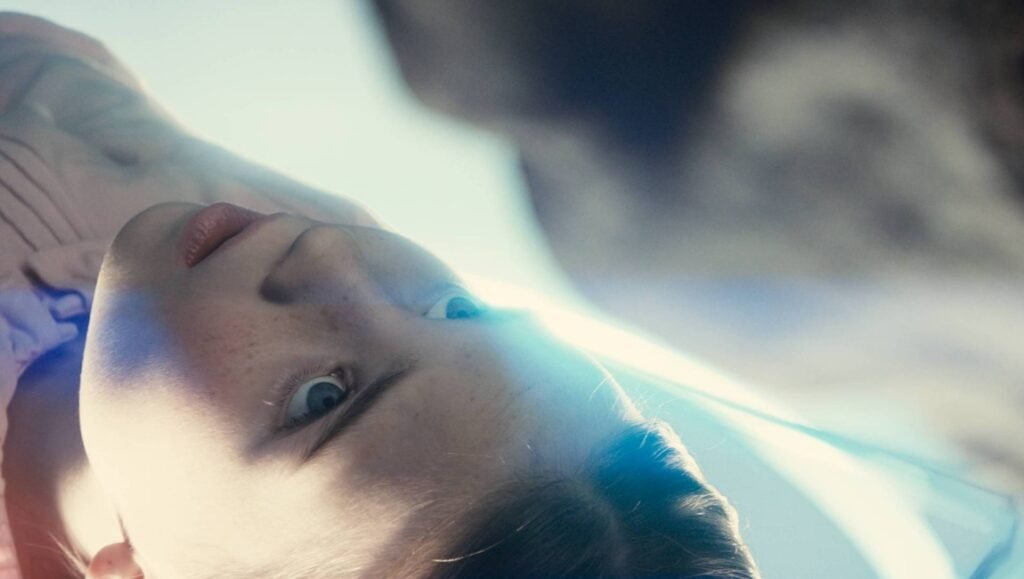
The moving image is the most direct line to the cortex of empathy. Just a few seconds of a strange, vaguely humanoid figure being prodded and we are immediately won onto the extraterrestrial side. Spielberg proves this thesis across the film. Emily Blunt’s Margaret is, by ET-means, granted the ability of sublime empathy. She can look into someone’s eyes and know their mind. When she repeats their mind back at them, they are moved into total pliancy. But in the film’s middle climax, this ability is supercharged: not only do people have their thoughts repeated, but they have their memories physicalized. Colin Firth’s villain is suddenly confronted by the face of his dead wife. That vision is sufficient to completely destabilize him. Disclosure Day is a film about looking, about seeing. Margaret and Josh O’Connor’s Kellner both acquire their supernatural abilities through shared a glance with (seeming) animals; the alien devices that were used to magnify their own eyes can also shroud someone with invisibility; Firth’s villain uses the same device to malignantly “see” through another’s eyes, a forced entry, a reverse-empathy.
The film’s ending is then the final “proof” of this visual idea. Spielberg suspends his drama — an often middling spies-and-runaways chase sequence that somehow spans two-and-a-half hours — for something almost entirely unrelated. A montage of disclosure — of various news channels reporting on the trove of declassified extraterrestrial footage now splaying across international television. Narratively speaking, there is nothing in this montage that is especially relevant: it contains no characters we have met, no real significance to the plot besides its having occurred. The themes of the film discuss the legitimacy of “disclosure,” of the ownership of “truth,” and a belief in the collective wisdom of mankind. None of these ideas require several minutes straight of abstract spacecraft imagery.
But therein is Spielberg’s entire design. This is a montage constructed so as to encourage genuine awe: to simulate the reality of alien life in the viewer, in becoming aware of some great, unknown truth, in really believing your eyes. The film then plays on this abstraction: we have spent the narrative looking at these aliens through indirect surveillance, or grainy handheld, screens through screens. Spielberg then reveals, in the television studio, the thing itself: the alien, suddenly more real for being seen “directly” and unmediated. No doubt remains. Margaret delivers its message live on air: she walks in front of the studio camera. We, instead, track behind: we see her through the viewfinder. Into the camera, through the camera, into another camera, to us. Those warping, fictional mediators, through which — despite everything, despite all technical and rational impediments — we are willing to believe. There is a reality being delivered to us, an authentic feeling. It need not be that aliens are or are not real. They, like the screen, like the cameras and lights and economy of the cinema, become in some regard the vehicle for something that is conjured within the viewer. Whatever notion of awe, or sorrow, or mercy, or excitement that is brought up by the film thereafter exists: it is made real. And it is through the eyes, speckled on our lenses. The film ends with a classically empathetic imperative: Listen. But Spielberg tells us something different. He says Look.
Comments are closed.