
America’s contested legacy began even before the signing of the Declaration of Independence and, as far as cinema is concerned, continues to outgrow the fervid imagination. Film grammar was born with D.W. Griffith, and its practitioners all trace their lineage shamefacedly to The Birth of a Nation; despite this common ancestry, few are unanimous with the symbols most true and representative of both the United States’ fractured heritage and this very process of fracturing itself. Intrinsic to the very imaginaries that underpin the exceptionalist ideal of this nation, “Americanas” proliferate the same way Manifest Destiny made its rounds across the plains and prairies two centuries prior; the famous ones — Westerns, Wall Street — became genres unto themselves, while the rest linger on, not in total obsolescence, but as tepid undercurrents goaded into action by an adroit eye or two.
Where America’s small-town communities typically lend themselves to manufactured indie quirk or documentary charm (a polite euphemism for poverty porn), there has been a resurgence of late in efforts to reclaim the originality of the lived American experience; or if not, then at least that of its observation. Noticeably tinting the canvases of Rob Rice’s bewitching second feature, Ponderosa, are shades of resplendent primary hues, re-colorizing the lifeless, disenfranchised nightmare of modern suburbia. In the film’s opening minutes, a water tower stands, ominous in the distance under a hellish red glow, while Zeke (Jack Dylan Grazer) returns home to his mother, Sandra (Alexis Bledel), whom he gently tucks into bed. Something spiritual, or at least allegorical, may be afoot: what does it mean for Sandra to turn, under DP Barton Cortright’s watchful gaze, momentarily into a sheaf of wheat? Throughout Ponderosa, these gestures are seldom and slight, yet their entrance has a sudden and destabilizing effect, as if explicitly cueing the viewer to the surreal undertones of our most banal moments.
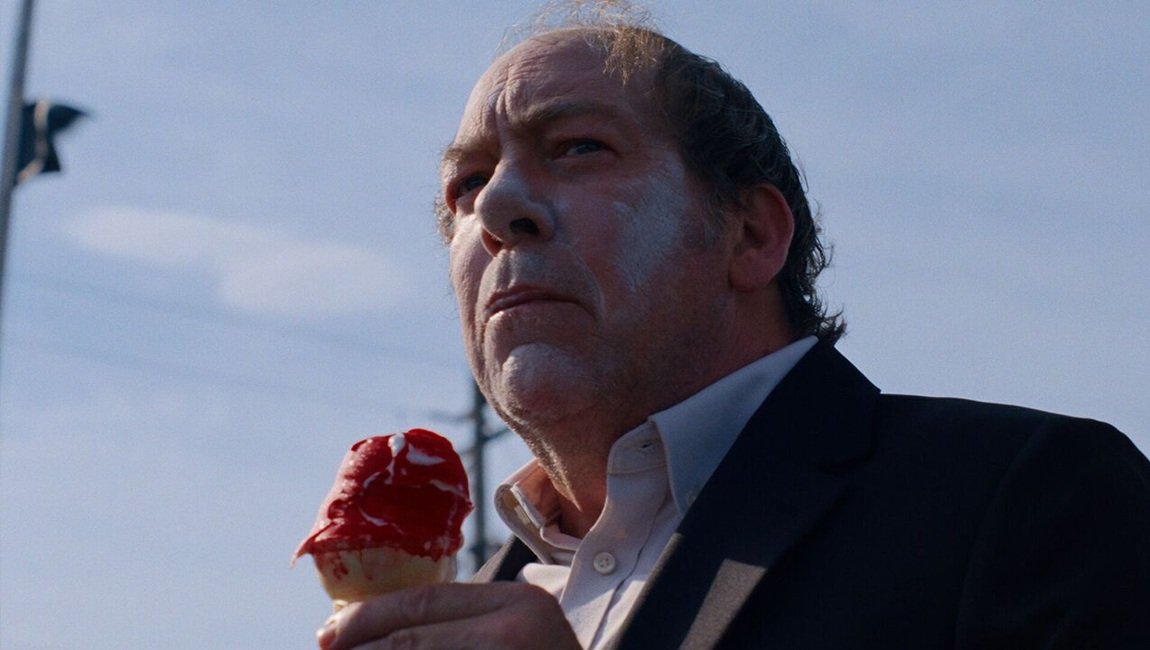
Ponderosa takes its title from the eponymous buffet chain, whose standardized deals and seating booths have come to represent the order of corporate and nuclear America alike. It is also where Sandra works, and where Zeke — while getting free servings direct from the kitchen — is introduced to George (Bill Camp), an older, wealthier man who latches himself onto the freewheeling Gen Z-er. Rice’s deceptively thin narrative has all the trappings of small-town drollery, encasing George’s motives behind a mask of deliberate uncertainty; while Zeke humors his self-styled mentor and benefactor by taking on a part-time desk job at the latter’s real estate company, George has already entrenched himself in a father-figure role, obsessed and on the cusp of unleashing the destructive fury of his delusions. He stalks his young Adonis across their neighborhood (southwest of Chicago) with unfettered enthusiasm, intruding in grossly comical fashion into Zeke’s life and home, even enjoining him to fix his “defective” ambition and embrace a certain work ethic. “It’s like the DSM for buildings,” he effuses about a handbook on zoning and land use. Talk of “private forces” is peppered, too, with the implication of his power as well as generosity; when the diner is slated to close, and the specter of rapid housing development looms large, there is little apparent choice for Zeke but to listen and let George in.
At the heart of this mysterious and confidently spellbinding film yawns a gap between generations, a schism whose lack of resolution veers discomfitingly close to the older, stauncher generation imposing their increasingly reactionary politics onto a younger and wider swath of the community. Moving away from the interpretivist docufictional mode that characterized his outstanding 2022 debut, Way Out Ahead of Us, Rice now immerses the viewer in Ponderosa’s off-kilter world without overdetermining its strangeness. George’s existential plight, whether as a capitalist alienated from his own labor or as a closeted homosexual deeply disturbed by Zeke’s lack of reciprocation, is punishingly real, and so are the stifled interactions he has with his peers. The latter comprises a firebrand therapist who quotes Carl Schmitt in his attempt to rile George into action, alongside a veteran group more plausible and immediately unnerving than the jolly Christmas Adventurers Club in One Battle After Another. As the core fundamentalisms of an insidious movement square up with the wider mythology of America’s difficult and schizophrenic identity, Ponderosa invites us to ponder and contend with the heavy and burdensome duty of forging and living her intrepid legacy.
Comments are closed.