
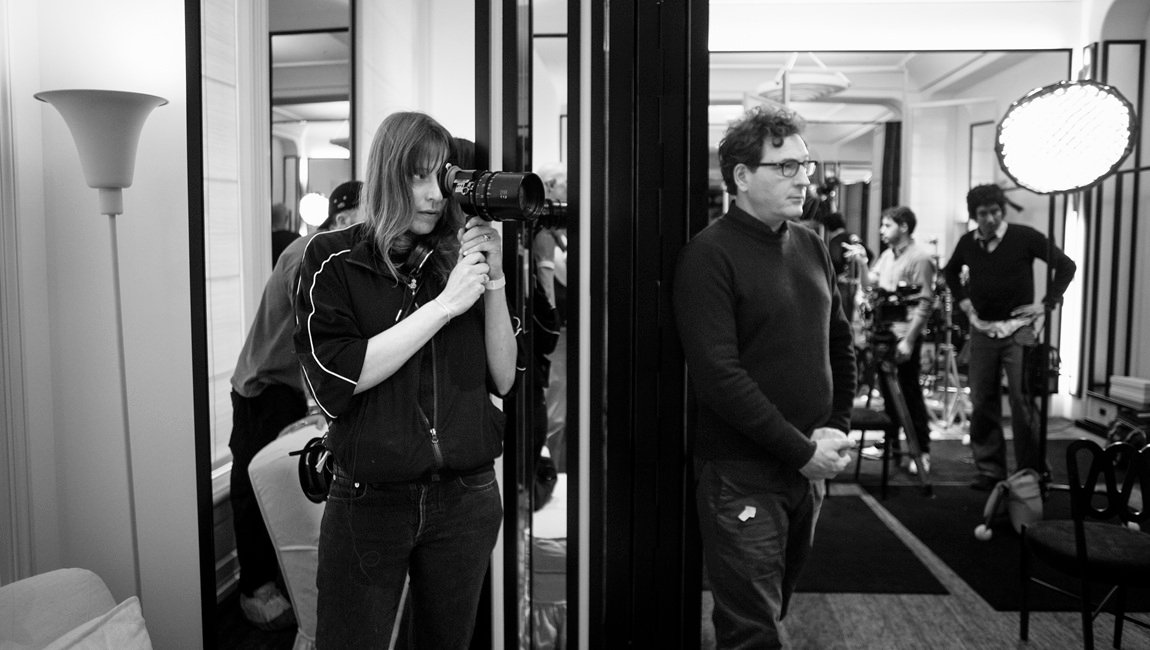
A 106-minute wisp of a film that unspools like the searching nature of life, Alice Winocour’s Couture keeps alive the ethos of a filmmaker who is known for invoking and healing her private traumas on screen. But this one more than ever, by Winocour’s own admission, makes for what might be her flat-out most intimate and personal film yet.
Recalling the director’s previous experience with breast cancer, the movie follows a filmmaker character discovering a similar diagnosis at a crucial juncture in her career. Played by the très chic Angelina Jolie, who had her own history with the disease, Maxine has flown from America to Paris to direct a gothic vampire film set to open Paris Fashion Week, which is out of her comfort zone as an indie movie director. Soon, the atelier gig sees her coming across the extremely hot cinematographer Anton (Louis Garrel), and different women from all walks of life whose stories and desires somehow mirror her journey back to herself. In this way, Couture is a swerving, impressionistic movie about the sheer power of brief encounters.
Over Zoom, I sat down for a brief chat with Winocour about her iconic leads, working with Chanel, and exorcising her personal pains.
Lé Baltar: Ella Rumpf’s Angèle is essentially your self-insert, in that her observations of these women at different junctures in their lives who are still trying to figure things out are based on your own real-life encounters. What made you want to stitch a film around these women, mapping their grief and desires, especially amidst the frenzy of Paris Fashion Week?
Alice Winocour: Yeah, I was inspired by my own experience, you know, of the illness and the announcement of the illness, but at the same time I wanted it to be set in a world of glamour and to have this contrast, which was interesting.
LB: It might be reductive to call this film a “fashion film,” and it’s one that’s particularly invested in what happens behind the scenes more than in the actual allure of fashion weeks. A character’s line somehow sums it up: “A fashion show is a war machine.” Do you also share that belief about the fashion world?
AW: Yeah, I think it’s not a fashion film. The fashion [aspect] is more like a metaphor of the contemporary world, the world where you have to hide your wounds. And yeah, I think it’s also a film more about women’s bodies and also the fragility of life. And the world of fashion is just, I don’t know, like a parallel world with this kind of metaphor.
LB: And what was it like to be immersed in the fashion world prior to making the film?
AW: It was very interesting, and I had to thank Chanel because they let me, they opened the door and let me film in their place, but also for one year and a half I was able to go backstage with fashion shows, meet so many people, and I was so inspired. You know, I had done a movie in the space world, and I did really the same when I had no script. I went to the European Space Agency and told them, “Can you support me? Can you open your door?” Because I can’t recreate space sets. And it was a bit the same. I wanted this Maison de Couture to feel so real and credible. And I knew it would be so difficult to represent it on screen. So I really wanted the support, and they accepted to be part of the adventure. It was a bit strange what I asked — [to have] their full support and at the same time not to have logos in the movie. So we shot. It was the first time ever a film was shot in the Atelier Haute Couture with the real chief of the atelier. And it was not just that they gave money, it was more like they were a partner in creation. I think they were happy with the idea to show the work of women that were not represented on screen.
LB: Something I really like about the film is the entire sequence in the storm. It’s insistently cinematic in that it has this sense of apocalyptic elusiveness. And you have these stunning shots of Ada and Maxine just being lost in the moment. Talk to me about conceiving this sequence.
AW: Yeah, to me, it had to be an exhilarating scene, you know, with this idea of the rain that washes all the wounds and this idea of a new life. It’s a new life for Maxine because she’s gonna go into chemo, but she wants to fight for her life. We don’t know what will happen to her, but she’s ready to fight. And it’s a new life for Ada as she doesn’t really know if she wants to be in this business of fashion, but she’s gonna go for it to support her family and send money. There’s a bit of a sacrifice of herself, but she’s going for it. And even if her feet are hurting, she goes for it. Also, the make-up artist, she’s writing, she found her voice. And I didn’t really care if it was good literature or not. To me, the point is that she had a voice, and she was talking for others. So yes, in the end, it’s an open ending, but at the same time, it’s a new life coming for all of them.
LB: And obviously, Angelina Jolie is the film’s anchor, and I like how you attend to this brief moment of connection between her character, Maxine, and Louis Garrel’s Anton. What was it like to work with actors as iconic as them?
AW: It’s funny, because I told my producer, you know, I wrote this very quickly with a feeling of urgency, and I want to do a simple, very quick movie. And it ended up being very [big] with a lot of actors, and it was like directing many films in one, because there are many stories. But it was a film of encounters, and it was very beautiful to see all of those actors coming sometimes for just one week or a few days and just tell their part of the story. It was like I really had the feeling I was sewing different parts of the lives of different persons. And to me, it was very important to have this love story in the film to show that even if she was in a very tough moment in her life, the love story was beginning, and it’s not often represented — cancer and love, and cancer and sex. Because sometimes in film, when cancer is represented, it’s always with a lot of care and, I don’t know, like [is] a kind of condescending thing I think, and I wanted to show it like real life. To me, what I’ve experienced is that life goes on, you know; even if you’re sick, it’s not like the end of your life. Like you have to struggle for other things, and you have to stay a woman with desire. It was important for me also to show the sex scene between the two of them, to have this described in the film. That’s maybe the last time she will have sex with her two breasts and entire body. That made this important for us.
LB: The labor and endurance of a woman’s body is fundamentally the film’s throughline, and it is, of course, a personal extension of what you’ve gone through in real life, again given your previous experience with breast cancer. Some filmmakers might have this aversion to being so personal on screen, but here you are openly embracing it. Can you pinpoint the source of that kind of openness?
AW: You know, I’ve always been writing from my traumas. It’s part of the DNA of my work. My previous film was inspired by my brother’s story of escaping a terrorist attack. And all of my films are super personal and intimate. So it wasn’t different. But this time it’s maybe one of the most intimate and personal films I ever did. But the idea of the whole thing was to share the warmth, you know, and with this collective experience of cinema — [which is] a healing experience to me. It was this collective thing of celebrating life also, and to show solidarity between women, even if it’s like they [only ever come across] each other in the city. I think that women can be stronger together by sharing their wants. It’s time that women share their wants together.
Comments are closed.