
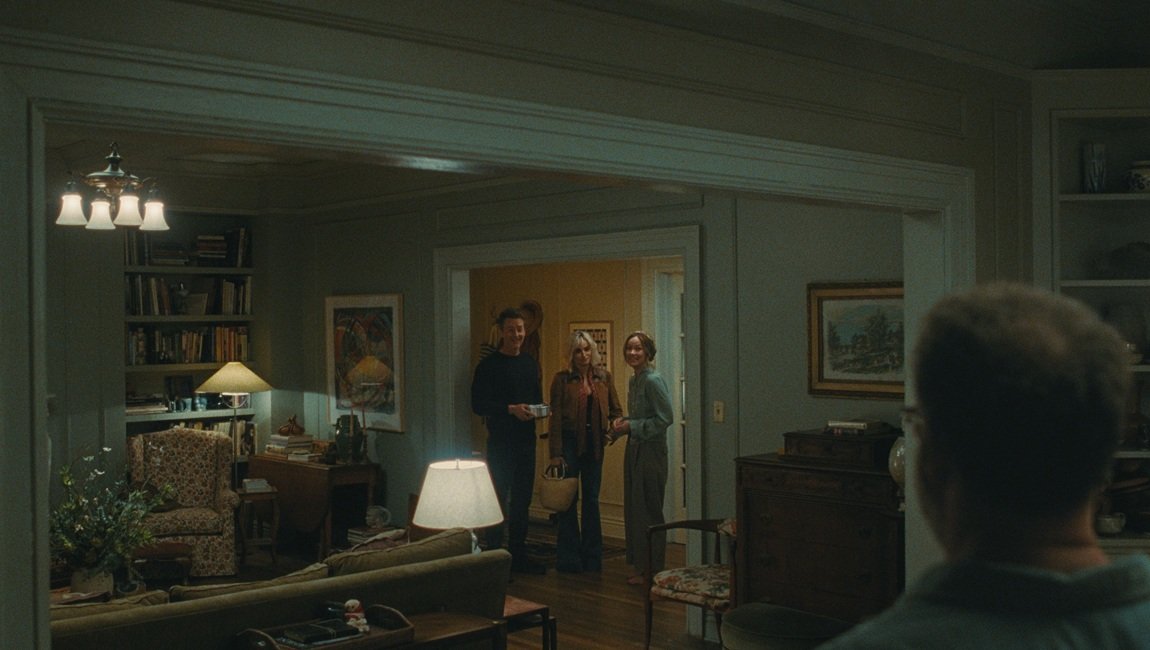
There’s no place like home. For Joe (Seth Rogen), home has metastasized into such a calamity that it’s all he can think about when he’s not there. At the start of The Invite, Olivia Wilde’s third feature as a director, Joe can’t keep a steady eye on the band students he’s leading through a rehearsal. He stares vacant, the music an afterthought, until he cuts practice short to drag his bike through the San Francisco BART and launch into a propulsive and perpetual argument with his wife, Angela (Wilde), back at their apartment. Joe’s and Angela’s marriage has reached such a boiling point that a brawl doesn’t really need a trigger, but there’s a good one tonight: Angela has invited the neighbors over for dinner, and they’ll be here any minute.
The Invite is a steady, lush, and consistently funny entry into a deep but dormant canon of relationship films. For Wilde, it feels like a deliberate (and wise) choice to scale down. Her last movie, the 2022 ensemble film Don’t Worry Darling, is better remembered not for its tenuous sociopolitical commentary, but for the intramural drama that leaked through turns of its press cycle. Darling couldn’t seem to keep pace with Wilde’s ambitions; its script is overloaded with half-baked perspectives, its direction buckles under a bloated and disgruntled cast. The Invite pares the guest list to a meager four and trades a dystopic, sprawling Palm Springs for an apartment that feels a little more cramped with each underhanded barb. It’s a setting that clears the noise from Wilde’s considerable talent to shape performances — and, this round, to perform herself.
Joe’s and Angela’s fight is the sort of boundaryless argument that doesn’t acknowledge borders like shared walls or impending company. They manage to pull it together before answering the door, but the guests know something’s up. “It’s okay, we love a contentious environment,” says Hawk (Edward Norton), a hunky and poetic ex-firefighter from down the hall. He’s joined by his partner, Pina (Penélope Cruz), who matches Hawk’s aspirational cool with her own outrageous career. She’s a sex therapist, and her frequent, window-rattling orgasms have been something of an obsession for Joe and Angela, whose own sex lives threaten a DNR notice. Hawk and Pina come equipped with a perfectly baked flan (a serendipitous one-up from Angela’s burnt soufflé), flirty, bilingual patter, and enough projected perfection to send Joe over the edge.
The best relationship movies — Who’s Afraid of Virginia Woolfe, Bob & Carol & Ted & Alice — are of the moment, not above it. One of The Invite’s greatest feats is its capacity to serve as a throwback to the disastrous dinner dates of the bicentennial era while remaining thoroughly contemporary. Before their guests arrive, Angela tries to cool things down by performing a “reset,” forcing Joe to reenter the apartment and try again; it’s a technique he rightly sniffs out as something she’d heard on a podcast. Joe’s bike is collapsible — something else they’d heard about on a podcast? — and another modern innovation that ends up making his life harder. None of these details feels contrived, and The Invite knows better than to dip a toe into cultural commentary. Instead, it finds a modern couple pushed to the brink by ancient problems: their sex life is dead, their neighbors are annoying.
Like in Bob & Carol, Joe and Angela are confronted with the sex-positive bohemia of both Hawk & Pina and contemporary liberal discourse. It turns out Pina’s notorious orgasms weren’t from Hawk alone. They’re swingers — ethical non-monogamists, Pina might frame it through therapy speak — and they’re hoping Joe and Angela would like to join them. That sort of setup lays fertile ground for a joke machine, a call The Invite answers with surprising grace. Credit that to Will McCormack’s and Rashida Jones’ screenplay, an adaptation of Cesc Gay’s 2020 Spanish film The People Upstairs. Joe and Angela can be downright cruel, but for all its ire, The Invite’s writing feels effortless, the natural byproduct of people who’ve been through the same ringer. It’s rare that any of the movie’s bountiful punchlines feel forced or out of place, and even when the impending wife swap yields its inevitable pratfalls, Wilde reins the jokes well within the limits of her movie’s reality. And, critically, it’s funny — no small miracle in a dying landscape of adult comedies.
After the debacle of Don’t Worry Darling, it’s refreshing to see Wilde flex her muscles as an able and accomplished craftsman. She shot The Invite sequentially over four weeks, blocking, rehearsing, and filming with the stage-to-screen diligence of Louis Malle. And that diligence transfers to her team, too. After making his name with The Last Black Man in San Francisco, cinematographer Adam Newport-Berra proves himself just as capable at a small scale: he shoots the apartment as if it were a breathing, elastic entity, letting faces fill the room in anger and vacant spaces swallow bodies in sadness. But the crew’s MVP might be Devonté Hynes (Blood Orange), whose pulse-pounding score wields an ornate delicacy like an antique blade. To watch Joe and Angela squabble over his strings can feel like witnessing a marriage strapped to the front of a speeding train.
Of course, the biggest draw to an A-list four-hander is performance, and Wilde’s castmates deliver ably. Rogen backs his textbook affability with a believable and characteristically compatible menace. As Hawk, Edward Norton offers a glimpse of what made his rise in the ’90s so exciting, letting that spark mature and gel into a walking Pinterest board and still manages to charm his way into the right side of likeability. And even against the couple’s hyper-elevated, neoliberal panache, Cruz punches another hole into her belt of ineffability.
But Wilde remains The Invite’s greatest revelation, both off and on screen. After a few years of celebrity eclipsing her raw talent, The Invite is a reminder of what made Olivia Wilde so magnetic in the first place. It’s rare to see face acting rendered with so much athleticism; the director-star manages to juggle half a dozen emotions between eye twitches and strained smiles in one take. Wilde’s turn has notes of Gena Rowlands, of Elaine May, all while feeling distinctly original. Angela, like Joe, like all of us, is a woman who wants to desire, to be desired. It’s a story we’ve heard before and will continue to hear into eternity; The Invite proves that story is worth repeating.
DIRECTOR: Olivia Wilde; CAST: Seth Rogen, Olivia Wilde, Edward Norton, Penélope Cruz; DISTRIBUTOR: A24; IN THEATERS: June 26; RUNTIME: 1 hr. 47 min.
Comments are closed.