
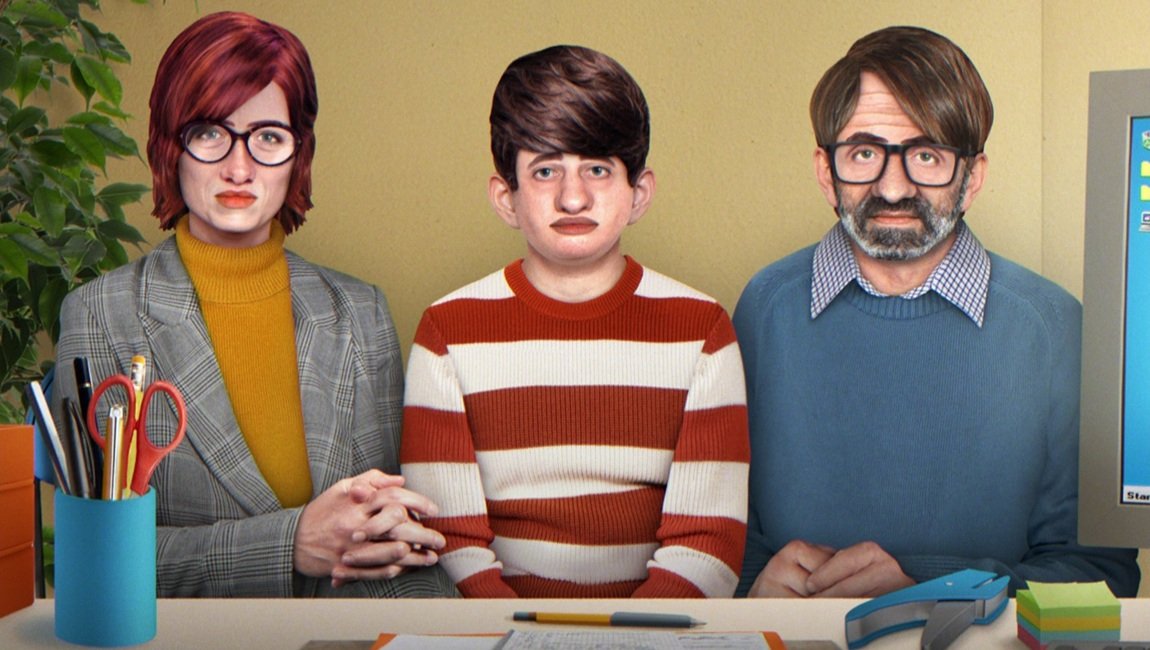
Among civilized Europe, the French as a collective may have a unique predilection for social dysfunction, or at least a unique openness to confronting and memorializing it. Not for nothing did faux pas enter the global lexicon to distinguish maladjusted etiquette from acceptable ones, and it certainly wasn’t English civility or Germanic bluntness that coined Sartre’s famous intersubjective lament: “Hell is other people.” A distinctly Gallic sensibility therefore characterizes the gold standard of modern European neurosis — Freud may have pioneered psychoanalysis, but Lacan lugged it on board the linguistic turn — and courses through Dimitri Planchon and Jean-Paul Guigue’s whimsical animated sketch comedy Blaise. In it, an anodyne family of three go about their un-merry, middle-class ways, mostly looking for some semblance of normalcy and the recognition of this normalcy to boot.
The eponymous Blaise (voiced by Timéo Beasse) is 16 and a sucker for solitude. Slinking into the sidelines and isolated, as his school counselor describes him, the adolescent would much rather serve as a puppet of external agency than assume an active disposition toward wider life. His parents are no less trapped in their own bubbles of solipsistic anxiety: mother Carole (Léa Drucker) fears resentment at the workplace, her tone and words always calibrated off-mark to cause unease or offense, while father Jacques (Jacques Gamblin) plays a hyper-fixated man-child given less to selfish impulse and more to eager-beaver self-pity. The parents don’t exactly commandeer the child around, but neither do they quite provide the much-needed guidance and direction an adolescent in the throes of budding identity crisis would do well to have. Instead, as Blaise is whisked away to parties and such fora of socialization, the film unfurls its loose and acerbically deadpan vignettes across three sinusoidal paths: honest therapy for le père, duplicitous misreadings for la mère, and a potentially revolutionary hotbed for le fils, complete with deceptions of class and intent.
The film’s distinctive 2D cutout look harkens back to its conceptual origins in Planchon’s comic strip in the Fluide Glacial magazine, which was later adapted into a short-lived episodic series. As a slice (or many) of social criticism, Blaise mounts a generally unfocused if charmingly non-sequitur campaign against the lengths people go to for validation. For Carole at her workplace, a fixation with literalness cooks up a chain of absurd misunderstandings and consequences that would make Quentin Dupieux proud; in Jacques’ case, a deep feeling of inadequacy only hardens his self-absorption. Their characters are literally flat, their uncanny gazes brimming with expressions traditionally the province of automata and bolstered by a springy jazz refrain courtesy of Alexis Pecharman and Denis Vautrin. Blaise himself gets talked into sex, and then a tenuous relationship, with Joséphine (Nina Blanc-Francard), the daughter of Carole’s boss and industrialist scion, each unaware of the other’s true status and intentions (and possibly their own). Inflecting these myriad disaffections is the film’s intriguingly matter-of-fact title: does Blaise trace its etymology to Blaise of Sebaste, the patron saint and blesser of throats (and thus language, clarity)? Or are its pleasures lesser, more mundane, and blasé? It’s a polysemy only a tongue from the Fifth Republic can twirl with.
Comments are closed.