
One of the hardest things to pull off in comedy is having characters who are knowingly foolish without also dragging the film around them into abject foolishness. Silliness tends to beget more of the same, and without any sort of constraints to rein in the buffoonery, it doesn’t take much for a film to spin off in a self-perpetuating feedback loop of “stupid is as stupid does.” Margaret Dumont may not be anybody’s favorite part of the Marx Brothers films, but she does serve an essential structural role as an ostensibly normal person who can register shock or confusion at the lunacy swirling around her. No such guardrails exist in David Wain’s Gail Daughtry and the Celebrity Sex Pass, despite theoretically taking place in the real world and being populated with big stars playing exaggerated versions of themselves. There’s no “straight man” in the film, nor any real structure to the film beyond a half-in, half-out homage to a beloved movie musical. And as a director, Wain is less the adult in the room and more one of the inmates who have overtaken the asylum. It’s gas-leak cinema, shotgunning shrug-worthy absurdist gags that are more miss than hit. If you can’t get on the film’s wavelength of non sequiturs and consequence-free behavior, it’s an interminable 93 minutes.
The Gail Daughtry of the film’s title — and we’ll be circling back to the significance of her name momentarily — is played by Zoey Deutch, a gifted comedic actress whose up-for-anything energy is one of the film’s few saving graces. Gail is a chipper hairdresser living in Kansas, engaged to her high school sweetheart, Tom (Michael Cassidy). It’s the sort of idyllic, white picket fence community that seemingly only exists in a studio backlot, where the mailman (played by Fred Melamed, also doing infrequent double-duty as the film’s put-upon narrator) gushes that Gail is “a shining light around these parts.” After some saucy shop talk with her best friend and fellow hairdresser Otto (Miles Gutierrez-Riley) introduces Gail to the “hall pass”-like concept of the film’s title — in short, every person in a committed relationship is theoretically allowed to cheat on their partner provided it’s with their predetermined celebrity crush — she shares the thought exercise with Tom (he volunteers Tilda Swinton as his choice). But poor Tilda never really stood a chance once Gail and Tom attend a local book-signing event featuring Jennifer Aniston. When presented with the once-in-a-lifetime opportunity, Tom switches his pick to the Friends star and — to coin an adage — punches his celebrity crush card with her in the stockroom while an oblivious Gail waits in the parking lot outside. After walking in on them, Gail’s entire sense of self is upended and, desperate for a change of scenery, she flees Kansas, tagging along with Otto to a beauticians conference in the heart of Hollywood.
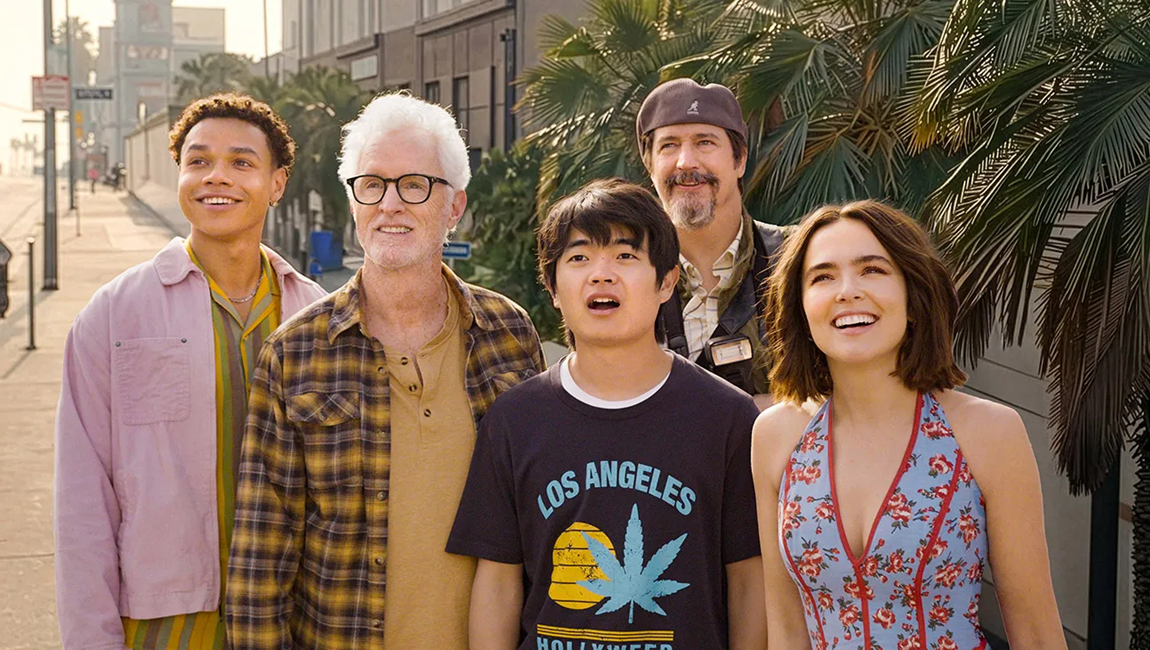
Toting a metal suitcase filled with beauty accessories, Gail and the ever-loyal Otto (has anyone else noticed that “Otto” is an anagram for “Toto”) cross paths with a couple of oafish goons at LAX who, as it happens, are also carrying an identical metal briefcase. After the cases get accidentally switched — you can blame the need to get a selfie with Henry Winkler for the mix-up — the thugs return to their employer, the no-nonsense mafiosa Ludovica (Sabrina Impacciatore, of The White Lotus), with a bunch of curling irons and crimpers rather than a cache of top secret documents. She promptly kills one of them and instructs the one she lets live to scour the city for Gail and the missing briefcase. Meanwhile, the rudderless Gail finally gets a sense of purpose upon visiting a Hollywood Boulevard fortune teller. Gail is told that the only way to restore balance to her life and place her on equal emotional footing with her estranged fiancé is if she sleeps with her celebrity crush, the actor Jon Hamm. And so begins an odyssey across Los Angeles that finds Gail and Otto accumulating hopeless stragglers who also would very much like an audience with one Jonathan Hamm.
There’s aspiring CAA agent Caleb (Ben Wang), who gets himself fired for giving Gail Jon Hamm’s home address; unfortunately for everyone, Jon sold the place years earlier to an assault rifle-packing “Weird Al” Yankovic. Then they bump into down-on-his-luck paparazzo Vincent (Ken Marino, a co-writer of the film along with Wain) who’s been trying to get a candid shot of Hamm for years and has long viewed the actor as his white whale. And finally, there’s the strange case of John Slattery, Hamm’s longtime Mad Men costar, who in the film’s telling has been chewed up and spit out by the industry and now spends his days practicing martial arts in his driveway, harboring resentment that Jon stopped returning his texts. Using their combined knowledge of the entertainment industry (which, it should be said, is practically a negative value), our hapless group of five travelers works their way to the famed Chateau Marmont where a meeting with Hamm awaits — although first they must complete an important mission. And all the while, Ludovica’s henchmen are lurking, willing to kidnap or kill to get the briefcase back.
The legend of David Wain began over 30 years ago when the filmmaker and his sketch comedy pals parlayed the short-lived MTV show You Wrote It, You Watch It into the cult comedy series The State (in addition to Wain and Marino, fellow The State alumni Joe Lo Truglio, Michael Ian Black, Kerri Kenney-Silver, Thomas Lennon, and Kevin Allison all turn up in supporting roles here). Long known as the comedy nerd’s comedy nerd, Wain has a gift for satirizing disreputable genres in order to deconstruct moldy comedy tropes, most successfully with the film Wet Hot American Summer and its myriad streaming spin-offs and sequel, as well as the romantic-comedy skewering They Came Together (and it must be said that even Wain’s attempt at selling out with the studio comedy Role Models is also kind of a scream).
But the big conceptual swing in Gail Daughtry and the Celebrity Sex Pass feels as arbitrary as it is half-assed. That’s because the film is not-so-secretly a send-up of The Wizard of Oz. Obliquely at first and then, possibly out of fear that the audience isn’t getting it, the film starts beating you over the head with its allusions. There’s Kansas resident Gail Daughtry (her name even kind of sounds like a reordered take on Dorothy Gale) and her ruby red Chuck Taylors. Ludovica has a certain Wicked Witch of the West quality to her — although in her defense, Impacciatore cuts a far more stylish figure than her analog. And then there’s Hamm as an all-powerful, god-like figure who is revealed to be something of a charlatan; one of the few jokes the film doesn’t over-explain into the ground is the notion that even a household name like Hamm ultimately wields very little power in the film industry. Some of the parallels are more constructive than others: Tobie Windham nearly steals the film away from his more recognizable co-stars as Hamm’s pedantic assistant who serves as a literal gatekeeper, not unlike the doorman of Oz. But then we’ll get incidents like Hamm making a late appearance in a hot air balloon — which just feels lazy — as well as an animated end credit sequence that draws direct, one-to-one comparisons between The Wizard of Oz and our characters. However, it all falls apart when you realize this is a situation where every character is on the hunt for a missing brain.
Of course, the main difference between Gail Daughtry and the Celebrity Sex Pass and The Wizard of Oz is that the latter is one of the most visually opulent, Technicolor films ever released while the former appears to have been made for roughly the amount of loose change one might find between the couch cushions. Wain has made zero attempt to aestheticize Los Angeles to lend it a surreal, Oz-like quality. Instead, the film — which at times appears to have been shot guerilla-style with a small crew at high-profile locations — looks barren, with external locations lacking extras while sets are consistently under-dressed and unmemorable; the film’s action climax is even staged at an abandoned Old West film set for no good reason. The film’s digital photography, meanwhile, is blown-out and flat, with the visual approach falling somewhere between looking like it was lit by a social media influencer’s ring light and something meant to resemble the Backrooms. It gets to the point that when Elizabeth Banks and Paul Rudd — who not coincidentally played teenage lovers in the aforementioned Wet Hot American Summer — turn up for brief cameos, it becomes an open question as to whether the actors filmed their appearances against a green screen and were haphazardly composited into the film.
Still, much of this would be forgivable if the jokes landed, but instead the entire effort stinks of flop sweat and overly mannered wackiness; the sort of gags that are 100% predicated on the conceit “what if these characters behaved like idiots?” That would certainly explain scenes like the one where Gail, Otto, and Caleb are forced to run around in their underwear after constructing a clothing rope to scale a security fence. Or, for that matter, why an irate Weird Al is firing a machine gun at them (while Penn Jillette looks on silently from a golf cart). When all else fails, Wain simply throws to one of his famous friends to adorn a silly costume or playfully tweak their public image. The film’s plot is needlessly cumbersome — something about a criminal syndicate trying to control the world’s financial systems — and encourages digressions into graphic violence, while Gail’s comedic journey of self-discovery feels ad hoc entirely. There’s no spite or lust in Deutch’s guileless performance, so the idea that she’d be motivated by either karmic retribution or sexual desire never registers as she’s put through the manic comedic paces of the film. Further, the entire Wizard of Oz homage completely falls apart as Gail can literally return home at any time (Dorothy, you’ll recall, didn’t have the option of just hopping a plane back to Kansas). Individual moments draw a stray chuckle — a studious explanation of the difference between “empathize” and “sympathize” is a highlight — but they feel like oases in a desert. The rest of the time one finds themselves wishing this — or they — would simply be whisked away by flying monkeys.
DIRECTOR: David Wain; CAST: Jon Hamm, Zoey Deutch, John Slattery, Ken Marino, Miles Gutierrez-Riley; DISTRIBUTOR: Sony Pictures Classics; IN THEATERS: July 10; RUNTIME: 1 hr. 33 min.
Comments are closed.