
Guy Maddin’s Careful is newly restored and once again bringing its unique, alpine, psycho-sexual mania to cinemagoers, who are perhaps a little better prepared for it than they were upon its initial release in 1992. The visionary Canadian director’s third feature film is an astounding work of playful artifice in which the hallucinatory dreams of cinema’s past become the formal radicalism of the present, damning banal realism to hell with a hearty laugh. While the visual impact of Maddin’s work is always immediate and arresting, Careful is also profoundly literate. Inspired by the German Berg films, perhaps the most famous being Der heilige Berg (1926), Careful tells the story of a mountain town that lives in constant fear of an avalanche. This elementally simple premise is then stuffed to the brim with allusions to 19th-century German texts, rich metaphor, antagonistic moral provocations, sex, violence, and butlers, all expertly sculpted, like one of the film’s papier-mâché mountains, upon a deeply original thematic core.
Ahead of the Los Angeles premiere of Careful‘s new restoration at The Academy Museum, Guy Maddin took time to speak with me via video call about Thomas Mann, Fernando Valenzuela, and why papier-mâché is more fun than AI.
Chris Shields: Can you talk about your involvement in the new restoration of Careful?
Guy Maddin: Back in the day, I insisted these movies be mixed in mono, but that’s a real pain for modern projectionists. So they have to be stereoized. And whoever stereoized Archangel cleaned up all the sound, and I had felt that what held that movie together for me, especially in 1990, was a kind of a delicious obsession with a blanket of optical noise crackle. And the fact that the voices were all disembodied from the speakers, and they seemed to come from a space about a foot in front of their mouths. But whoever worked on it worked very hard, did a great job, but they attached all the words to the lips, cleaned up all the sound. And news of this came to me while I was busy shooting Rumours in Budapest. So this time I insisted on being part of the process, and it went very nicely. I should add that we rectified the sound misunderstanding in the end and got all the crackle put back and the voices disembodied anew!
CS: You have some of that optical crackle in this film as well, here and there, that plays at key moments, like when father and daughter start to play the piano, and it’s just the hiss of the optical track.
GM: Well, I’m a baseball fan, and I feel like I’m an old guy with a sore arm. So I feel that I need every trick pitch that an aging Valenzuela would have had. And so every now and then, there’s not even room tone in Careful. There’s just utter silence. And you can hear the actors’ tongues getting ready to pounce. You can hear them sort of slipping and sliding on the molars, like a seal off a rock. But at other times, all you can hear is this optical crackle. So I throw one in as a change-up for the other. And there’s some other tricks, too.
I just felt that movies had become so standardized, easily by 1992, but more so now. And in the film festival world, there’s some return to blurry and low-res movies, but in the mainstream, no. And I thought, if this is supposedly an art form and in painting you can apply the paint with any size brush or with a stick or with your hand or get a chimp to throw it at the canvas or whatever, you should be allowed to apply sound and color the same way in film.
CS: Even though visually the film is so gorgeous, the script really hit me very hard. I’d like to ask you about the writer George Toles and your relationship.
GM: I came back from Munich, all excited about this genre, the Berg film, Mountain film. I decided I wanted to make a Berg film. George was very excited, and he wanted to make a pro-incest movie. I think he wanted to push back against all these Oscar-bait films like Prince of Tides where, you know, it’s a dead serious subject, incest and child abuse and everything, but he was tired of the Oscar-bait tone of these films. And so we just merged our two manias and made a pro-incest film and set it on a mountain. And making it in the mountain film genre gave us the freedom that Howard Hawks and John Ford and Budd Boetticher often spoke about concerning Westerns, that so few things happen that it’s actually liberating to make a Western. It seems like a paradox, but you aren’t obliged to find something to replace a gunfight or a cattle stampede or a shootout or a love triangle. There’s only so many things that can happen on a mountain. I decided to make a mountain film without ever having seen one, but I figured people could climb up a mountain and they could either climb down or fall down or jump down from the mountain. There’d be a love triangle, and instead of a cattle stampede, there’d be an avalanche.
George, he’s got a real ear for that great dialogue that sounds like it was translated from a 19th-century German text. He speaks that way for crying out loud. He speaks like an English translation of a 19th-century German text. Anyway, he just started writing, and I remember feeling that he was just heading in all sorts of wild directions. I couldn’t keep up with him. We were supposedly writing partners, but he was just writing, writing, writing, reading these scenes to me. The only contribution I really made was writing some of the overture, the narration about the town in which the story was set. And George started explaining this world of mountains, and I guess he, like me, lived his whole life in a perfectly flat place. And he was scared of slopes and stairs and things like that. And in justifying the use of all these plots, he just used the word “careful” to describe someone’s steps or someone’s romantic approach. And I thought, that’s it. Let’s make a movie in which we have our pro-incest, our mountain, but let’s make everyone really cautious. And that motivated every decision after that. I really appreciate the script more than ever now. I originally had a co-screenwriting credit on the film, but in this restoration, I righted a long-standing wrong by giving George the sole screenplay credit on it.
Back in 1992, I wished that it ended all in one climax, the way Billy Wilder ends Ace in the Hole. Like everything comes to a head and Kirk Douglas falls toward the camera dead and the end goes up on the screen. And I wanted one of those, but it just wasn’t one of those movies. It’s sort of a mountain-shaped movie, and it ends in a series of smaller climaxes and foothills.
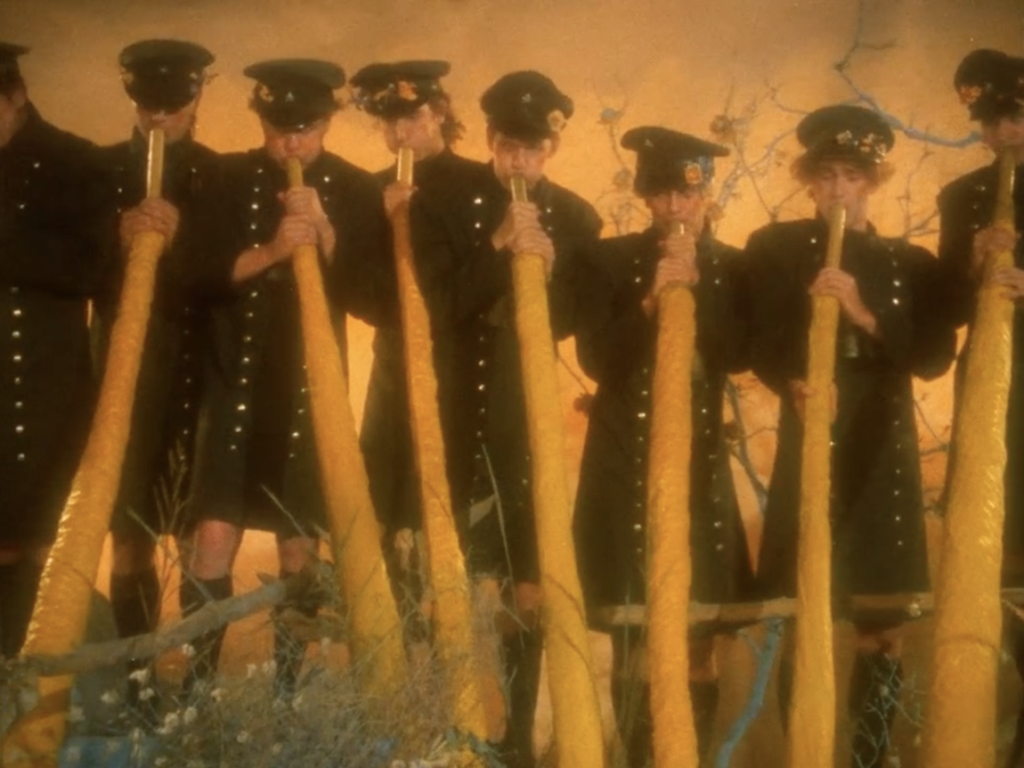
CS: That structure actually really struck me, that kind of ending where we see the quiet after the avalanche, kind of this emotional devastation. I love the mountain as metaphor and then you also have this German, Austrian psychosexual dimension as well, a la Thomas Mann. But I want to ask you more about this idea of “careful.” That really struck me. I think the film is thematically unique to many films that I’ve seen, in that it’s a film about this brutal lesson to children and people to stay small. I’ve never really seen it so well expressed.
GM: You make a very good observation that no one ever made 34 years ago. The idea of staying small, George and I were both obsessed with the Swiss writer Robert Walser, who’s obsessed with staying small. He wrote Jakob Von Gunten, which the brothers Quay adapted. And it inspired us, too. So the Quay brothers and I got to know each other, having made two movies about Butler schools. But the idea of staying small and being as quiet as a mouse and just keeping in your corner is something that obsesses Robert Walser. And he wrote his books and stories in a microscript because he wanted to stay small. And for many decades, people thought it was a code, but it was just small writing. And then he just checked himself into a mental institution halfway through his life and never wrote again.
You also observed that something in it reminded you of Thomas Mann. Now, I’m sure you might have been thinking of The Magic Mountain, but in reality both George and I were obsessed with Thomas Mann’s The Holy Sininner. You know, the guy who accidentally sleeps with his mother and then becomes Pope. It’s crazy, that guy’s as funny a writer as there is, you know, right up there with Nabokov. Nabokov hated him, perhaps because of the narcissism of marginal differences. I was under the influence of other Germanic writers, of Rilke’s prose. I just read lots of German literature and translation around this time. And so I had the right size gesture for things in my mind already when it came time to directing.
We didn’t improvise at all on the set, really, maybe a tiny bit, very tiny, but George’s dialogue cannot be said naturally. I think his dialogue, which is really rich and beautiful, does unite actors of very widely varying abilities into the same movie. And the lines of dialogue are just as stylized and artificial as the papier-mâché mountains — and just as beautiful and sometimes just as trashy. There’s a nice trash-to-beauty range in it that I’m always going for. I don’t think there’s anything stupid about Careful, but it’s definitely got a wide high-to-low brow range.
A lot of people watching it just walked out back in 1992. It’s nice to see people come pre-warned now that it’s a Guy Maddin movie. Walkouts are negligible now, but boy, my movies really had, you know, 50 to 85% walkout rates, those first three movies of mine. But I always knew that my style would have a lot of margin for error. If certain effects came off poorly, I knew that my style would just insist on my mistakes belonging right along in the same world as my accomplishments. So I’m very pleased with the job George did. And I’m very pleased with the acting that Kyle McCulloch and Brent Neale did as the two brothers. And Sarah Neville.
CS: The brothers are fantastic, especially Johann and the mania in his eyes. Silent cinema is able to express more intense emotions, including that kind of intense mania. It’s always been notable to me, like, how did they do that? And in this film, made in 1992, you’re able to accomplish that as well, particularly with Brent Neale.
GM: I didn’t start watching silent films until I was making movies. And then I realized that if I’m making movies with very little dialogue, in black-and-white that look a bit expressionist, maybe I’ll start watching expressionist and silent films. And I quickly found I was comfortable in that world because silent film is one giant step in the direction toward fairy tale or opera libretto. They’re larger gestures, and they’re more emotional. The emotions are more uninhibited. And with more naturalistic movies that have talking, everyone wants realism. I remember reading a contemporaneous review of Thomas Edison’s The Kiss. It’s the guy with a big wax mustache kissing a woman on the cheek. And people were praising that movie for its realism. And it’s still two dimensions and shot in the Black Maria. Just a black backdrop. Nothing really realistic about it. Anyway, realism is a pointless word. I’m comfortable just approaching movies more or less as fairy tales. I approach, I enter the subject or the texts through the big door marked fairy tale, and once I get inside, I start figuring out what it is instead of just a fairy tale. I’m a Buñuelian from way back. I often think of just how true dreams are; no matter how crazy and surreal they are, they’re produced by something that’s real inside of us. If you can find the right surrealist gesture that feels psychologically honest, that feels good, too.
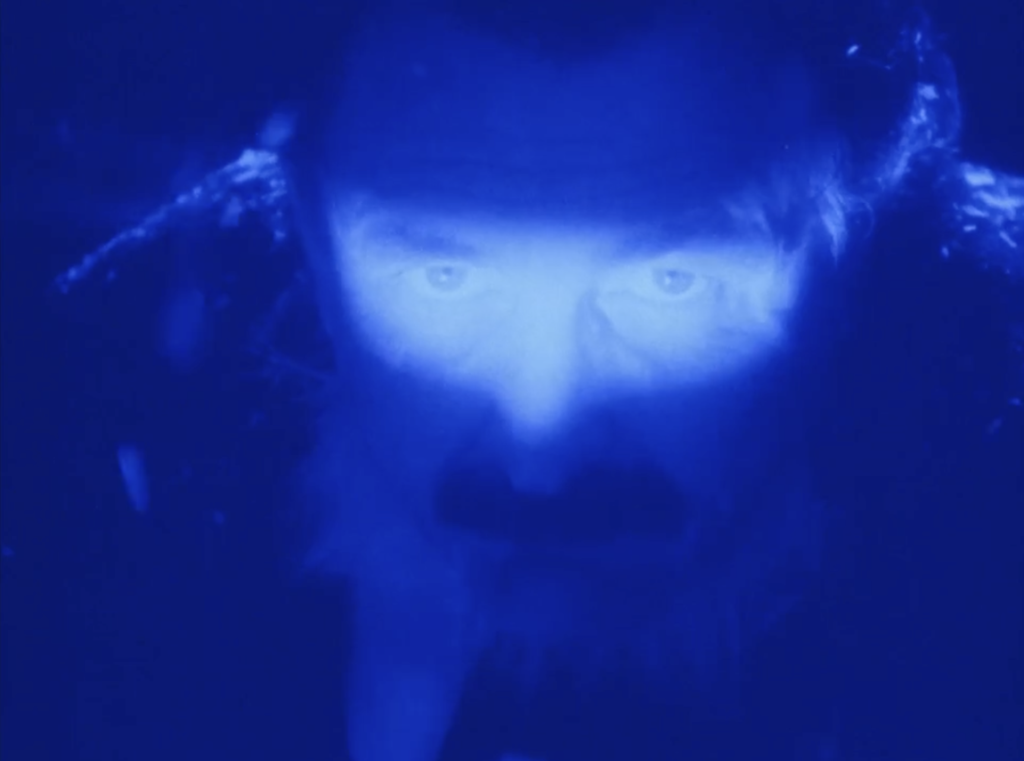
CS: Speaking of the dream aspect of the film, the cutting of the mother’s bodice with sheers or fixing the face of the corpse are truly nightmare scenarios.
GM: George Toles played the corpse. When he got dressed in drag to play Paul Cox’s mother, he just looked like his own mother, who I knew very well. And all of a sudden, it was just like seeing Mrs. Toles lying in the coffin.
CS: You said something I think about a lot: your style and the way you approach things, it leaves room for your mistakes. I guess my question is about where pragmatism meets creativity. With visionary work like yours, people don’t realize that the makers are also quite pragmatic.
GM: I feel that the script and the pragmatism intersected all the way. It doesn’t just intersect on a point. It’s like the whole running time of the movie was just the intersection between what I wanted to make and pragmatism. And they were the same thing. It was so easy. The movie was so doable. Yeah, I had lots of people helping me to make it doable, but we were all assured, it all seemed doable. Sometimes the solutions my art department came up with were better than I was willing to settle for. But other than that, it was well within the range of possibility. I think when you get alienated from your movies, it’s when you lose touch with what’s doable. Everything is doable now if you have enough money, you know, CGI or AI or whatever, but who cares? That’s no fun. Already in 1991, Canadians tended to be trying to make naturalistic, realistic contemporary movies. And if they made period films, they were trying to make them realistic, if that word has any meaning at all. I was just interested in the story and whatever psychological honesty could be concealed within the story, and that never had anything to do with realism. So it was just a matter of just turning the studio, which was like a big truck garage and grain silo combined, some noisy toxic mess, turning it into a big playground, and it really was fun to just walk around. All the sets were in one big room, and it was kind of amazing to just feel like everything was practical and doable, but strange that no one had ever bothered to do it. Or if they did, it was way back in the early days of Hollywood, but no one during my lifetime had done it ever, and that felt good. It made me feel special.
CS: You were the production designer as well. How early does that start, and does that stop at a certain point once you start directing?
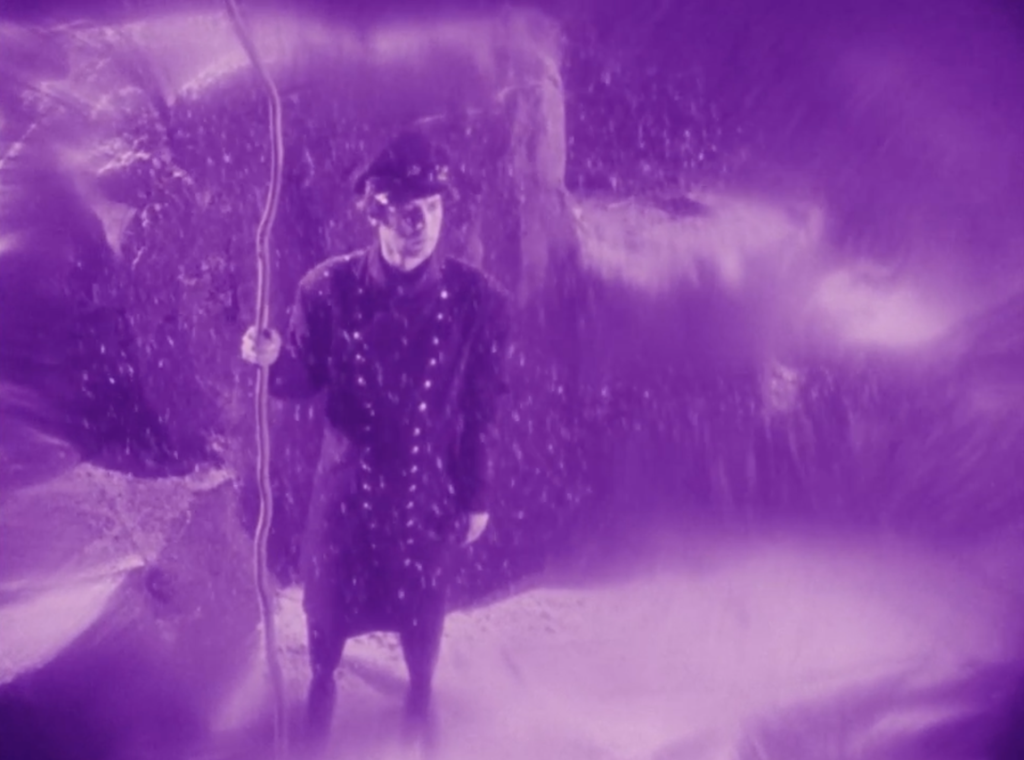
GM: There were people contributing ideas along the way. But I remember sort of the overall design of the film; I just kind of had it in mind while prepping George’s script. I didn’t know how to design a mountain. So someone suggested getting plasticine and putting the features you needed from the mountain. I needed a little cliff that Johann could jump from. I needed a path that Clara and Griggors could meet on, and we needed to make that walkable. All these papier-mâché mountains, they’re not walkable; you have to build them like octuply reinforced two-by-fours in an otherwise chicken wire and papier-mâché world. It was a matter of making the mountains the way we liked them with a 14-foot maximum altitude. And then having the features we needed to give the variety to the script. There were no blueprints for such a thing.
I’ve always liked stalactites and stalagmites and made sure the caves had those. You know, not all caves have those, but nothing reads cave like a stalactite, so they went in there. It’s just a gesture. It’s a trope, you know, but they look good. They also close the frame in. The cave’s sort of more womb-like. Joseph von Sternberg is a real visual inspiration for me. His frames are almost always closed. He almost never just has an open sky above the actors. There’s always something closing in. And I just realized the more I closed the frame with stuff, stalactites or plant life or window frames or whatever, the more womb-like every shot would be.
CS: Now that the restoration is complete and the film is going to be out there, what do you hope people experience with it now?
GM: I don’t know. I just hope they come out and see it, and the film is remembered for a few more years. It had really slipped into near oblivion, I felt. I’ve always wanted people to come away from it going, why would anyone make that? And thank God they did.
Comments are closed.