
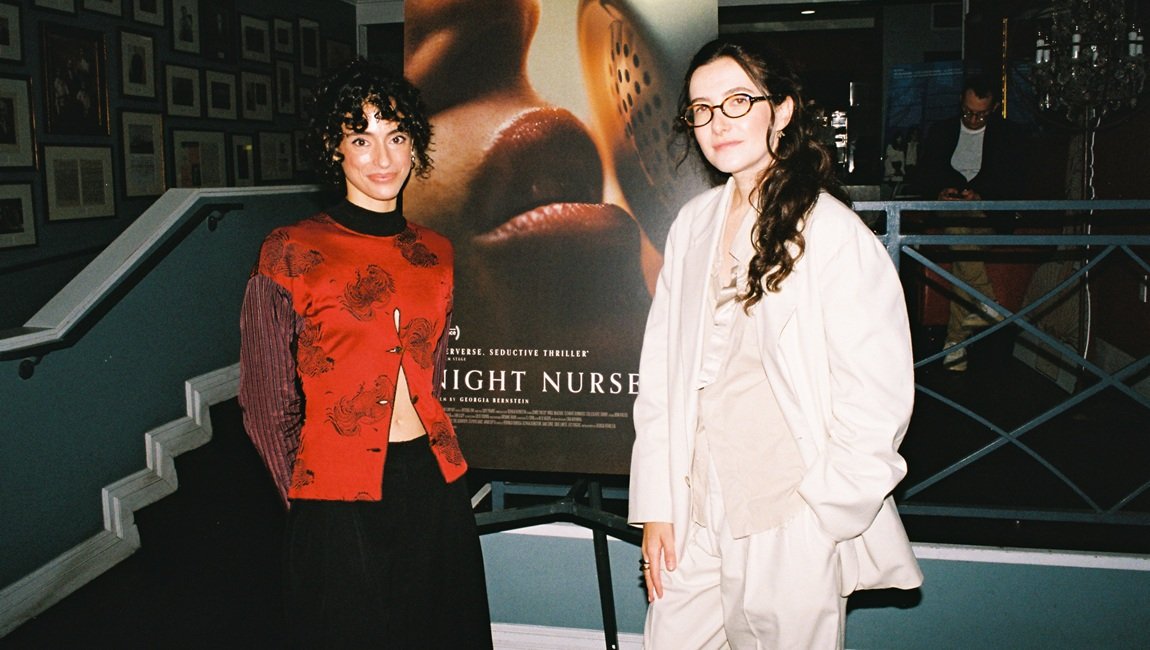
It’s been five years since RS Benedict’s essay “Everyone Is Beautiful and No One Is Horny” was published by Blood Knife. While Benedict focused on action films in particular and their lack of sensuality and sex, the essay has stuck with me as a diagnosis of American cinema at large. In the years since, independent cinema has worked to dispel that criticism. The work of Isabel Sandoval comes to mind, while a pair of 2025 festival titles that received U.S. releases this year — Fucktoys and Anything That Moves — are all about pleasure and its ups and downs. It’s rare, though, to see something swirling in sensuality yet never allowing us nudity or a sex scene whatsoever. It’s one of the many reasons Georgia Bernstein’s Night Nurse caught me so off guard.
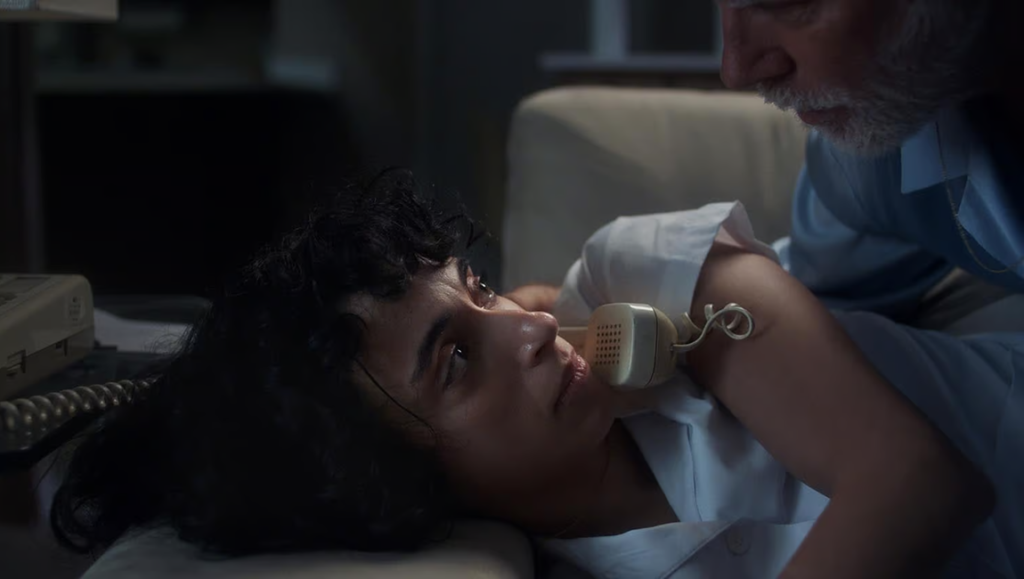
Eleni (Cemre Paksoy) is a new nurse at a community for the elderly, predominantly those with dementia. Assigned to Douglas, a beguiling yet strange older man (Bruce McKenzie), she finds herself wrapped up in a phone scam he’s been running with another nurse (Eléonore Hendricks). The scam, convincing the elderly men in the neighborhood to send money to their granddaughter in need of legal help, begins to net them large sums of cash. As their scam goes deeper, an erotic undercurrent bubbles beneath. There’s never anything explicitly sexual about their relationship, and their pleasure is instead found in the thrill of the call. Phone cords wrap around bodies, the breathing intensifies, and Eleni becomes intoxicated. With Douglas, the scam, or her newfound purpose, it’s hard to say, but the further it goes, the deeper she digs in.
What’s so fascinating about Night Nurse is that its sensuality comes in the desire to be needed. Eleni needs to care for someone and to be given meaning. Douglas needs to feel young again by caring for the younger nurses. Even in their scam, the pair fulfill their victims’ want to be needed as well. There’s a tender love expressed to the elderly in a strange, delirious way. They’ve been shoved off into this home, left to be cared for by a stranger, and in these moments of being scammed, they’re also given purpose. Even if it’s fiction, for one moment they’re needed again. Bernstein’s depiction of sensuality is one born out of loneliness. Eleni, Douglas, and the victims are all lost people, and acts of service are their pleasure. Drawing from shades of Breillat, Cronenberg, and Verhoeven, Bernstein finds a lane all her own, creating a seductive tone rarely seen in cinema. Alongside her, Cemre Paksoy brings Eleni to life as a quiet, observant presence. Her large eyes scan her surroundings as she hides behind walls and crawls into frame — equally of-its-own-wavelength performance that serves Bernstein’s vision beautifully.
As Night Nurse hits theaters, I sat down with Bernstein and Paksoy to discuss the film, sensuality, being present on screen, Lucrecia Martel, and so much more.
Brandon Streussnig: The approach to sensuality here is so fascinating. There’s no nudity, no real sex scene, yet it’s sexier than most movies being made right now.
Georgia Bernstein: Cemre and I talk about this a lot. We’re both very interested in how you make an erotic thriller today. I think we both feel strongly that in our culture, where everything is permissible, the contemporary erotic thriller should look more like In the Mood for Love than Basic Instinct. Of course, Verhoeven is king, but I think we’re both interested in this idea of an erotic thriller that’s full of restraint and withholding, and that there’s desire in something unresolved, and that real eroticism is killed with consummation.
Cemre Paksoy: I also think, more practically, some of that was the camera. Some of that, when you are blocking us and giving us notes and communicating the tone and the ethos of the film, this pacing just came about, which is slow and delicate. Even movements like bathing someone. That’s the one that comes to my mind. You made us do that at such a pace that I think really added to that sensuality. Everything in the movie was approached with that very specific pacing that I do think was sensual. We weren’t doing anything sexual, but we were doing it in such a way that perhaps made it sensual.
GB: Bonnie and Clyde is one of the inspirations for the film. I love a doomed love story, and in Bonnie and Clyde, obviously, he’s impotent. Because they can’t have sex, they rob banks, and that’s how they get their kicks. I wanted to do something similar with this. Douglas is impotent; they can’t have sex, so their equivalent of robbing banks is scamming the neighbors.
BS: There’s a real care that each person takes of one another, even if the situation is outside the realm of what we perceive as a traditional relationship.
GB: When I was writing the script, I was reading this screenwriting book. I’m going to paraphrase it incorrectly, but it said that basically, every character should have the same desire. I don’t know if this is good advice or not, but it worked really well for Night Nurse because I felt like every character in the film should desire to care, and that fundamental desire permeates the film and defines the world itself. It makes the whole movie feel very dreamlike.
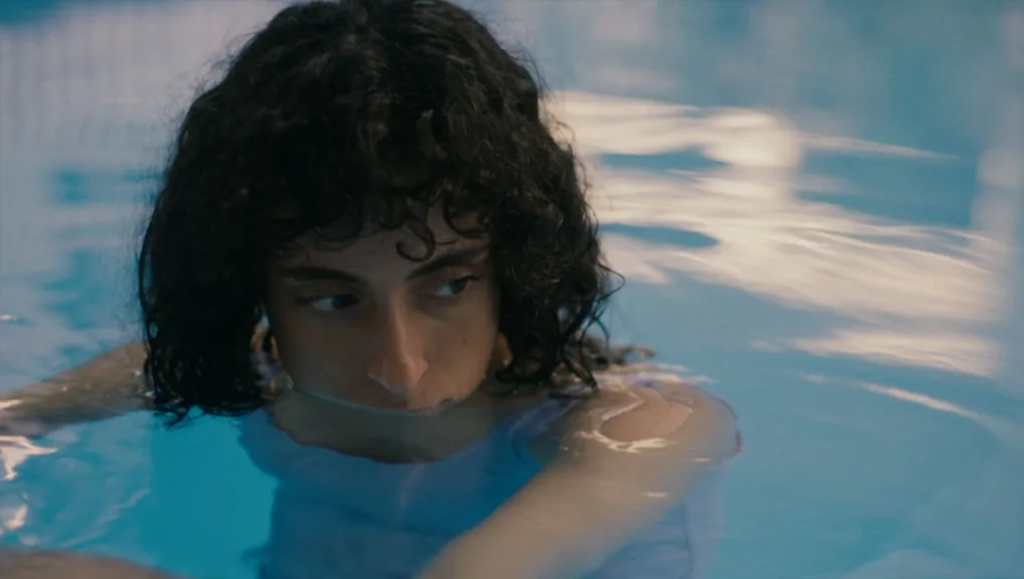
BS: Cemre, your performance is so childlike in some ways and animalistic in others. You’re always hiding behind something and observing. What went into crafting this performance?
CP: Hiding behind stuff was really fun. That, for me, was kind of like a game because I think Georgia and our DP Lydia had a really cohesive aesthetic. Sometimes, in terms of the hiding or the shapes I could make behind objects, and how I get in and out of that, it was almost like I was just trying to make them happy, or surprise them, or something. I liked approaching it physically like that, especially when you don’t have that many lines in those moments where you’re watching. Getting in and out of hiding became the way I entered those scenes emotionally.
The emotions that she’s dealing with are quite primal. Like, desire and desperation. That lends to something. It could be interpreted as perhaps a little, maybe, unpleasant or debasing, or it could just be that it’s really relatable and human. It was the latter for me. I tried to lean into that and just bring physicality through that.
BS: Was this always written for Cemre? I know you both have been collaborators for a while now.
GB: Yeah, I wrote this film for Cem. She and I met in college. We met on the very first day of school, and we were in the same acting class at Northwestern. The school tries to make the acting program like a conservatory, so we were in the same acting class for three years. During that time, we really developed a shared language around performance and also around tone. Then we made this web series in college and turned it into a short film. I think at that time it was really about learning how much we loved making stuff, and I think we both loved literally putting it together, and doing it really small, and actually making it.
Then Cemre went back to Turkey because her student visa expired. I was in Chicago producing really super-microbudget features, and I was developing this project, and I just couldn’t think of anyone else I would want to make this movie with. Because it’s my first feature, I really wanted to put together a group of people that I thought would be there no matter what. Cem definitely is that for me.
BS: I imagine there’s a shorthand you develop over time. I mean, this movie is very funny in addition to being sexy and sensual. How do you communicate tone to each other?
CP: Sometimes we wouldn’t speak. I remember after takes, Georgia would be walking up to me, and I would see her coming, and I’d go, “Yes, I know, I know, I know.” Then she would nod and walk back.
GB: We joked that we had a telepathic communication style, but I think it really came from a shared sense of references and taste. I think we love the same movies. I had Cemre watch a couple of movies, and then she brought a couple of movies into our inspiration bucket.
CP: Georgia’s vision was so clear that it took a lot of guesswork out of it, which I think is a real blessing. Because that’s actually when you get to be really free and experiment, since you’re not guessing what the scene is supposed to look like. Then, I think that, with that shared understanding, she would sometimes make jokes that only made sense to me, but they translated into the performance.
GB: I just think that because there’s so much trust between us and so much shared life, I definitely felt like I could give Cem a note or say something I know she’ll understand. Even if I don’t say it perfectly, I know she knows what I’m thinking because we have this rapport.
Because I wrote it for Cem, I always wrote it with her voice in my head. I would bring the script to her, and I would say, “Tell me, are there any lines that don’t feel like you could say them, or that feel awkward or weird or whatever? Let’s really put this in your voice.” Cem is the kind of performer who’s like, “I’ll say anything.” She will make anything work, and she really can.
I mean, take a look at her. She’s got these big, beautiful, expressive eyes. People comment a lot on her performance being so primal, a word I love that Cem used, because we have a backstory for her character that we didn’t spell out. There were very specific lines that I was going to put in and then didn’t, because I really wanted the audience to be able to project onto her. I feel like that is what it feels like to fall into a bad relationship, or fall into a cult-like situation. I wanted her to almost feel like a vessel for ideas and influences. I think Cem’s wide-eyed performance, if you will, was the perfect vessel.
BS: That actually leads directly into a thought I had while watching: It’s so hard to be an active listener on screen. So few can do it. I’m sure the eyes help with that, but Cemre, what goes into actually being present on screen?
CP: Oh, interesting. I’ve been asked a few times about the difference between having a certain number of lines or not having a certain number of lines in a scene, or not in a scene. I think this process confirmed for me that, in terms of acting, it doesn’t matter whether you are saying a line or not. It’s hard for me to answer because, to me, it feels so instinctual.
I’m glad I’m able to do that or that that came across. I don’t know if there are any rules to acting, but it sounds like if there were, that would be one, if not the one. Just being present. I really like acting. Weirdly, something about the camera is not distracting to me. It makes me less self-conscious and more present. So much of the movie and so much of acting is about subtext, which makes the lines almost irrelevant.
BS: Georgia, you mentioned Verhoeven. I’ve seen you talk about Breillat and Cronenberg in other interviews. I’m less interested in influence and more in how you develop your own tone and wavelength. It’s so impressive to see something that’s so clearly of a piece with those influences but still gives you that “I’ve never seen anything like this” feeling.
GB: It’s instinctual, but there’s also so much thought that goes into it. I spent many years filling up my sack, as I used to call it. The tone for Night Nurse, I think, really stemmed out of place. I wrote the film to be shot in my grandmother’s real house. So, there were a ton of practical decisions that went into everything. The script was perfectly written for this specific house. Then this house is in this neighborhood in Northbrook, Illinois, which is outside of Chicago. It has an interesting feeling to it of suburban alienation. All the houses look exactly the same. It’s home to many retirees. My grandma moved into this house in the ’70s.
All the decor was ’70s. So, there’s fully wallpapered walls with matching beds. Then, over time, she gets a flat-screen TV and then a last-gen landline. I was interested in this feeling that there was no specific time period in this area and in this specific house. So, I was trying to emulate that in the film, like we don’t know where we are in time. I tried very hard not to have smartphones or to not show a ton of contemporary cars, but sometimes you see one, and I do think it’s disarming to see. To suddenly be like, “Wait, what time period are we in?” I wanted that feeling of being unmoored.
So I think some of the tone came from that. Then, even though we’re a low-budget film, I wanted it to feel big, and I didn’t feel like shooting handheld would serve the story. I felt like it needed something heavy and weighted, which is why we shot almost the whole film on a dolly. There was a lot of talk about, “Should we film on Steadicam? That’s cheaper. The house is pretty small. It would be easier to get through.” But I just feel like Steadicam is so light, and I really wanted the feeling of a dolly that’s hunkered down and moving very slowly on a specific plane. We were lucky that we got one, and then that it fit literally so perfectly in the house. Literally in between doorways, it was just the perfect size. So all of those things contributed to the tone, the feeling of the movie.
Then all the references that, I think, maybe I guess you’ve read or that I’ve been saying, like Cronenberg, Crash, of course, and Exotica, and Catherine Breillat. I pull from references. I love Cassavetes. When I was writing Douglas, I was like, “It’s a guy like Cassavetes.” What if he were the sexiest man alive? Then we have this party scene that was heavily influenced by Faces. My DP and I watched a lot of Lucrecia Martel, which was when we came up with the idea of the desire angle, and most of the film is first-person from Cemre’s perspective or from Cemre’s character’s perspective. This idea of seeing just the back of the neck, or the top of the ear, or someone through a doorway, and peeking and peering and spying, that was influenced by Holy Girl. I just pull specific things from different influences. When you mush them altogether with a real place and a different story, it just comes out different.
BS: It’s so interesting you mention Martel because I just rewatched The Headless Woman and…
CP: I just watched it too! Unbelievable. Best film I’ve ever seen. It also ties into what you were saying about active listening and being present. They’re asking her if she wants some tea. Then you look at her, and you’re like, “Whoa, so much is going on.” But she’s like, “No, I don’t want tea right now.” What a great example of that on display.
GB: I was re-watching Headless Woman right before we picture-locked, and I went into a full crisis where I was like, “It’s just not Headless Woman. I don’t know.”
BS: I don’t know, you should just lean into it. Cemre has that great head of curly hair. You can always just recreate that iconic poster with her.
CP: I’m going to take that poster to the hairdresser.
GB: We need to recreate every iconic poster where there’s one woman on the cover.
BS: Well, at risk of turning this into hair chat, I do want to ask. Maybe it’s silly, but what…
GB: I thought you were going to ask, “This is maybe a silly question, but what’s your curl routine?”
BS: Well, ok, that too, because I’m forever in search of something that doesn’t turn my curly hair frizzy. [Laughs]
CP: I’ll send you a list of products. [Laughs]
BS: No, but the scam in the film. Is that a real scam that you found out in the world?
GB: The scam in the movie is one that almost happened to my grandmother in real life, but not erotic. So the scam that happened, or that nearly happened to my grandma, was someone calling her pretending to be my brother, and he said he had been in a horrible car accident, that he needed help, he needed money, and convinced her that she should go to the bank and wire the money. So she goes to the bank, and the tellers told her that it was a scam.
This was many, many years ago, and it just stuck with me because I thought that it was such a performative crime. I thought I should use Crash as an influence and eroticize these scams, basically, that’s the long and short of it.
BS: Have you tried it on anyone yet?
GB: No, but truly, every call I have with anyone involved in this project starts with us going, “Grandpa?” And that is fully how I answer the phone most of the time. [Laughs]
Comments are closed.