
Through a career of empathetic, patient character studies, Japanese master Hirokazu Kore-eda has developed many running fascinations. Gaps in families, how we fill those, and manipulation of memory have all filtered in and out of his work. His latest, Sheep in the Box, takes a little bit of everything: After Life’s concerns with memory, Shoplifter’s found families, the complicated fathers of Nobody Knows, and even a little bit of the artificial becoming reality of Air Doll. The catch here is that Kore-eda is swimming in the murky waters of AI. An existential threat that is increasingly permeating every aspect of our life, Kore-eda approaches the subject with his trademark sensitivity. An interesting route to take, he doesn’t so much ask us to live with it as he shows what living with it actually means.
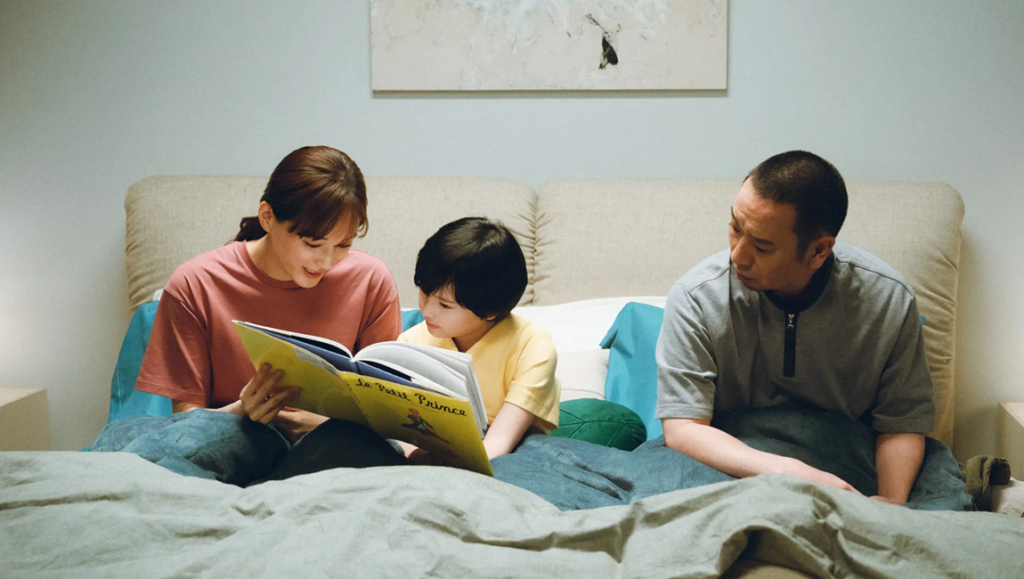
Centered on a mother and father (Haruka Ayase and Daigo Yamamoto) who have recently lost their child, the couple enters a program to bring him back to life via a robot child. The “child”, Kakeru, looks exactly like their lost son but is essentially an infant in conception. Having no understanding of the world around him, it’s up to his parents to ease him into the world. His mother is eager, almost too eager, to accept him as being their actual son, no questions asked. The father is hesitant, almost resentful, asserting to the child that he isn’t actually his father. These are, of course, the polarities to living with AI in this moment, at least according to Kore-eda. Immediate acceptance versus immediate dismissal, with the question of how this dynamic affects the larger relationship lingering above.
What stands out most in this portrait of artificial living is Rimu Kuwaki as the child. Kore-eda has always been a tremendous director of children, and it’s no different here. A first-time actor, he plays Kakeru with an uncanny innocence. If anything sells the looming specter of AI and all its worrisome tendrils, it’s this performance. This isn’t to say he’s creepy or frightening, but that he nails the idea that Kakeru isn’t quite real while still so clearly being a child. It’s strong work in a film seeking to observe rather than change minds.
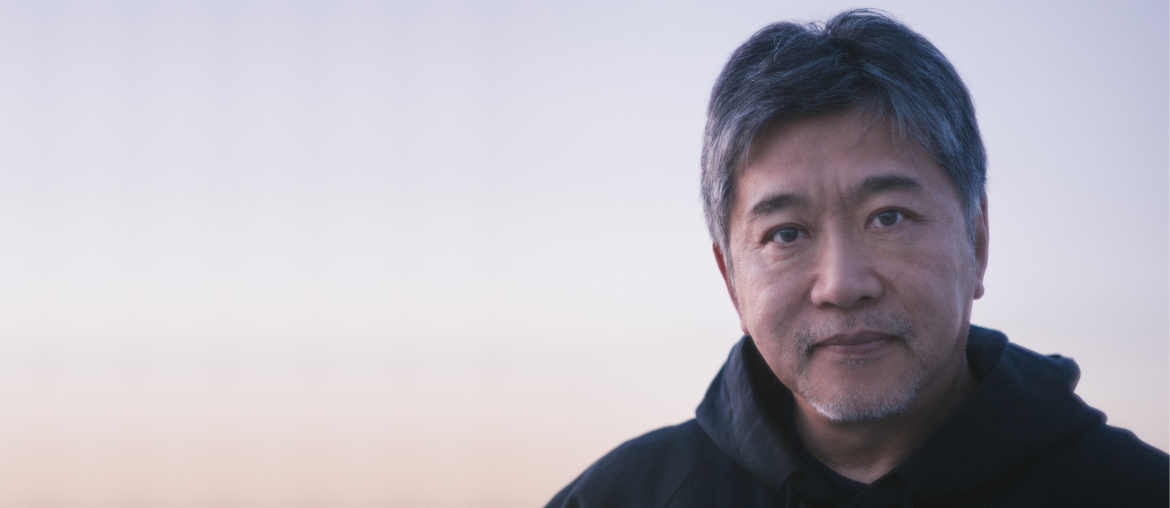
Ahead of Sheep in the Box’s theatrical release, I sat down with Kore-eda to discuss casting Kakeru, passing the baton in his films and his life, and how his work taught him how to forgive his father.
(Thanks to Monika Uchiyama for translating.)
Brandon Streussnig: You’ve been outspoken about your aversion to AI and about your fears of its encroachment in film. It’s interesting because this film deals with AI in a much more hands-off, almost empathetic approach, particularly in how you depict Kakeru, the child. How did you rationalize those two sides of your brain when making Sheep in the Box?
Hirokazu Kore-eda: It wasn’t really about balancing those two elements. I try to see or recognize that there are two sides or multiple sides to anything, whether it’s a human, an event, or even technology itself. I think that technology also needs to be looked at as being multifaceted. So that issue itself is made into a material form through the presence of the boy. The boy who’s introduced into the family causes a kind of conflict. There are many different sides to both positive and negative aspects of the boy’s relationship to the family. Then there’s also positive and negative results that happen in the relationship between the husband and the wife. I think that instead of trying to strike a balance, it’s really a building up of all of those small differences that end up creating a story. So for me, it’s really about carefully inspecting what kind of conflicts emerge from these types of situations.
BS: Speaking of the boy, Rimu Kuwaki is excellent as Kakeru. It’s such a challenging role because you have to play the initial cold, robotic nature and the progression into his humanity. How did you cast him?
HK: I cast him in a typical audition process just like in my other films. It wasn’t as if I had looking out for a boy that would be able to play a robot at the top of mind. [Laughs]
One thing that is true is that kids of that age, boys of that age, particularly, can’t stand still. They just can’t sit still. Oftentimes they can’t even sit properly in the chair at all. They want to lean back and sink into their chair. So I was really observing the physicality of the kids that auditioned, and I would also play games with them. I would have them walk around, and if I clapped, they had to stop and stand very still, or maybe I’d turn off a light, and they would have to go to sleep.
Throughout the audition process, I tried to incorporate these games that would be fun for them and see which boys really responded to them. Rimu really enjoyed these activities. I’d also say he has a particular face that suited the role. I haven’t really said this to many people, but when you’re casting for a very human presence, it’s often nice to have a face that’s very asymmetrical and has these kinds of flaws that make a person human. With this one, I was paying attention to things like his teeth, just having very straight teeth because if you have teeth that are a little crooked, then your eyes go to the teeth and that immediately makes it hard to sell this idea that he’s a humanoid robot.
BS: His integration into the family is what’s most of a piece with the rest of your work. You often deal in loss within families, and then how those families repair themselves either by blood or otherwise. What keeps bringing you back to this?
HK: When I was young, I didn’t understand this, but as I grew older in my 40s and my 50s, I realized that there’s this expectation that families are connected by blood. But when you think about it, the moment when every member of a family is actually alive and together is just a blip in one’s lifetime. There’s always someone missing in the family, and then somehow they’re replaced with another presence. So someone else fills that missing spot. For instance, when my father passed away soon after I became a father, there’s this process of almost like a relay where you’re passing on the baton, and the vessel for that activity is the family. It really isn’t until you lose a member of the family that you suddenly become aware of their presence to begin with. When they’re still around, you’re not that aware.
It’s that repeated process of loss and passing on the baton that really is the process of life. That’s something I know definitively now that I’m in my 60s, as I grow closer to being the one who is lost. That’s kind of the reality of how we live our lives.
BS: This baton passing — was this an impetus behind forming your own filmmaking collective (Bunbuku Inc.) and mentoring younger filmmakers?
HK: That’s interesting that you say that. Do you mean that when I die, I’ll be able to pass on the baton? [Laughs]
I don’t think it’s as convenient as that, but with the next generation, there was about a 20-year period where I would go to these international film festivals and just wonder what’s going on? What’s happening with Japan and the film industry that we really couldn’t see an emerging next generation following my own? As a film worker myself, I really notice how bad the situation is. It’s also my responsibility to try to do something to improve it. That’s for the sake of not just the Japanese industry, but also the film industry overall and for myself. Because when there are young, exciting filmmakers, they stimulate me and I also learn a lot from them. So it’s important for me to try to nurture the next generation for that reason.
BS: Something that’s really been on my mind lately is cinema as memory. There have been a ton of great films recently exploring this. You’ve built a throughline from After Life to Sheep in the Box that explores how our memories can be manipulated. We’re talking about you growing older. As you have, do the images you’ve created start to replace or merge with your own memories?
HK: It’s not that my memories are overwritten, but certainly I’ve modeled certain characters or overlapped characters with the idea of a father figure or a mother figure to create these characters that in turn become a kind of memorialization. I’m borrowing the format of fiction to memorialize these figures, like my parents. It’s a way to try to understand them once more, but also to create some kind of objectivity and objective distance. I think that those images that I’ve created in that process have fed back into my memories of my parents. That wasn’t intentional, but that has happened. In particular, I’ve experienced that with my father. I think I’ve also been able to accomplish that kind of forgiveness toward him through the process of depicting father figures.
Comments are closed.