
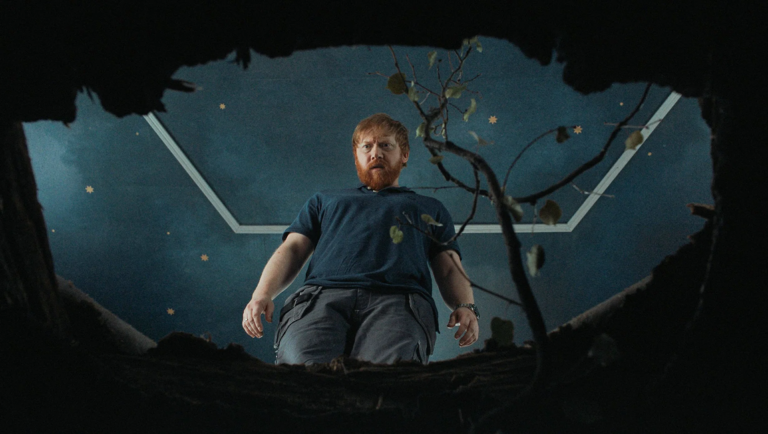
Hanna Bergholm’s second feature has had two lives. At its world premiere in the Berlinale competition, Nightborn was generally considered a low point in an already underwhelming lineup. As far as hybrids between arthouse and genre cinema go, the Finnish director seemed tonally undecided, visibly wrestling with a stiff screenplay and stiffer performances. Five months later, however, it took the Cheval Noir for Best Film at Montreal’s Fantasia International Film Festival, with lead Seidi Haarla also awarded for her performance. That it fares so much better with a genre crowd indicates the film’s potential to have its cake and eat it too. Bergholm’s sophomore feature, however, straddles the line between these tonal extremes so awkwardly that it generates tension out of neither — let alone any tension at all.
As a follow-up to her much sharper Hatching (2022), Nightborn strains the body-horror-as-psychological-metaphor approach that carried Titane (Julia Ducournau, 2021) and The Substance (Coralie Fargeat, 2024) into the ranks of contemporary classics. It’s an even more overt genre take on the maternal anguish that recently shaped Mary Bronstein’s If I Had Legs I’d Kick You (2025) and Lynne Ramsay’s Die My Love (2025), while naturally harkening back to the demonic urtext of Polanski’s Rosemary’s Baby (1968). But if anything, Nightborn mostly brings to mind Nightbitch (Marielle Heller, 2024), an Amy Adams curio in which a mom finds postnatal relief among a pack of dogs.
What exhausts those tropes here is the film’s literalness — as if subtext really is for cowards. Saga (Haarla) and her British husband Jon (Rupert Grint) move into the spacious but timeworn country house, deep in a Finnish forest, where she spent much of her childhood. Seemingly enchanted by the ancient spirits circling the place, Saga abruptly decides she wants a family. The arrival of the baby is, unsurprisingly, anything but a blessing. With every beat of the plot foreshadowed by typically unsettling horror effects — think angular sound design, micro jump scares, whispers from the woods, and gnarled trees that seem to trap human faces — the only real suspense is whether the newborn can live up to its spooky hype.
And Kuura’s arrival certainly comes with a healthy dose of the uncanny. The growling baby is so unusual that he is initially kept from family members, much as the audience is denied a clear look at him for most of the film’s running time. What we do see is its almost furlike hair, tiny claws for fingernails, and an unchild-like appetite for bloody red meat. Much of the actual horror in Nightborn stems from Saga’s subsequent psychological torment, as she endures nursing her ferocious newborn that leaves her bruised, bitten, bleeding, and mentally depleted. All the while, she is gaslit into normalcy by her reluctantly optimistic partner and her stifling family. Bergholm clearly makes the point that recent motherhood can be horrific and painful, that it requires taxing bodily labor rarely acknowledged by others. A noble theme, albeit one delivered by making the horror all too literal. There is little dramatic space for Haarla to express genuine isolating dread, and no one interesting enough around her to amplify it. The film simply relies on playbook horror tricks to carry its central metaphor of motherhood-can-be-hell over the finish line.
While composer Eicca Toppinen (of Apocalyptica fame) sustains the spooky vibes with his jarring score, Bergholm’s formal register doesn’t suit the tiny monster now running amok through the family home. At some point, the always amiable Grint seems more at a loss with the film itself than with the family as it’s almost literally torn to shreds by Kuura. And how can he not be, when every interesting detail Bergholm has woven into her script immediately slides to the background again? Notions of witchcraft, ancient forest spirits, and trolls are either just alluded to or handled so matter-of-factly that none of the spiritual density that makes folk horror so captivating manages to find fertile ground here. Amidst that absence, Bergholm finds no solid ground of any kind.
DIRECTOR: Hanna Bergholm; CAST: Rupert Grint, Seidi Haarla, Pamela Tola, Pirkko Saisio, Rebecca Lacey; DISTRIBUTOR: Shudder; STREAMING: July 31; RUNTIME: 1 hr. 32 min.
Originally published as part of Fantasia Fest 2026 — Dispatch 1.
Comments are closed.