
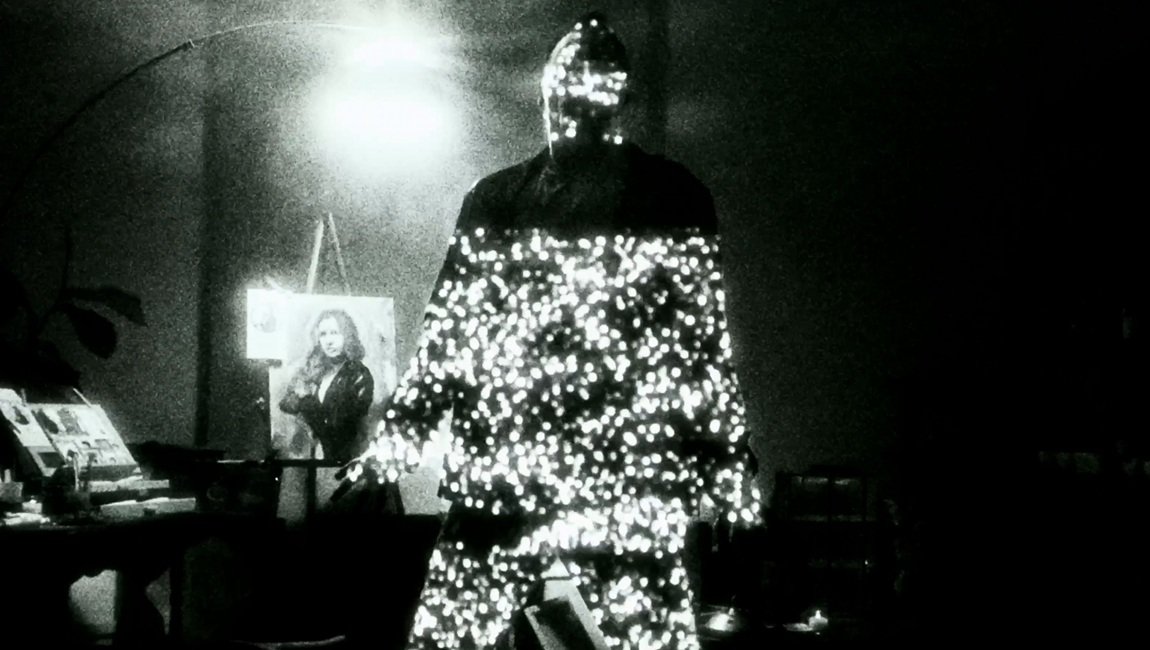
The following statement about Alan Resnick’s first feature, Dance Freak, can easily be misconstrued as a fault on the film, an accusation of artistic counterfeit. For one, the very mention of something reminding one of David Lynch’s body of work is automatically cause for alarm, that the subject of this comparison is derivative in some way. Yet with Resnick’s latest, somehow, this comparison and many others only serve to bolster his already distinct style of absurdist comedy. The statement in question: Dance Freak evokes the visual syntax of everything from Twin Peaks: The Return (2017), to Inland Empire (2006), to Tetsuo: The Iron Man (1989), to 964 Pinocchio (1991), to Maya Deren’s oeuvre and various motifs from silent-era cinema. This is a compliment above all else, as Resnick leverages such muscular inspiration, turning what could have been just a feature-length Adult Swim-style bit into an arresting piece of multimedia art. This statement is, also, an insult upon this particular critic who generally tries to avoid the cardinal sin of film criticism: collating a bunch of comparisons. So much for that goal.
The “plot” of Dance Freak is more of a vibe than a linear set of beats. It involves a man named Obie (Robby Rackleff) who stumbles through an economically depressed, industrial coastal town, all shot in strikingly visceral, monochromatic black-and-white photography. He works a dead-end office job that, for the sake of guesstimating, might as well be life insurance, and has a wife (although she insists she’s not) named Dorty (Megan Koester) who is running for a nondescript government office on a campaign to “give a new coat of paint” to the town they call home. Along the way, Obie runs into increasingly surreal and hysterical encounters with a cast of notable actors, among them Stavros Halkias, Sarah Sherman, and Conner O’Malley. Many of them, acting as a testament to Dorty’s campaign, use hyperbolically violent, profane language about their town and each other, including a running gag with other men pointing out Obie’s inability to take care of Dorty, that she deserves better. And Obie is always right there while they say it to her.
Clearly, something is not right, and to top it all off, there is a “Dance Freak” who looks eerily similar to Obie running amok and killing people in shockingly creative ways. He is dressed like a 1950s greaser — something similar to Elvis, if his gyrating caused people’s skin to grotesquely scrunch inward like a balloon instead of inciting moral panic. These slasher moments are among the film’s greatest strengths, showcasing Resnick and team’s use of multimedia. Sometimes, they employ animations or stop-motion projections of animals and insects which coexist in different styles and even frame rates alongside the usual action or human movement already present. At other times, they apply exaggerated filters to characters’ expressions, like one that Grumpy Cat-ifies Obie’s face and another that renders a woman’s eyes scarily wide and bulbous. The Dance Freak himself makes appearances as uncannily frightening as the feverish Locomotion scene from Inland Empire, with Lynchian use of strobe effects, isolating spotlights among void-like darkness in the frame’s periphery, and dizzying camerawork that seems to break through to other dimensions or visual planes while thrashing about.
Dance Freak makes perfect sense (meaning none at all) as a longform evolution of the artist responsible for viral experiments like Unedited Footage of a Bear (2014) and This House Has People in It (2016). Whereas those shorts played with the grammar of found footage, home video, and infomercials, gradually using them to surreal, disarming, and sometimes downright horrifying effect, Resnick’s feature-length endeavor deals in the aesthetics of the experimental art film, the slapstick silent film, underground punk videography, and more. Inserting his erratic brand of humor into these styles and remixing it all even further from there, he gives us a film that lives up to its title and transcends mimicry. In fact, let’s cut this review short so as not to explain or analyze away its many surprises. Instead, let’s look to an instructive quote from Obie’s “computer mail” that we catch glimpses of him composing early on: “piss, piss, piss. i dont need water anymore. gurl i am going to bring a gun into the office and watch it kill stuff. DIE!”
Published as part of Fantasia Fest 2026 — Dispatch 1.
Comments are closed.