
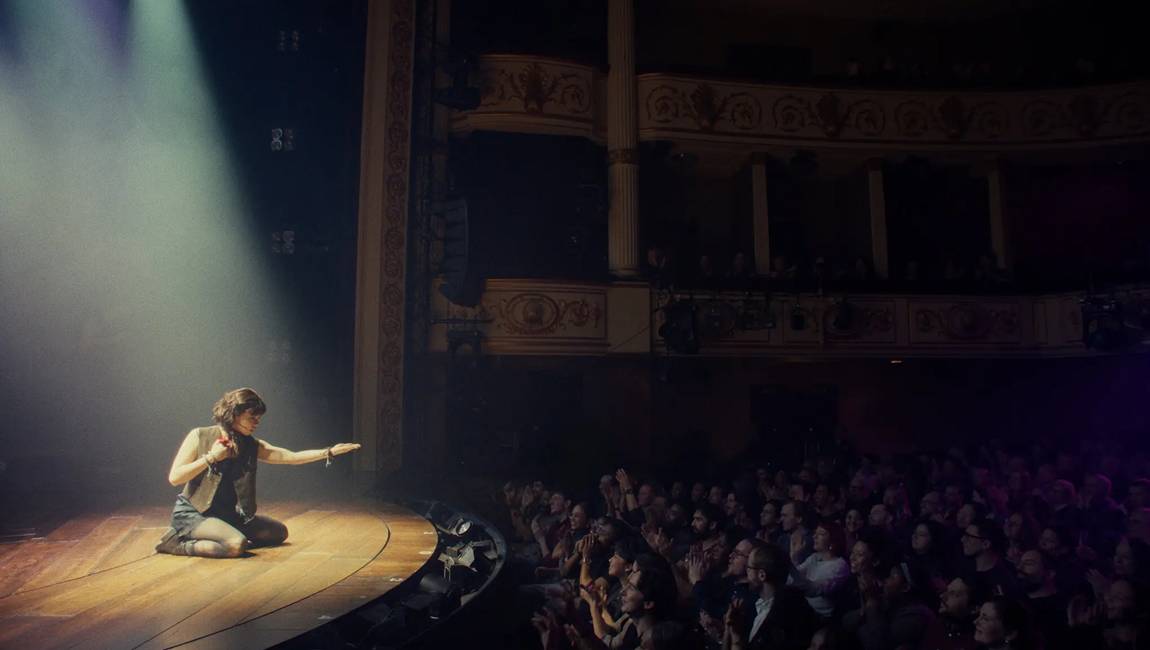
If you have ever had a chance to see Hadestown live, you won’t wonder at its success, running on Broadway for seven years now despite a financially unstable industry, with news of Cats: The Jellicle Ball’s closure coming quickly on the heels of three Tony Awards and nine nominations. Hadestown — itself a winner of eight Tony Awards, including Best Musical — is a reworked retelling of two Greek myths in parallel: the budding relationship between Orpheus and Eurydice and the decaying marriage of Hades and Persephone. Originally conceived by singer-songwriter Anaïs Mitchell, the almost entirely sung-through book leans heavily on jazz influences and complex harmonies. The story exists in an alternate universe of Gods and Men in a setting resembling Depression-era America, cut through with the apocalyptic tones of present-day climate change (Persephone affects the balance of the seasons, after all). But what really makes the musical sing are the production elements and choreography under Rachel Chavkin’s direction. It’s an exhilarating piece whose gradual descent into the tragic and epic nature of the original myths is truly an experiential treat.
But this is not a review of the stage musical Hadestown. 20 years after Mitchell first performed a version of the show throughout Vermont and Massachusetts, the now-massive hit is debuting its pro-shot — prized tapings of fully staged productions, once rare, now in routine production, especially since Hamilton convinced a quarantined audience to subscribe to Disney+ in 2020. Though the pro-shot was recorded in early 2025, it features five key original cast members, with the West End cast making up the remainder of the ensemble. Director Brett Sullivan is a veteran of these pro-shots, directing and producing several filmed productions in addition to stage promos and music videos for more than a decade.
Sullivan, for all intents and purposes, then knows what he’s doing. He’s done this a dozen or so times before, and through his company STEAM Motion and Sound will hold a substantial monopoly on producing these tapings for a bit. But that mechanical, workflow-focused level of output is exactly the problem. The first act here particularly suffers from frenetic shot selection and editing that prevents the audience from taking in the full scale of the production. Though one hesitates to publicly write too fondly of Hamilton, one of the successes of its pro-shot is how the camera effortlessly fits into the show’s choreography. That is not the case in Hadestown: The Musical, and the effect is almost as disorienting as an MCU fight scene.
One of the strongest arguments for pro-shots is accessibility. Theatre tickets — especially for big-production musicals — have gotten to be prohibitively expensive, and good luck if you’re even able to make the trek to Broadway or a limited-run tour stop. For the curious, Hadestown is certainly worth your time in any form. It’s a romantic musical — without a hint of irony — about trust vs. self-doubt, the things that can and can’t be changed (and the wisdom of knowing the difference), and how women fall into the shadow of men seeking greatness. It is unfortunate, though, that the filmed version is uninterested in filming techniques best suited to the show. The musical is treated like a concert film, complete with shots of the audience enjoying themselves and cuts to the percussionist shredding the drums in the middle of a fight sequence. There is no dedication to giving the audience the full experience they might have access to should they see the show in person.
A key example is when we arrive at the Act 1 number “Wait For Me,” the sequence where the world of men gives way to the underworld. Live, this piece is choreographed with stark lighting that cuts through darkness, the proscenium completely invisible as the walls of Hadestown crack open. The film foregoes capturing the lighting design and often opts to keep us in close-up on Orpheus. This is not a scene about Orpheus’ performance (and if you’re like this writer, lead actor Reeve Carney may be your least favorite performance in the show), but about the overwhelming magnitude of following the road to Hell. It’s one of the most impressive set pieces you could find on a contemporary stage, and very little of that live magic makes it into the film.
That’s not to say it’s all bad. Act 2 jibes more with the performance-focused approach as there are more solo pieces benefited by claustrophobic close-ups — especially numbers from Eva Noblezada as Eurydice and Amber Gray as Persephone, who both earn every second we get to see them at work. André De Shields as Hermes, who is frequently pushed off to the edge of the frame in the first half, is also given more command in the latter part of the film. Patrick Page even plays for the camera at one point, making subtle facial expressions that could only be captured in this context and which elevate his performance. So while there’s no doubt that Hadestown’s pro-shot gets the job done, it’s worth asking if we deserve better than the minimum. At the very least, Chavkin and her creative team do.
DIRECTOR: Brett Sullivan; CAST: Reeve Carney, Eva Noblezada, André De Shields, Amber Gray, Patrick Page; DISTRIBUTOR: Crosswalk/LD Entertainment; IN THEATERS: July 24; RUNTIME: 2 hr. 21 min.
Comments are closed.