
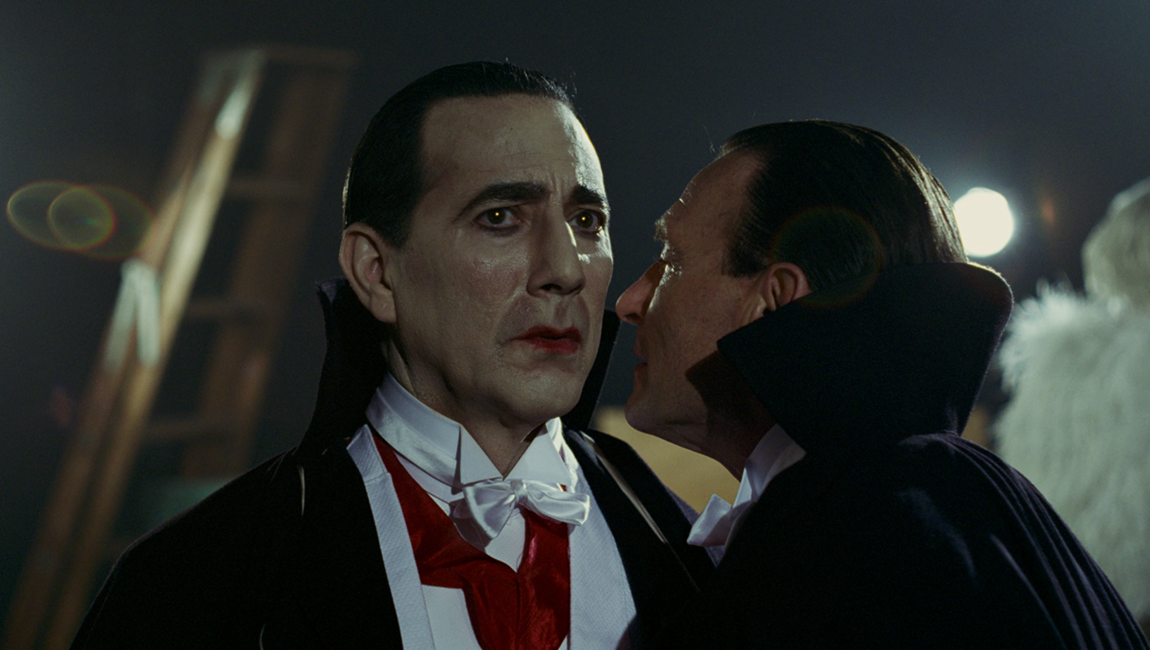
In Los Vampires, director Craig Mitchell draws on the parallel production of Universal’s two 1931 Dracula films, then gradually lets that industrial history go magnificently to hell. Luis De Ossario (Henry Ian Cusick), a Spanish actor watching his career recede, has been hired to play the Count for a company working overnight on sets occupied by an English production during the day. What begins as a funny drama about prestige and professional panic inches toward suspense before surrendering to gothic delirium. The night shift first describes De Ossario’s subordinate place within Hollywood; soon, however, it governs his failing sense of time and his inability to tell where performance ends. In this way, Mitchell’s limited resources become an advantage: the soundstage closes around the actors until cinema itself seems vampiric, promising De Ossario the immortality his industry has denied him while calmly naming the price.
Universal’s early-sound production practices supply Mitchell with an uncanny premise. Tod Browning’s English-language Dracula was filmed by day, with Bela Lugosi as its star; George Melford’s Spanish-language Drácula used the same sets at night, with Carlos Villarías and Lupita Tovar leading another cast. These multiple-language versions briefly answered the problem posed by synchronized sound before dubbing prevailed. Mitchell retains the arrangement but replaces its participants with fictional counterparts. De Ossario and Kürt Orlov (Thomas Kretschmann), the Lugosi surrogate working days, embody an industrial disparity without presenting their hostility as historical record. The studio admits the foreign actor on compromised terms: he must work while Hollywood sleeps and suppress his interpretation to imitate Orlov.
All of this would remain dry film history cleverness without Cusick, who makes De Ossario’s humiliation wonderfully combustible. He carries himself like a man whose pride is all that remains liquid; debt and diminishing prospects have otherwise left him stuck. Copying another actor confirms that the studio values his fluency more than his art. Cusick keeps the resentment active even in De Ossario’s comic indignation, his accent lending the character authority without advertising strenuous period work. Kretschmann answers him with a colder vanity. Orlov knows that a rival using the same costume, gestures, and scenery might expose how little of a star image belongs exclusively to its star. Their encounters move through threats and reluctant admiration. Competition over Bianca (Daniela Couso), a novice actress brought from a Mexican convent, gives the jealousy an erotic outlet, although possession of the role remains the deeper contest.
Once the two Draculas begin circling each other, their quarrel spreads into the geography of the studio. Mitchell and cinematographer Simon Coull reserve black-and-white for the Dracula footage being produced, while the surrounding world remains in color. Monochrome initially belongs to the finished image, color to the labor outside it; the longer the shoot continues, the less useful the boundary becomes. De Ossario and his colleagues sleep on the soundstage, sometimes inside coffins used as props. It is a terrific joke and the cleanest image of their predicament. Ricardo Jattan’s production design uses repeated corridors, crypts, dressing rooms, and artificial partitions to make a modest space feel mentally expansive.
The closer De Ossario gets to Bianca, the less stable that geography becomes. When he searches for her, the camera follows her face and body without establishing the path leading to either. Handkerchiefs, veils, and thin hanging layers interrupt sight without concealing her. Red light floods her rooms and the routes toward them, offering a warning De Ossario declines to understand. It returns after the death of the nun assigned to accompany Bianca, as though her final restraint has been removed. Couso’s composure lets the camera’s instability gather around her. Suspense comes from watching De Ossario invent rational explanations for what the image has already revealed. He thinks Bianca has disappeared into her role, while remaining oblivious to the same process within himself.
De Ossario loses time as readily as he loses his way. Evan Millard’s editing places us inside that confusion. Several transitions fade to black with the finality of television act breaks, one place where the construction feels cheaper than the ideas. More effective are ellipses that swallow days. De Ossario loses a tooth and begins taking honey supplied by the nun as a botanical analgesic, later learning that it behaves more like potent wine. Sleep deprivation and intoxication make time unreliable. Cuts deposit him after intervals he cannot account for, and the audience receives no steadier position from which to reconstruct them. Missing time can conceal anything a mystery wishes to postpone, but here the convenience grows from De Ossario’s bodily condition and becomes a persuasive subjective form.
Before the plot fully commits to horror, a low bass note with heavy vibrato begins disturbing its comic rhythm. Josh Mancell’s score gives the sound a physical wobble rather than an orchestral sting, as though the studio were vibrating beneath the dialogue. Comedy remains present in bruised egos and absurd labor conditions, but the music slowly withdraws its protection. Oscar Nuñez, as Gaspar Lazano, brings an unavoidable residue of affection from The Office, and thankfully Mitchell does not exploit that familiarity as a gag; Nuñez is simply a reliable, welcome presence within the company.
By then, the corpses outside the studio, their blood drained, can no longer be dismissed as an unrelated mystery. Bianca’s origin, on the other hand, makes that exponentially harder. The nun invokes a modified version of the Mexica Cihuateteo tradition, turning death in childbirth into a vampiric lineage. Once the nun is gone, Bianca no longer respects the partitions around her. Neither does the film, and its backstage drama begins obeying the vampire story being shot.
Mitchell is at his best once rational explanation stops providing De Ossario with shelter. His fear of being forgotten and his fury at imitating Orlov become parts of the same temptation. Vampirism offers him the chance to surpass the English Dracula and remain fused with the role. Remaining human means keeping his soul while accepting that cinema may file him away as a relic. Cusick makes De Ossario embrace the offer with palpable terror and an appetite he can no longer conceal, and the decision frightens because he genuinely wants it. With Los Vampires, Mitchell has delviered a hugely entertaining film about an actor who confuses artistic freedom with becoming inseparable from an image.
Published as part of Fantasia Fest 2026 — Dispatch 1.
Comments are closed.