
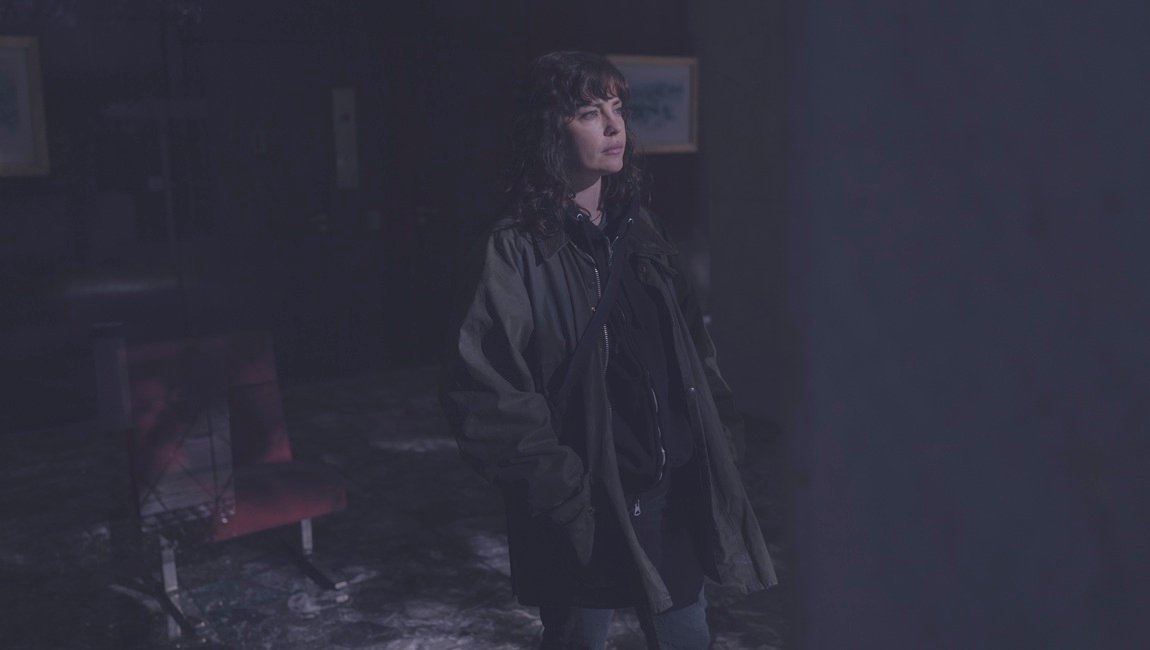
In My Sad Dead’s picture of Buenos Aires, death is everywhere. That’s especially so for Emma (Mercedes Morán), a recently retired gastroenterologist with the gift (or, more accurately, burden) of communication with the dead. Emma’s mediumship is absent the elegiac reverence of the Netflix limited series’ obvious touchstone, The Sixth Sense; instead, she endures the last moments of the deceased’s life in Vine-short loops, the streets of her Buenos Aires a chamber of cyclical cries, gunshots, and slumped bodies.
Emma has wielded her ability since birth, but the most indelible death in her orbit — My Sad Dead’s first and most affecting shot — is that of her mother, Suzana (Luz Jiménez). Emma holds Suzana’s hand as she chokes out her last breath and closes her eyelids once the breathing stops. Then, as director Pablo Larraín’s camera descends from the ceiling, Suzana’s face blurs, fades, her eyes shoot open. It’s the picture of Emma’s mother that will stay with her as long as she’s alive.
It’s bleak stuff, especially for audiences most familiar with Pablo Larraín through his Western work. With Jackie, Spencer, and Maria, Larraín won a comfy space on the mantle of American viewers and regional critics by documenting the Fabergé tragedies of gilded women. But the Chilean director’s Spanish-language films reveal a greater tolerance for the political and the severe. El Conde dips its toes into horror across dictator Augusto Pinochet’s gothic legacy; Post Mortem sharpens its tooth for the macabre via the coup of President Salvador Allende. Still, My Sad Dead stands superlatively morbid within Larraín’s work, its politics smoldering with contemporary ire.
Emma is approaching her golden years, and while she’d encountered the waking dead her whole life, she’d long believed she was the only member of her family with the ability. That is, until, the arrival of her niece, Julie (Carolina Sánchez Álvarez). Julie is a sweet (if not afflicted) woman who’s brought from Oregon to Buenos Aires by her mother and father (Alejandra Flechner and Carlos Portaluppi) to be placed in a psychiatric facility after a life of mental health struggles. Like so much of My Sad Dead’s politics, Julie’s care falls under the shadow of America’s behemothian disaster. It’s cheaper and more sustainable to enter Julie into a facility in Argentina, her parents argue; there are also fewer questions asked. By the time Julie is finally admitted, her death note is practically inked.
There’s a bizarre air of cruelty that haunts Julie’s character, both within My Sad Dead’s world and from its own perspective. So much is made of Julie’s weight. Álvarez is a plus-size model and influencer, and her inclusion here comes with the care and intention of a marginalized performer seasoned by the limelight; still, her execution is botched at the proportion of The Whale. Julie is inexplicably costumed in an ill-fitting Joe Namath jersey; she’s announced with a dour musical sting so unintentionally comedic it might as well have been Beethoven’s fifth. She was incessantly bullied in her youth by peers, abuse that extended into adulthood via her parents’ perpetual scrutiny. Julie is handled with an ugliness that fits well within My Sad Dead’s M.O. Curiously, she’s the only player within the series that seems to bear the brunt of the series’ malice.
For all her intertextual blunder, though, Julie finds a kindred spirit in Emma, an affection that only deepens when Emma learns Julie can see her mother’s ghost, too. As you might expect, 60+ years of enduring the final screams of a city full of ghosts has run Emma ragged. She’s confessed her clairvoyance to a few close family members — her sister, Lidia (Flechner), her daughter, Caro (Dolores Fonzi) — only to have been met with rebuke. You care more for the dead than you do the living, they accuse her. They may have a point. There’s an immediacy to the problem of a screaming ghost, a fire to put out that makes the trifles of a disgruntled sister or truant daughter seem petty. Emma works with everything she has to quiet the dead and guide them off to the beyond, and she’s left with little more to give to her family and community, so close to that threshold themselves.
But the morbid cloud that follows Julie presents a special case, an interest that multiplies when she politely greets Suzana’s ghost moaning in the corner of a kitchen. In My Sad Dead’s first episode, the reveal of Julie’s second sight endears her to Emma as a kindred spirit, one she endeavors to protect from a negligent facility. It proves to be a lost cause: Julie is admitted and subsequently escapes, only to drown herself in the water tower in the town’s central square. We watch as her flesh peels from her body and into the town’s drinking water, spreading the curse of the dead along with it.
Julie’s dispersal as macabre sacrament serves as My Sad Dead’s inciting incident, one that settles the limited series into the now-familiar groove of streaming prestige. With over a decade of television production under his belt, this is hardly Larraín’s first foray into episodic narratives — though Netflix scales its audience and production to new heights. There’s also auteurist precedent for notable directors in limited series. The most notable example is likely Ingmar Bergman’s Scenes from a Marriage, but My Sad Dead aligns more closely to HBO’s 2021 adaptation. Larraín’s series proves vulnerable to modern streaming’s infamous pitfalls. The grain and flare of works like Spencer are smoothed into a homogenous sepia; its wilder edges — the perverse violence of Emma’s cyclical dead, the mirror of American politics a down-and-out Argentinian project finds itself performing — are dulled by the repetition demanded by a major streaming series.
There are moments in which My Sad Dead lifts itself from its own bingeable malaise. The most notable is likely the vicious murder of three preteen girls from within the project. It’s shot with the sort of unrelenting momentum that made City of God a touchstone of adolescent reinvention, and Emma’s subsequent duties — to quiet the screams within a community of newly clairvoyant ears — is the series’ most effective dip into the metaphysical, a firm thesis on the spirituality that radiates from dire straits. Even at its most politically and doctrinally solvent, though, My Sad Dead too often spins slow loops in the wake of its own contractual necessities.
DIRECTOR: Pablo Larraín; CAST: Mercedes Morán, Dolores Fonzi, Alejandra Flechner, Carolina Sánchez Álvarez, Carlos Portaluppi; DISTRIBUTOR: Netflix; STREAMING: September 24; RUNTIME: 3 hr. 21 min.
Comments are closed.