
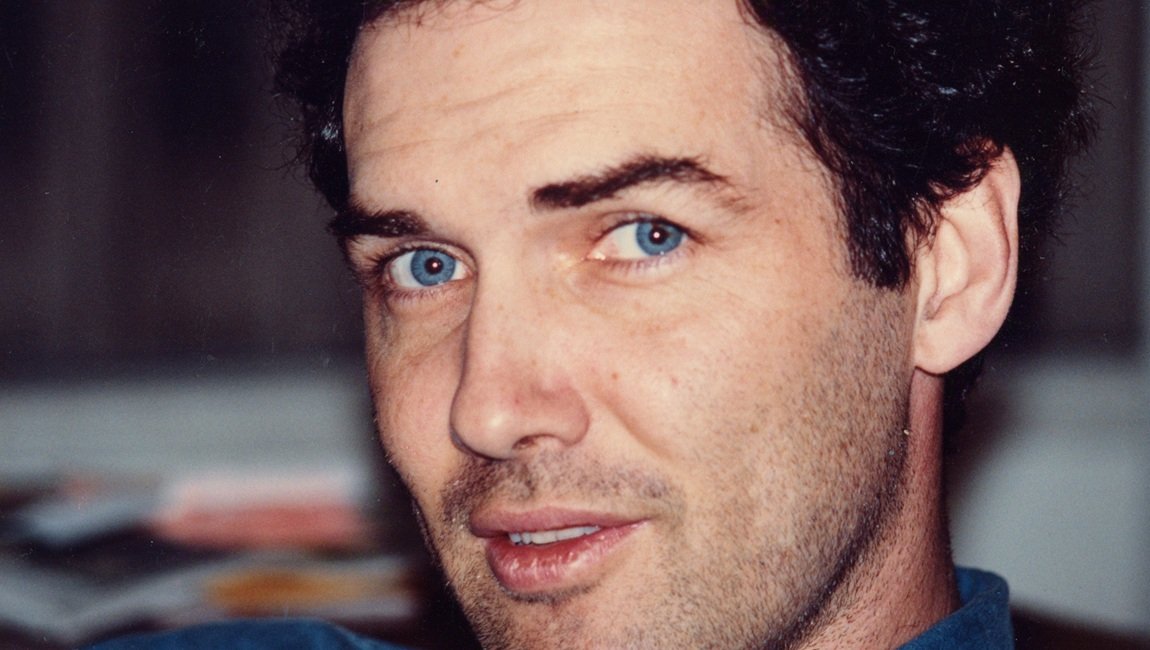
Judd Apatow’s Norm opens, obviously with a Netflix logo, followed immediately by a digitized “play” icon. A cursor is dragged to the middle of the screen and clicks, cueing a video of the late great comedian being interviewed on The Daily Show 20 years ago by Jon Stewart, on a pixelated screen. If you’re watching this documentary by choice, or have been fed it by a Netflix algorithm you’ve trained with enough classic comedy, it’s likely you’ve seen this bit before, and it’s reproduced in the exact same format, with a Comedy Central watermark in the bottom right corner. You can likely do Norm’s bit, about the Crocodile Hunter, by heart. The bit is heightened by how amusingly host and interviewer Jon Stewart is reacting, because Norm truly was every comedian’s favorite comedian, and you appreciate the craft, quintessentially Norm because it’s just repeating the basic facts of the Crocodile Hunter’s demise, only adding common sense perspective and emphasis to Steve Irwin’s famous job title and the observation that there’s probably not much job security in that particular profession.
The clips begin to quicken in speed, and we jump from Tom Green, to Howard Stern, to Shane Gillis, all discussing the joy of Norm YouTube deep dives, a content comfort food we’ve all indulged in, even before his passing in 2021. There’s a screen mirroring a simulation, presumably on a laptop, scrolling down a Norm Macdonald YouTube clip page, searching for an old favorite Macdonald stand-up clip or late night interview you’d like to revisit. This is the conceit of director Judd Apatow’s eighth documentary: the viewer will be taken on a two-hour tour of well-curated Norm clips, narrated by the comedian himself using his own stories, bits, and audiobook recitation to explore a wide swath of his career and life story in a relatively conventional manner.
Norm Macdonald’s genius was making very funny, challenging, and experimental humor look and sound dumb and incredibly easy — to understand, to write, and to deliver. He’d make jokes about being lazy, and he’d steal his jokes from hacky books his father kept lying around his French Canadian childhood home in Quebec, so you’d imagine he’d appreciate a story about him told in such a brazenly lazy fashion. The difference, however, can be found in how transgressive Macdonald’s humor actually was, what a highwire he was constantly tiptoeing, how unafraid he was to bomb regardless of the size of the platform, and how raw and cutting and real he would be if a good joke presented itself, regardless of how powerful the target of that joke might be. It’s why we loved and respected him. With a smirk, with a beat, with perfectly timed and placed repetition, he could show you the artifice of news, or how well-crafted and thoughtful a “hacky” joke was. Norm: The Tale of Norm Macdonald doesn’t contain any of this layered brilliance. It is exactly what it appears to be: a comedy primer speedrun through a life and career that at its best replays the bits you’ve watched a thousand times. You will chuckle at them again, without having much cause to look up from your phone.
Judd Apatow has more or less left the autobiographical portion of his career, having played out most of his stages of life in his narrative films, and has moved on to the role of mentor, teaming with young talent and helping them realize their own versions of Apatow comedies. It’s a service he’s performed for Amy Schumer and Pete Davidson, along with countless others as a producer in film and television. Documentary is where he seems to focus his personal passions now, making movies about childhood hero athletes, musicians, and the comedians who helped him find his voice and make his bones, including George Carlin, Mel Brooks, Bob Newhart, Don Rickles, and his former boss Garry Shandling. That last subject, whose story was told by Apatow in 2018’s four-hour The Zen Diaries of Garry Shandling, saw Apatow finding an early peak as a documentarian. It was a real passion project about a dear friend whom he had a unique perspective on, related through a mix of original reporting with all-star collaborators and unearthed footage.
Norm lands within a few days of Apatow’s next Netflix comedian documentary, Paralyzed by Hope: The Maria Bamford Story, and a few months before his forthcoming comedy The Comeback King, a collaboration with Glenn Powell that is set to hit theaters in February of 2027, and those projects are on top of his putting the finishing touches on a documentary about Bluegrass guitarist Billy Strings. When considering the cumulative workload of this upcoming slate, it’s easy enough to imagine the director watching the occasional cut of Norm from editor Jake Hostetter (who also edited Morgan Neville’s Lorne this year), selecting footage from a team of archival researchers, and offering notes while toggling between an inconceivable number of concurrent projects, which may well include renovations on a summer home the next Netflix check will make possible. Apatow’s justification for this approach is that Macdonald is such an enigmatic subject, in his winking, invulnerable insincerity, that there’s no way to truly comprehend, let alone relate, an honest interiority, so why try? Let him serve as his own unreliable narrator, and let the viewer draw their conclusions from the man in his own words — or so the director has said. So what you get is a fairly uninspired, paint-by-numbers “Best of Norm” clipshow not really befitting the brilliant subversive subject.
There is, of course, biography along the way, always presented with some puckish ambiguity leaving you to wonder if Norm, in fact, was a drop out or graduated from high school years early, if he had gotten fat or was having an adverse reaction to steroids as a part of his cancer treatment. There are the career beats, rising from a Canadian stand-up to the greatest “Weekend Update” host in SNL history, his firing by NBC President Don Ohlmeyer and the public grudge that lasted for decades after, his three-season sitcom, the film work, and the sporadic audio and video podcast he released, all punctuated with Norm’s classic roast, stand-up bits, and talk show appearances spliced in. But most of the “revelation” here is shit from his late career that wasn’t worth knowing or that you have suppressed, like Norm’s one-season Netflix show or the apology tour he had to go on after making a “gaffe” in coming out against the “cancellation” of his friends and collaborators Rosanne Barr and Louis CK, likely in an attempt to save the show he never should’ve had to beg for in the first place. There’s also a homelife you’ve probably never considered, scenes with his small family and Norm’s slow acceptance of Leukemia, that he seemed to make his peace with, even as he refused to share it with the rest of us.
Norm: The Tale of Norm Macdonald merely reaffirms he was not for the mawkish and had no truck for the sentimental. He was a gifted writer and the consensus most unique comedian of his era. He liked to gamble. He was a good son to his mother and a good father to his son. He “fought” cancer privately for nine years. He spent nearly the entirety of his life married to comedy, and no one and nothing else. He believed in God. He died with dignity. Apart from his family, then, his true legacy was his vast, hilarious, brilliant library of comedy clips, which will live on the internet for as long as we have access to it, and which we shoudl hope future generations will find as formative and rewatchable as generations who experienced Norm during his lifetime did. Or, you can watch Apatow’s documentary. There isn’t much difference.
DIRECTOR: Judd Apatow; CAST: Norm Macdonald; DISTRIBUTOR: Netflix; STREAMING: October 16; RUNTIME: 2 hr. 6 min.
Comments are closed.