
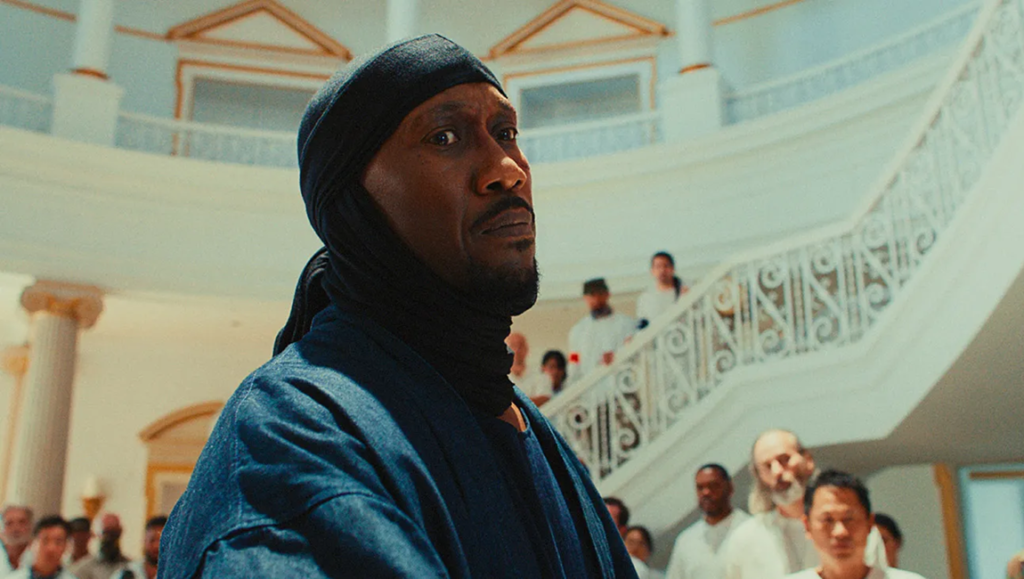
The image of a lone warrior holding a child is baked into cinema’s fabric. From Lone Wolf and Cub to Hard Boiled, it’s iconography that immediately tells you everything you need to know. A father, or father figure, braving violent threats to ensure the safety of the child left in his care. It’s a bold choice to make that a key image of your film, but the way writer-director Bassam Tariq gets there in Your Mother Your Mother Your Mother is as thrilling as cinema gets.
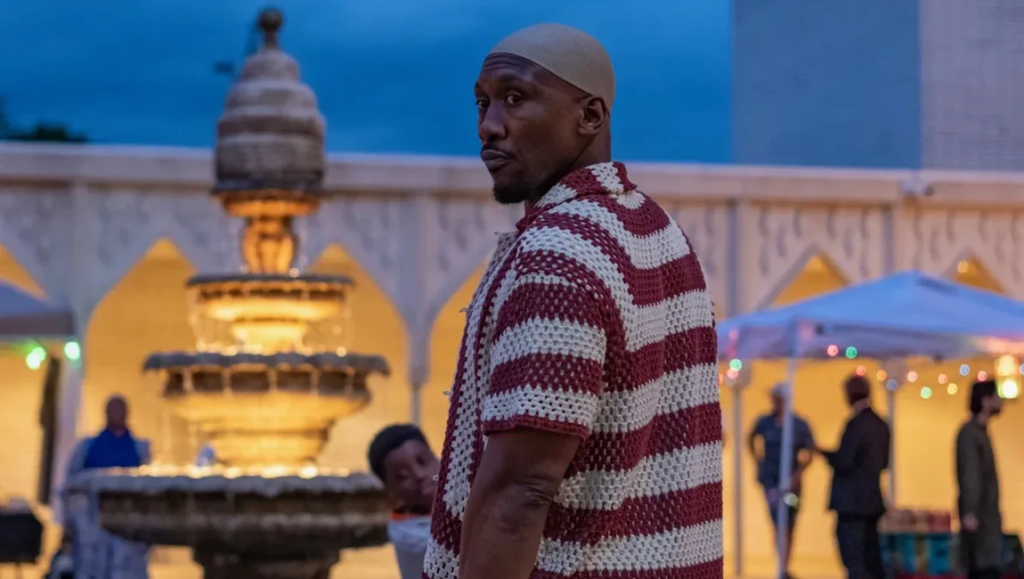
After his wife dies, devout Muslim hitman Latif (Mahershala Ali) is sent across Houston with his baby son in tow, searching for breast milk. This is, of course, an oversimplification because Your Mother Your Mother Your Mother is full of big ideas and even bigger emotion. One of the most proudly Muslim films ever made by a major American studio, it’s both an examination of fatherhood in the absence of motherhood and a profound dissection of faith. What does it mean to espouse when you, yourself, are a hypocrite? This brings Latif face to face with hypocrites of a different faith: Christian fundamentalists.
Led by John Cho, a southern, venom-spewing zealot, this group seeks to rid the country of sin by any means necessary. They share this with Latif’s stoic samurai and, perhaps, their idea of “sin” isn’t too far afield from one another, but his different faith means they won’t leave him alone. Bloody, painterly action accentuates their “differences of opinion,” but it never overrides the quiet reflection Your Mother Your Mother Your Mother forces you to contend with. Providing catharsis but maybe not the one you’re looking for, its aim isn’t a grisly climax, though that’s certainly present, but a salvation of a different sort. It’s a stunning film that never quite goes where you think it will, with Tariq swerving in just the right ways to make his samurai odyssey a potent mix of violent soul-searching.
As Your Mother Your Mother Your Mother hits theaters, I sat down with Tariq to discuss the film, finding grace for those who may not “deverse” it, and finally collaborating with Mahershala Ali after their now infamous Blade film fell apart.
Heavy spoilers follow.
Brandon Streussnig: This is going to sound like an oversimplification, and I don’t mean it to, because the film is working through so much, but just at its basest level, your hero is a Black Muslim samurai going up against Christian zealots. That’s so bold for any movie today, especially one from a major studio. Again, there’s such a rich movie here, but many, I think, might see it in those terms, which could feel scary, too. Not for them, but for you making it. I don’t think I’ve ever seen anything like it. Can you talk to me about having the confidence to do that? It kind of took my breath away.
Bassam Tariq: Oh, wow, thank you. Thank you. I appreciate that you also prefaced it with that oversimplification of a Muslim versus a Christian kind of thing. I think that’s where the oversimplification of our world has come to, and I think it’s smart that you’ve pointed that out. I think that is why the way we have to end it has to be in such a swing, in such a way, that it makes you pause. I think that’s the idea. Just like how John Cho’s character pauses and is like, “Wait, what?” and then he has to come to terms with something.
Miyazaki is a filmmaker I deeply love, and he’s made such complex films. But when you look at Princess Mononoke, which is kind of like a war epic, you don’t really know who’s good or bad by the end. Everyone is just trying to understand where they fit in, whether it’s someone trying to fight nature and why they’re trying to take over nature, and then there’s nature fighting back. There’s just all these elements. Everyone’s stuck in really complex places, and they don’t know how to necessarily navigate it. I found that to be so beautiful. I wanted to attempt a film like that in the samurai genre, I would say.
BS: Where do you find grace for people that seem so hypocritical? Because I struggle with it myself. I find it hard. I wonder, does that come from your documentary background where you’re engaging with real people from all walks of life?
BT: Yeah, that’s a good question. I think the documentary side of it really helps you understand that everyone has their own challenges. I would say that it’s been a challenge for me, too. I’m not saying I’m good at giving people grace. In fact, I’m the one that’s probably really harsh. I think the person who has helped me understand this, though, has been my wife and how she has been someone that’s offered grace, not just to me, but to many people where I would be a judgmental asshole.
In some ways, I feel like I am like Latif in that kind of performance of piety. At the same time, I’m also like Hatty [Abubakr Ali], who has this immense amount of rage against that performance of that piety. They’re just fucking cosplaying religion all the time. He hates it. In some ways, he’s holding up a mirror to everybody: “Look, I know your search history better than anyone else. I know what you’re doing at night, bro. I know what you’re searching.” So I love swimming in those spaces because I think it lets me ask myself difficult questions.
BS: It’s so easy to relate to that because it is hard, living in a world where it’s like, “Well, I hate this corporation, but I’m using their products. I hate what this country’s doing, but I live in it.” He’s dealing with that same hypocrisy. He’s a walking contradiction.
BT: Yes, yes. He’s like, “I’m a righteous assassin.” It’s like, “Well, did money have anything to do with it?” and it’s like, “Well, yeah.”
BS: You’ve been working with Mahershala for years now, but that project never came together. I’m not going to ask you to talk about Marvel for the millionth time; instead, I just want to know about the catharsis of finally getting to make something with him.
BT: It’s incredible. It was never a question of if we’d work together. It was always a question of when. We felt very spiritually aligned. We’re very different people, very different generations, but we do have intersections, and I think those intersections are very important. I think our inner compass for what we want our work to mean aligns. He pushed me every day on set to be a better filmmaker, and I think I pushed him to be a stronger actor. I think it was really great. I think we learned a lot from each other.
BS: You mentioned your wife. I think that as much as this movie is about fatherhood, it’s scaffolded by motherhood and how the lack of that, whatever that means to you, can really debilitate a family. How much of a role did your wife play while conceiving this story?
BT: Yeah, thank God she’s still alive! Sometimes people say, “Be careful what you write because it may happen.” But it comes from fear of what would happen in our household if something did happen. Right now, I’m here. I’m in L.A., and my family’s in Brooklyn. She’s the one taking care of our kids, dealing with all the school stuff, and I’m here, dressed up, just sitting with you. So it’s like, honestly, I feel like a fraud even right now, where it’s like I’m talking about fatherhood and all that, but I’m over here with you. You know what I mean? I’m not being a dad right now. But in a way, I guess this is to give myself some grace, too. It’s also part of being a dad to show up to work, do the hustle, and pitch the film to people.
BS: Maybe another oversimplification, but the main thrust of the film is finding breast milk. Again, that’s such a bold choice. Latif is in conversation with all of these iconic characters like Chow Yun-fat in Hard Boiled or Lone Wolf and Cub, but the way you spin that is so cool.
BT: Of course, of course. Lone Wolf and Cub is such an inspiration for us. The stroller that had all these weird concoctions on it, it was so dope and so ridiculous, but also so awesome, like, “Cool, I’m going to do anything for my child. He and I are on this journey together to go to the depths of hell,” basically. There’s that element of it that I really loved.
What I’ll say is I wanted us to also try to create in that canon: How can we add our own thing, our own image? I do think that the breast milk is sort of the search. In some ways, it’s him also looking for his wife, trying to keep his wife alive because, in a way, that’s like his wife. Then those moments when the breast milk’s being thrown in that scene in the film, it’s almost like his wife being thrown. You know what I mean? It’s like he’s losing his wife as that milk is dripping out.
BS: You’re also in conversation with the action in those films. Tell me about building those set pieces with coordinator Adam Hart.
BT: We wanted to always escalate the scenes as much as we could. Start him off in a place where we see him go at 80% in the bathroom, and then we bring him back down. Then when we see him in the strip club, when someone’s taken his child from him, at that moment it’s like, “I’m going to do whatever it takes to get to my fucking kid and whoever I need to take out on my way there, boom.” Then, of course, there’s the kitchen scene, which is more of him being really tactical.
I think each fight scene had a different element of whether it’s humor or what the points of tension are that you’re trying to reach. Then I would say that the final one was really about somebody who feels deeply irredeemable. He’s going to go in wherever he needs to, or he even uses a gun at one point. Hopefully, people are watching this after they’ve seen the films so we can talk openly. But I do believe that in that moment of darkness, the light he shows is important. Usually in an action movie, when a guy comes back, he’s going to kill everybody, but here he just walks out because it’s like, “I’ve got to get to my family.”
BS: As bold as the rest of the movie is, that ending is so risky. Was there any fear around not giving audiences the catharsis they maybe wanted, but instead one that Latif needed?
BT: Yes, massively, massively. This was a huge fear that the fight wouldn’t be satisfying enough to people. That was one concern that I had. Then the other concern was the whole deus ex machina of his miracle of coming back to life. It was frightening. It was really, really frightening for me, but it was something that I believed we had to do. To land that plane, which I believe we have done, and I know everyone’s going to feel the wrong way about it, and I like that. I don’t want everyone to like it, but I hope they at least appreciate the swing. I really have to thank Cam McLauchlin, our editor, who did a phenomenal job putting it together, and Son Lux, who built the score. We wanted to have this religious, parable feeling to it, this entire journey, this whole quest feeling deeply spiritual and allowing it to build to that moment in the end when he does kind of come back. The last thing I would say is I think the performance is that John Cho’s got to sell it, you know what I mean? Because in a way John Cho’s got to be the one that lets him go. So he’s got to go from this high-horse, arrogant, self-righteous douche to somebody who goes, “Oh my God, I am humbled right now, and I have to accept that this is a miracle of God.”
BS: You were talking earlier about the spirituality of the film, and I love how you convey that through image, particularly those upside-down shots of the road as we follow him into the abyss. Or how those revert when he’s reached his enlightenment. It’s a great way to depict heaven and hell, so to speak.
BT: Yeah, you nailed it. Also, the funny thing is, yeah, we wanted to do some of the flipping and all that because, one, it was also to indicate visually that we’re heading into different tones in the film. Then I think the other side of it was what you said about him going into the darkness or the darkest part of the night. I also love that Pastor Hwan is singing the song “Salvation,” which John Cho helped co-write. It’s a beautiful song that he made, “Salvation.” I think that’s what we’re all kind of looking for at the end: some form of feeling that we’re saved, that we’re going to be okay.
BS: Speaking of John Cho, another way that the film is transgressive is in how the other person who holds a position of power is an Asian man. I think when we see these fundamentalists, it’s usually a blustering old white guy spewing venom. The dynamic here is so fascinating. Was this always written with that in mind?
BT: Yes. It was funny, I was talking to John Cho about this. It was always written with a colonized Asian in mind. It was either going to be a Korean or a Vietnamese. That’s because, growing up in Texas, when I saw some of the most ardent followers of these things, it was people with this inferiority complex. I say this as a person that’s also from a colonized territory like Pakistan. So we have this massive thing, whether it’s whitening creams and the desire to be part of certain things that we’re not a part of, or the power structures. I find that a lot of the religious Koreans, or even you notice with a lot of movements, I think it’s really simplified to say that it’s just a racial thing. It’s not. Actually, when you look at the Proud Boys, some of the followers or the heads of it are Indian and Hispanic. You look at ICE, and a lot of the people that are there are also of minority backgrounds.
So what I’m saying is, things are more complex than we want to make them. I mean, it’s too easy to make it a race thing, I think. Not to say that race doesn’t play a role. Of course, it always does. But I also think that we’re living in structures where people are trying to fight for dignity in some way. Then I think that in that fight for dignity, they even overcompensate in ways that can be quite toxic.
Comments are closed.