
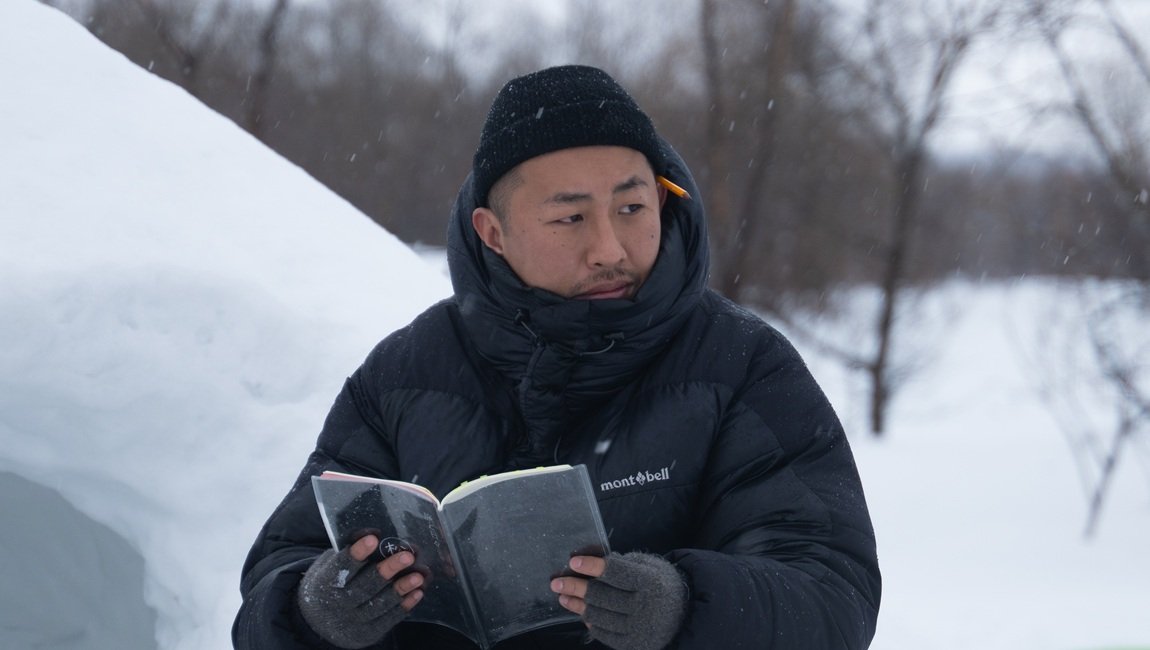
Few manga adaptations are as alive as Sho Miyake’s Two Seasons, Two Strangers. There are no bright, poppy explosions of color or wacky antics within this quiet and thoughtful search for connection. No, it’s in the environments where Miyake brings the pages of Yoshiharu Tsuge, one of the form’s most influential masters, to life. As his subjects remain still, viewed from a distance, they lose definition and blend into towering waves or lush snowfall or the deep greens of windswept trees. In a filmography (Small, Slow but Steady, All the Long Nights) that threads a yearning to understand people and new ideas, Two Seasons, Two Strangers is Miyake’s finest work in melding the idea of connection into a visual palette.
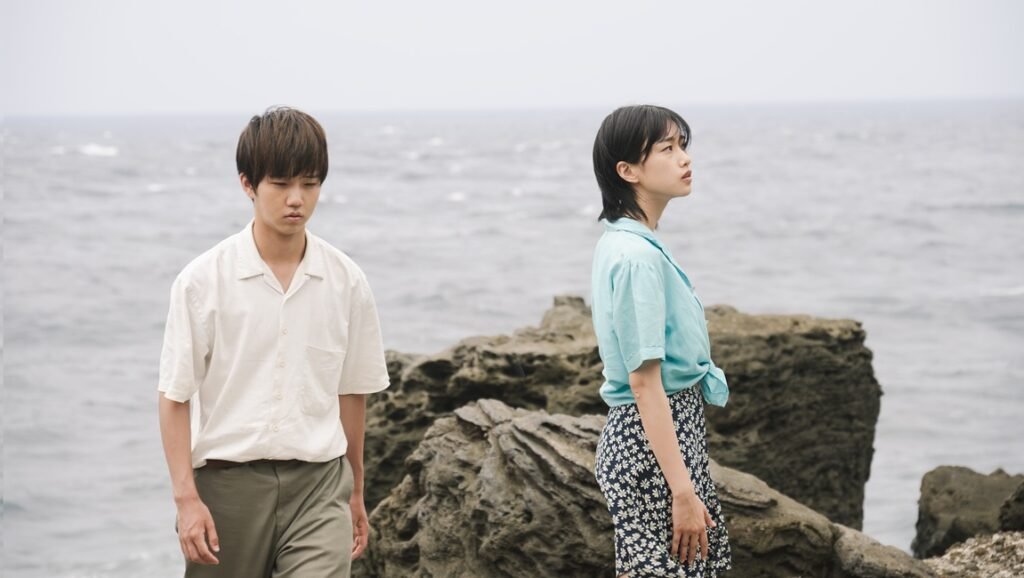
Opening on a screenwriter, Lee (Korean actress Shim Eun-kyung), deep in the throes of writer’s block, Two Seasons, Two Strangers follows her as she retreats to an inn during a snowstorm. Before this, we meet a young man and woman quietly connecting on a hot summer day at the beach. This, as we soon find out, is Lee’s film that she’s screening for an audience. An awkward Q&A with terrible audience questions (when aren’t they?) follows, leading to Lee’s eventual sojourn into the snowy Japanese countryside. A stranger in a strange land, her struggle to open up to her host mirrors that of the fictional couple inside her film. We’re all beings dwarfed by nature, looking for just one person who understands.
Loosely pulling from two different Yoshiharu stories, Miyake excavates the spaces within a glance or the words just on the tip of your tongue. It’s an astonishing work of patience and intentionality. As the winner of the Golden Leopard at Locarno opens at Metrograph in New York City, I sat down with Miyake to discuss the film, the fights he has with himself as writer and director, the never-ending quest to understand new things, and his dream to direct an installment in the Mission Impossible franchise.
(Thank you to interpreter Monika Uchiyama for translating.)
Brandon Streussnig: What drew you to the work of Yoshiharu Tsuge when conceiving this film?
Sho Miyake: The first time I read his work was when I was in university, and I’ll never forget the hesitation I felt with it, in that it was just so different from any other manga and really difficult to reduce to a simple understanding. It sat on my bookshelf for many years, and I would take it, look at it, and read it again every few years. So when a producer approached me about adapting Tsuge-san’s work, I said yes, mostly because I wanted to understand the mystery that I felt when I first read his work. Why did it feel so different from other manga? I wanted to get to the bottom of it and get a deeper understanding, and that’s why I said yes to the project.
BS: Talk to me about melding two of his stories, albeit loosely, via two seasons together.
SM: Of course, each of the stories was a story that I love, but I thought that putting together summer and winter in one film might create a new, interesting feeling. That was a simple starting point for me. I’m the type of person who, when it’s summer, I can’t wait for it to be winter, and when it’s winter, I can’t wait for it to be summer. When I’m sitting in the heat, I forget about the cold, and when I’m sitting in the cold, I forget about the heat. So I thought maybe if I put the two seasons into a single film, it might produce a new sensation, an unexpected feeling, or a new understanding of those seasons.
BS: How long was the production, having to jump between seasons like that?
SM: The production took a year in the sense that we started with the summer scenes, shooting the summer scenes across 10 days, and then later the winter scenes took about a month and a half to shoot.
BS: Something I loved about this film is how you shoot your environments. I’ve never seen an adaptation of manga capture how alive the backgrounds feel. Whether it’s the trees or the waves or the snow, your frames are always moving while the people within them remain still. Can you tell me about how you went about that?
SM: Thank you so much for noticing that and pointing that out, because it’s something that was really important to me. How could I depict the landscape to help everyone notice that everything around us is moving at all times? Inspiration for that came from Tsuge Yoshiharu’s manga itself, because in his manga, a person might be very simply drawn, but then he has a really absurd attention to detail in how he depicts the background. For instance, on a single tatami mat, you’ll see every single individual piece of the tatami, the weaving of the tatami mat, and it’s really, really intense and surprising. It was clear to me that for him, the background wasn’t just the background, it itself was a huge part and theme of the stories for him.
Using that as a theme, as a hint, I wanted to make sure that in showing the landscape, the viewer would be drawn into details and notice, and have a sense of surprise at something as small as the branch of a tree moving in the wind. In order to accomplish that, there were decisions like the stillness of the camera, the staticness of the shots, and the frame size.
BS: It really ties into the overall search for connection within the film. That’s a running theme through much of your work. Is that something you’re looking for yourself?
SM: It’s interesting you say that because I myself don’t feel like I’m actively trying to connect with a lot of people. I think I’m interested in the discomfort that we all feel. In order to understand that discomfort, it becomes necessary to understand what kind of society we live in and what kind of societies other people live in. That could mean geographically, but it could also mean societally. So that, of course, leads to an interest in the lives of other people through wanting to understand the discomfort that I feel and the discomfort that others feel, and perhaps that leads to a desire to connect with others.
The people who appear in the film are not particularly good at communicating or connecting with people. I thought that maybe it would be interesting to have these people who are introverts or people who aren’t really people-people interact with each other, and maybe they would find a way to get along. There are a lot of different kinds of people that are going to come see the film, and I think that each person should be able to find their way, their own way of relating to others and relating to society, because I don’t think that there’s one right answer.
BS: Those instances of discomfort often lead to quietly funny moments throughout the film. How do you approach that balance? It feels so delicate here.
SM: Humor was a really important part of the film, and I knew that it was really necessary. I also knew that the balance, trying to balance that, was going to be difficult. You can’t produce humor in the edit. It has to happen on set. So to create that environment, I had to make sure that we had a fun set, that the actors were happy, that there were funny things happening, and that they were able to engage in these awkward moments and to create moments. Then we could take that into the editing room and decide what felt like too much and take it away. It just became necessary to make sure that all of those things happened organically on set.
BS: The framing of the film focuses on a filmmaker suffering from severe writer’s block. Is this something you struggle with?
SM: Yes. That first scene is completely drawn from my own experience. The script says it’s the beginning of summer, and a woman wakes up in the car, and that’s what is written in the script. But then, when you see it depicted in her film, you suddenly notice the sound of the waves, the clouds are moving, there’s sweat on her skin, and the heat that you can feel from the season. There’s so much that isn’t clear from the words that are in the script that becomes possible when you get to set.
As a screenwriter, that moment is a sense of failure for me. That, oh, “I’ve lost to reality,” that the things that I’ve written are never going to hold the same weight. But then, as a director, I feel like I’ve won because that’s going to be the movie. That’s something that I’m always grappling with as a writer: the camera is always going to depict so much more than what I’m capable of conveying through words, but that also is the source of surprise and tremendous excitement.
BS: You’ve cast prolific Korean actress Shim Eun-kyung as your screenwriter. Was the idea of a stranger in a strange land, so to speak, always present? How did casting her come about?
SM: It was my first meeting with her. I knew that I had met someone so incredibly special, and I was very motivated to work with her on a project. If I were to try to put this into words, it’s like if you go into the mountains or the forest and you see this crystal clear water in a river or a stream, the kind of mountain water that’s completely pure, she had that kind of beauty in her presence. I knew that she was a very exceptional and special person. It was around that time that I was writing the script for this work, and my pen had kind of stopped for a moment. Then once I met her, I started to imagine her in the role. Once she was cast, things became very easy to write, and then the story progressed very quickly.
BS: This is completely unrelated to this film, but it’s something I like to ask of filmmakers who do something so outside of what they’re usually known for. For instance, you largely make quiet, thoughtful, and intentional films. So, when approaching something like a Netflix series, but one as well-known and disparate from your work as The Grudge: Origins, does the base of who you are as a filmmaker stay the same?
SM: I’m happy to be asked that question because when I look back at my filmography, I notice what a strange career I’ve had. Regardless of whether it’s a Netflix series or any of my own films that I’ve written and directed, I’m always approaching everything as kind of a new world that I don’t understand. For instance, I didn’t know anything about boxing when I made Small, Slow but Steady. I don’t know what it was like to be a manga artist when making this film. So I’m trying to explore things that I don’t know and explore worlds that I don’t understand.
I don’t think I’ve ever decided on what kind of filmmaker I am. When I approach each individual project or film, the way that I answer that question slowly reveals to me what kind of filmmaker I am. It’s something that I’m constantly discovering for myself. An easier answer, I guess, for this specific question is that approaching this Ju-On movie, I was approaching it less as a filmmaker and more as a fan of films. I knew I always wanted to direct something that was a part of a series. My dream would’ve been to direct one of the Mission Impossible films, but unfortunately, my career just didn’t catch up so that I could do that. The Grudge being such a beloved series, being able to take part in that as a fan of cinema was really exciting.
BS: You’re often compared to Rysuke Hamaguchi, and it confuses me because I don’t think you could be more different. I know he’s a friend, though. In other interviews, I’ve seen you talk about a classic movie club you have together. How does that friendship and club shape your process?
SM: First of all, your perspective that his work and my work are not the same at all is correct. I appreciate that understanding. Of course, he is someone that I look up to tremendously as a director, and he’s also a very trusted friend. Because he’s a little bit older than me, I think of him almost as an older brother or a mentor-type figure. I really am appreciative of how respectful he is toward the craft of filmmaking. I feel lucky to be making work at the same time, in the same generation, and at the same time as him. I only hope that he feels the same way about me because the way that he approaches filmmaking with such reverence and respect is really incredible and exceptional. He makes me want to try my best in every project that I work on and put my best foot forward in my collaborations with the incredible actors that I get to work with.
Comments are closed.