
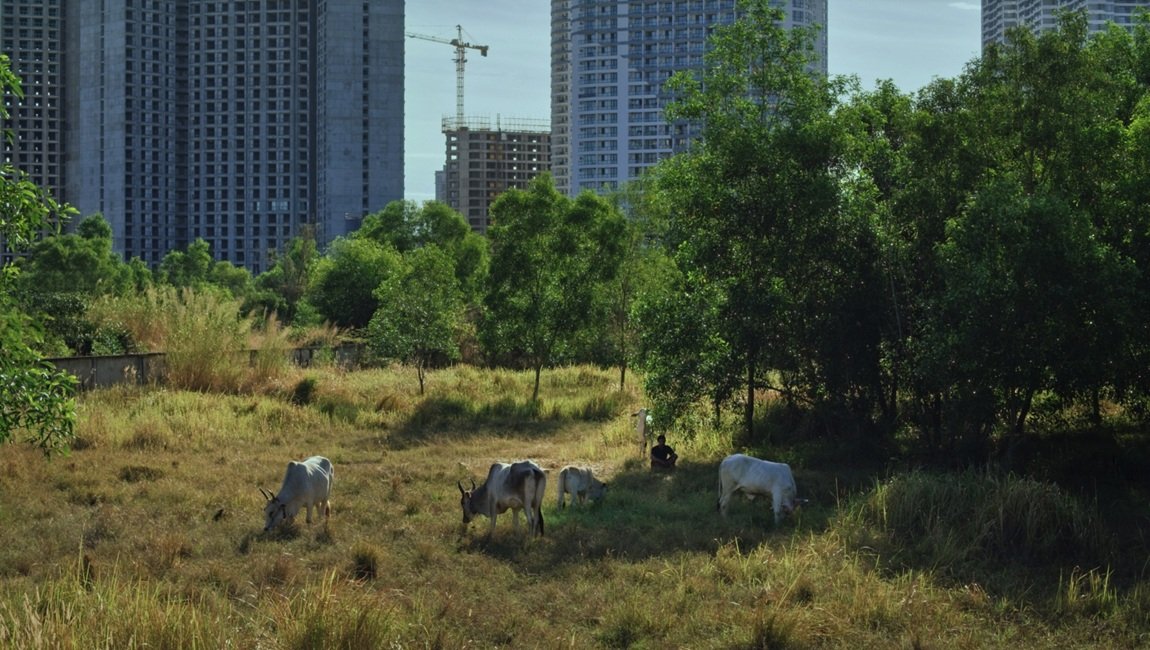
In the 1960s, the sociologist duo Barney G. Glaser and Anselm L. Strauss noticed a phenomenon quite common in healthcare. What they call “a ritual of mutual pretense” is a situation in which everyone, including the patient, is conscious of their impending death, yet everyone — including the patient — acts as if death does not exist. There seems to be something similar at work in Ivan Marković’s Promised Spaces. As appears obvious from the title, the places that capture Marković’s interest are just as real as they are projections; both found and made in and by the real world and, well, capitalism. They are houses, squares, and yards, gated communities and entire neighborhoods even; abandoned and subsequently rediscovered structures now populated by those no one had in mind at the time of construction.
One of these people is Jorani (Lyer Von), figuring as a real estate agent for one of the unfinished high-rise luxury apartments in a Cambodian ghost town. As she welcomes the seemingly better-off Seda (Vita Vong), the first and only resident, to walk her through her new apartment, she is quick to note that the acquired object looks just “exactly like in the pictures” she saw online. It is at this moment that a first “mutual pretense” sets in: and not only because both women see plainly that the image — magnified and reiterated throughout the numerous dingy hoardings showcasing the paradisiac edifice, now functioning as curtained dividers of room and space — is not exactly reflected in and by reality. For as Jorani shows the business woman around, impossibly tasked with the cloaking of the many stains and flaws in the apartment, it soon becomes even questionable whether she has any legal claim to the apartment she is offering. “There are no supervisors, don’t give me that,” Seda rebukes Jorani as the putative agent asserts that the many flaws will be discussed with her superior. And still, while both are seemingly aware of the sham in which they find themselves involved, they, after all, do stay in character, acting as if there is this third party imbuing their transaction with legitimacy.
Marković does not open his just-feature-length solo debut film with this uneasy encounter, but with Sokun (Vollak Kong), a construction worker, who at the beginning of the film flees his work site — including the crammed bunk beds and the sultry, all-pervading heat — that is, as far as that is an option. At the time the baton of focalization is passed on to Jorani, Marković’s preoccupation with the geometry of spaces and the manner in which light reflects in and penetrates them is well established, mostly through still wide shots. Given the marginal existences of his characters, there is perhaps something fitting in the way in which he abandons them one after another. Most unexpectedly, the perspective subsequently shifts from Jorani to the new resident Seda. It’s a clever move through which the antagonism toward Seda is confined while still in its nascent stage.
For what Seda soon has to realize — and we alongside her — is that in this place, the mere suggestion of wealth renders her a stranger. In the glowing heat, her problems are soon most strikingly embodied in her malfunctioning air conditioning that sends strong drafts down her apartment. As Seda later that night chases down a noodle place, the central motif — mutual pretense — occurs once again when she suggests to pay for her meal, well knowing that she already did so upon ordering. The hostess seems to pick up on the subtext of Seda’s request, the longing for connection, as she steps forward to wish her a good night and tells her to come back soon.
There is some pleasure in seeing how Marković, at this point, has fully subverted the viewer’s initial expectations for this character. However, given the centrality and motivic conception with which this episode looms over the others, there is some incongruence to the way in which he sets off from here, transitioning to a final episode in which what could have become a panorama ultimately opens out into a mere snapshot. But again, perhaps it is only just for a film about a disparate group of forgotten people that we are not allowed to keep track of any of them. The shots remain stunningly beautiful throughout, and yet when, toward the very end, we are presented with an extra wide shot — with an urban undergrowth in the foreground that soon gives way to an uneven cityscape whose gridded structures of finished and unfinished high rises randomly align — it’s hard to ward off the impression that there is some hollowness to the unperturbed mise-en-scène.
Comments are closed.