
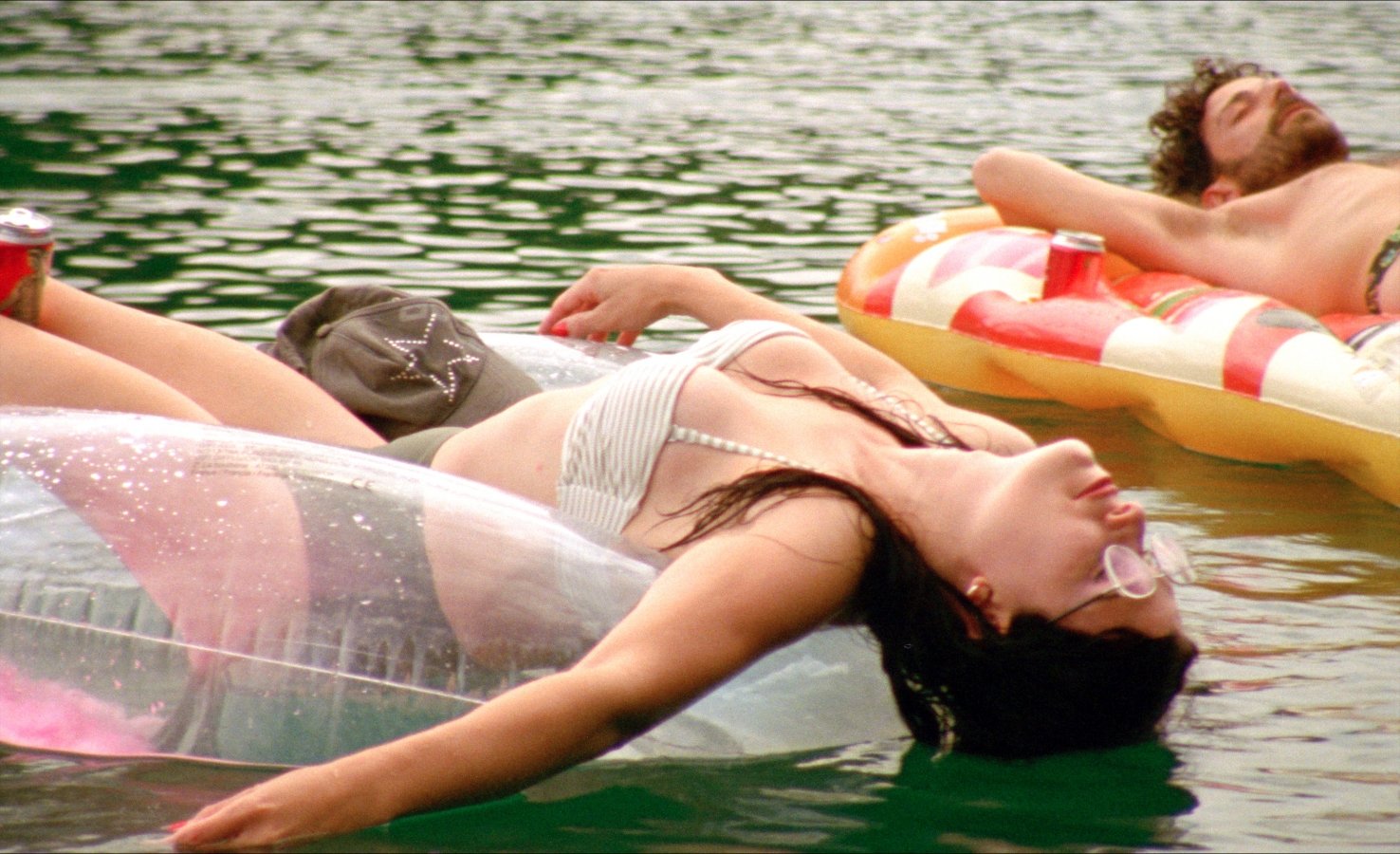
I will admit it upfront: had I been told that one of my favorite films at Cannes 2026 would be one about a woman in her late 30s who knocks into shape her old VW Beetle to compete in an oldtimer race in Belgium, I’m not sure I would have believed it. Then again, though this is undeniably a plot point in Céline Carridroit and Aline Suter’s collaborative debut feature, Summer Drift, it is only one aspect within their overall project, at the center of which is Johanna, who, not coincidentally, bears the same name as her actor, Johanna Schopfer. More than merely autobiographically inspired, the film takes Johanna’s life as basis for poetic and humorous exploration. Some call this hybrid documentary, since myriad elements really do happen in Johanna’s life (such as the car race). Others, however, hold only traces of real events — in one scene, we see Johanna in negotiation with her boss to get extra vacation for her trip to Belgium, which served the “real” Johanna as a kind of rehearsal for the actual talk with her superior (this information, however, is extratextual, which sets it it apart from projects à la Nathan Fielder).
Johanna is Colombian, living in Geneva. She is trans, has a long-time partner abroad, and is still working on perfecting her French. Occasionally, we see her walking down the street, placidly humming “lundi, mardi, jeudi” or “janvier, fevrier, mars.” But it is not as if Johanna needed many words to deliver her deadpan humor, which more often than not goes by unnoticed with her interlocutors. At work, for instance — Johanna, who doesn’t like watches, works for a worldly renowned watch manufacturer — when asked by her colleague about her family situation, she, off the cuff, cooks up a husband and two children, though it takes her some time to summon their names.
At times, the scenery, though visibly heightened by the 16 mm film, takes on more of a documentary register. An open-air screening of Mad Max, for instance, is captured in wide-angle shots of Geneva’s inner city, with attendees and bystanders being just attendees and bystanders. All the more do these scenes contrast with the occasional comic strips that, entirely uncommented upon, fill up the screen in silence. It is in these muted moments that we learn, if drawn into abstraction, about anti-trans violence that Johanna may or may not have faced in her life. In the life to which we are privy, meanwhile, it remains entirely unclear whether anyone is aware of Johanna’s transition. In a similar mold to these dismal comic strips — which, as we learn from her friend, the tarot-reading comic shop owner, are drawn by Johanna herself — are nightmares of cut-off limbs in a garage.
Carridroit and Suter, thankfully, never overstretch such allusions, the mental leap from drag race to drag racing being the pinnacle of their buffoonery. If we are to make out a lineage of filmmaking inherent in their work, it would probably lead back to Alain Guiraudie, via Anton Balekdjian, Léo Couture, and Mattéo Eustachon — the trio who brought us last year’s Laurent dans le vent, a film that likewise premiered in Cannes’s sidebar ACID and eventually landed a place in the Top 10 of the Cahiers du Cinéma. One should not be surprised if Summer Drift reaches similar accolades, despite its obviously low profile. It’s a cinema that is not obvious, one that finds comedy where others find trauma and depth where others defer to the prerogatives of genre. And for all its brevity and seemingly low stakes, it should be said that Summer Drift never feels slight, but rather like a fresh summer breeze down the Rhône.
Comments are closed.