
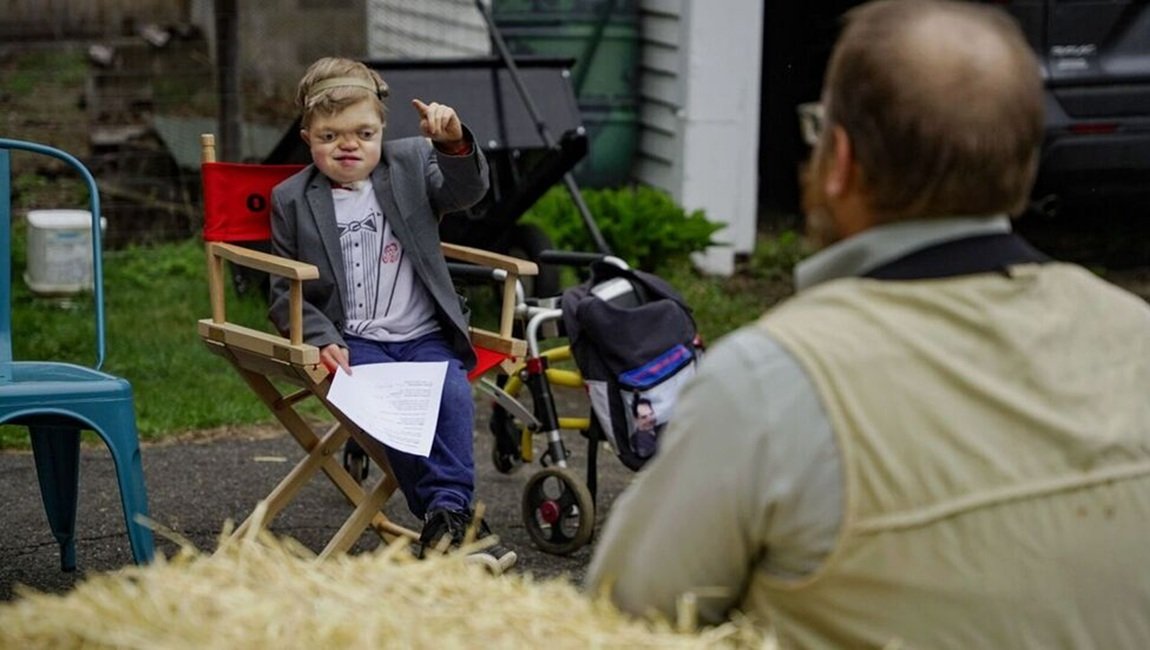
Designed to please any movie lover with a heart, Cynthia Lowen and Jon Cohrs’ Kids Like Me follows Oliver Odwazny-Beebe, a passionate indie filmmaker with a murder mystery obsession who is bent on bringing his latest vision to the screen, even if it means corralling everyone from friends, neighbors, and family members, to Tony Shalhoub and the local police. Indeed, the smart and scrappy director is convinced that “people are finally gonna recognize my artistic talents through the delightfully macabre world of murder.” Never mind that Odwazny-Beebe is only 12 years old, and with a rare genetic condition that requires him to be tethered to numerous life-saving (and quality of life-preserving) medical gadgets around the clock. His creative savant imagination seems to be fully operating at warp speed.
“I would be happy to endanger myself for the sake of cinema,” the dedicated actor-director proclaims during a break on the set of one of his homemade thrillers. As his mother, Casey, and 7-year-old sister Willa apply fake blood to his forehead in preparation for his turn as a dead body, he adds that he’s “both repulsed and delighted by it.” Though off set, the complexities of daily life do intrude, such as his reliance on his father Chad to carry him down the stairs to leave for school. (That said, the youngster is too immersed in his own personal soundtrack, singing OMD’s “If You Leave” to himself, to notice the lack of mobility. He also mentions that he’d like to do “jazz hands.”) “If me and Willa get through a car ride without doing or saying anything mean, something’s wrong,” he explains while riding in the backseat with his sis. Though Oliver also assures the camera, unintrusively lensed by the always offscreen Lowen and Cohrs, who are longtime friends of the family, that he does actually like her.
Once at school, Oliver’s aide prompts him to stop chatting with his fellow student and get down to concentrating on the work. “I’m talking — is that a crime?” he responds rhetorically. Unsurprisingly, the loquacious filmmaker’s exuberance is contagious, and classmates vie to be cast in one of his playground scenarios during recess. However, due to an extreme sensitivity to sunlight, Oliver himself must direct from the shade. Yet even as his body is confined to a walking device called “The Crocodile,” Oliver’s mind is forever fixated on the next fictional corpse. Showing off his book collection, he notes that he particularly likes murder mysteries where it’s just an ordinary person “who just can’t seem to stop stumbling over dead bodies.” He also emphasizes that while the “who” is important, the “how is equally important.”
And while larger-than-life personalities play well on the big screen, living with one can prove challenging — especially for a younger sister. Willa complains that Oliver won’t play any of her games and “won’t let me wear anything pink” — and also that he “doesn’t like rainbows or unicorns or anything.” (Her big brother acknowledges they have a “complicated love-hate relationship.”) As for Chad and Casey, they must contend with healthcare paperwork and endless medical bureaucracy in addition to the nonstop sibling rivalry. (Though by the end, Oliver has agreed that the new rule with Willa will be to “constructively give criticism.”)
Refreshingly, difficult realities are never sugarcoated within the loving family. On the way to Oliver’s annual checkup, Casey asks if there’s anything he’d like to discuss with the doctor. Oliver dismissively declines, as “she’s not a psychiatrist.” And when the tween mentions that he can’t wait to finally experience the sense of smell, his dad eagerly replies, “It’s gonna blow your fucking mind.” Indeed, Chad and Casey are determined to treat both Oliver and his sister as equal human beings whose thoughts and feelings matter, rather than children to be condescended to. In turn, Oliver gives the adults around him permission to be kids.
Which is likely why once the Monk backpack-toting auteur decides his next nail-biter, starring a character named “Detective Oliver,” will be his greatest hit yet, all ages seriously rally to the cause. A drama coach is enlisted to help the youngster develop the backstory of the investigator who’s a “better-dressed version of Colombo.” During a table read, Oliver is thrilled when his dad catches a discrepancy in the script. That’s “why we do these things before we go to print,” he cries. And as costume-clad folks gather for the latest production at the Odwazny-Beebe home (or rather, the “Full House Theater”), Chad remarks that he never realized how special their community was until Oliver was born.
Of course, that community includes the documentarians, who are able to secure access to a soundstage for the shoot — yet another rare space where Oliver can be firmly in control. (“We’ll fix it all in editing!” he assures after one imperfect scene.) So when the director finally reveals during the post-screening Q&A for the Detective Oliver premiere that he’s considering a sequel, it doesn’t seem that far-fetched. After all, this out-of-the-box kid with superhuman grit has raised an entire village already.
Comments are closed.