
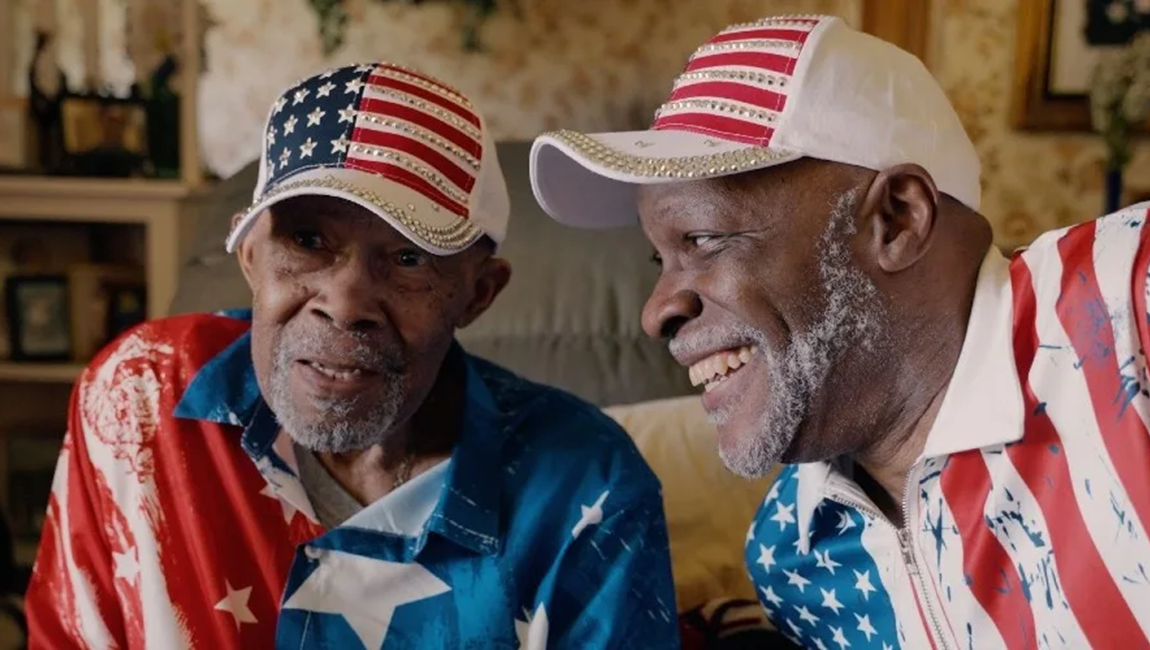
Nestled in the rural midwestern town of Three Oaks, Michigan, the largest flag day parade in the nation is a surreal scene of unabashed Americana, radiating with irony, sincerity, and, most tangibly, the aesthetics of neoconservatism. Co-directors Melissa and Andrew Shea capture the event for their latest film, Flag Day, which they describe as a verité-style documentary. And while their filmmaking somewhat reflects this observational mode, verité is historically rooted in a tradition of exposition and critique. In the United States, this fly-on-the-wall documentary genre was largely popularized by the late Frederick Wiseman, whose extensive filmography was dedicated to interrogating the nation’s most coveted and longstanding institutions. Of course, in this vein, a flag day ceremony is a golden opportunity to parse what it means to fetishize a divisive America and its polarizing symbolism, which has come to represent far more than its most superficial qualifiers of supposed freedom and unity. Yet instead, Flag Day approaches the event at sheer face value, only fortifying, rather than interrogating, a blind faith in patriotism.
A small farming town, a pageant, corn fields, and a water tower, a parade, an overlarge American flag, and an excess of red, white, and blue — Flag Day is pierced together with observational footage of midwestern scenery and loose interviews with Three Oaks’ residents that attempt to sentimentalize almost every aspect of rural American life. As a result, its images are largely informed by a unified cliché. The Sheas primarily follow key members of Three Oaks’ community: a group of veterans, a Peruvian immigrant and small-business owner, a teenage pageant contender, an American Legion officer, and a high school marching band instructor. While these figures offer the film a diverse array of voices, their testimonies are nearly indistinguishable, each echoing the same admiration for the flag, their parade, and their community. These anecdotes are certainly not inherently bad, but at a time of clear political division, their homogeneity comes across as vigorous and lopsided.
When constructing a verité documentary, there is a clear difference between letting a scene unfold without intervention and subtly embellishing its content for an underlying narrative. Granted, the Sheas’ laissez-faire approach does largely fall in line with what viewers have come to expect from this style of filmmaking. The compositions of many shots are expertly framed, and their subjects play well into the film’s observational mode. Still, a thick coat of self-indulgent nostalgia obscures any form of meaningful interrogation of the themes it could otherwise extrapolate.
Flag Day conspicuously fails to acknowledge the volatility and nuance of America’s contemporary political landscape. Instead, its portrayal is naively simplistic. A saccharine score codes nearly every shot with non-existent sentimentality. Each anecdote reinforces an air of nationalistic pride, and the film’s tone ceaselessly wields a romanticized view of the rural American lifestyle. Consequently, the film disingenuously fails to display the far more real cultural and economic difficulties that are embedded in the community, yet conveniently remain just offscreen. Its observations are repeatedly reduced to naive affirmations of the values it celebrates. Without any form of critical inquiry, Flag Day’s portrait of small-town America aligns closer to a vehicle of propaganda than a verité film with something to offer.
If Flag Day is an attempt at bipartisanship in a time of division, the result is remarkably tone-deaf and mundane. At best, it’s defined by a striking lack of self-awareness, capturing a manufactured unity amidst political unrest. At worst, it’s a weak attempt at aestheticizing patriotism with brazen naivety. Verité, therefore, remains only a hollow qualifier for a film without concern for authentic discourse or holistic observation.
DIRECTORS: Melissa Shea & Andrew Shea; DISTRIBUTOR: Abramorama; IN THEATERS: June 12; RUNTIME: 1 hr. 15 min.
Comments are closed.