
Near the end of The Gas Station Attendant, filmmaker Karla Murthy admits that she is “stuck in a time loop” while she sifts through boxes of old videotapes. Fashioned from home movie material, old and new, voiceover both confessional and authoritative in tone, and a compelling personal arc, Murthy’s film dances along the fine line between documentary and personal document. It’s a drifting essay, a meditation on the unique — and the universal — experiences of her immigrant family. Attempting to be generational in scope, the film offers not only a portrait of her father, but also of herself, the director constructing her own meaning from a personal archive of analog tapes. The familiar gaze of the home movie camera follows her father first as a young man in Houston and then as an older man persevering through financial hardship, catches glimpses of the filmmaker herself as a child, and eventually finds her own children running barefoot in the sand.
The voiceover is constructed in almost a direct address. Though glimmers of poetry emerge, the film has a motivating, if quiet, central theme. In a particularly candid moment, driving home to Houston from a trade show in New Orleans, Murthy’s father admits to the anxiety of his crushing debt but also offers advice, as he says it, for marriage. “Make peace no matter how long it takes.” And Murthy’s film is just that: a way to make peace. The weight of her father’s debt, the constant fear of failure, became her weight. She had to step back in order to move forward. In her own words, The Gas Station Attendant is about “reliving the past” and “looking for answers,” and is a personal practice, meant for therapeutic ends as much as for public exhibition — possibly more so.
There is, of course, precedent for this within the documentary tradition. Sarah Polley’s Stories We Tell and Chantal Akerman’s No Home Movie, for instance, both render exceptionally personal narrative experiences into a material form easily readable by a broader audience. But these aren’t only personal documents, intended as exorcistic exercises. They hold interest for a universal public, many of whom relate to their themes, concerns, and even specific instances. This sort of film can manifest interest of an empathetic kind, the interest held by listening, learning — an interest in our fellow humans. Both Polley and Akerman elevated their personal excavations through craft. Murthy, too, elevates her raw material, but there still exists this strange dynamic within the form of the film. While it seems to posture as a cultural object, a “documentary” as the form might be understood within the market — a market which has, via straight-to-streaming documentaries, made the voiceover and archival editing defining elements of the form — when really it is, more than anything, a personal document.
In the film, Murthy returns to the landscapes — culs-de-sac, highway overpasses, suburban farmhouses — of her childhood outside Houston, Texas. There is a dialectic jump when we transition between high definition video, with the filmmaker’s voice (and hand) guiding our view, and the mini DV cassettes shot years before. We visit the “beaches of home,” including her father’s childhood in India and her mother’s home in the Philippines. It is, Murthy says, “a time-traveling gift to see your parents in the places that made them.” But it isn’t joy only. The gift is of recognition. We see Murthy’s mother on the beach of her childhood during a trip that would be her last before her untimely death. Murthy’s father tells a story of abject poverty and disenfranchisement, which illuminates images of his own childhood landscapes. Murthy wants to know the “complicated,” sometimes tragic, stories lurking behind “smiling family pictures.” Family histories aren’t fairy tales; or, to the degree that they might be, are much closer to those classic haunting tales of old, before Disney’s neutering took hold of them. This practice is, then, of a universal concern: discovering — uncovering — the lives of parents, grandparents, is a fraught, often fascinating, endeavor.
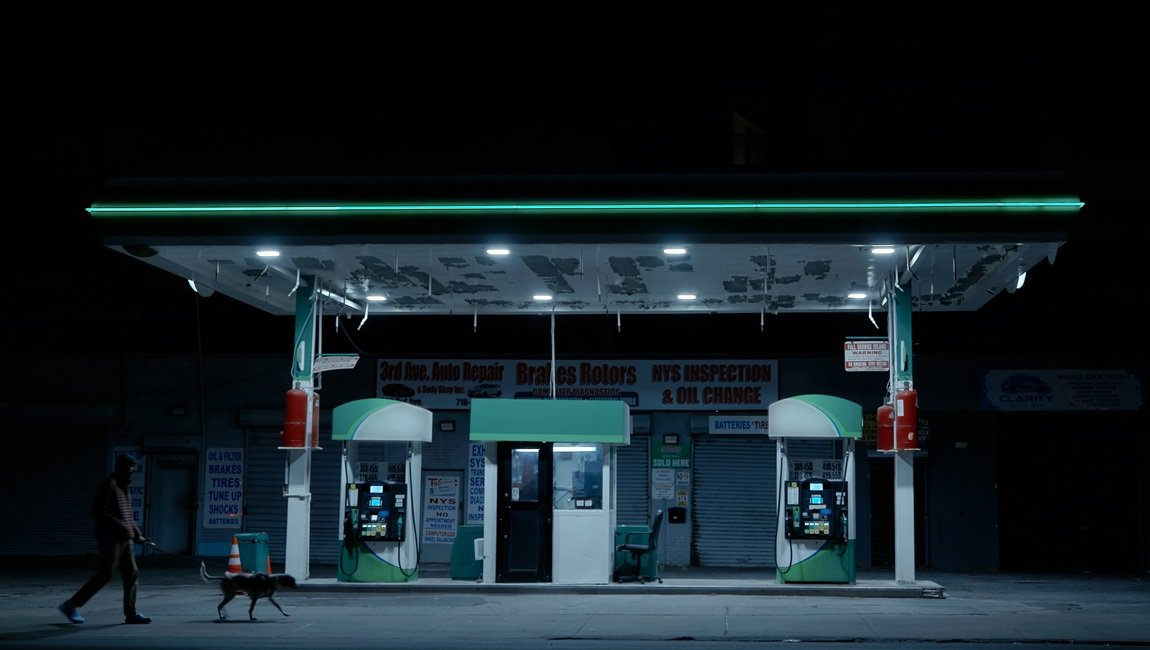
Reference to the film’s title is fairly subtle in the text. One of the many part-time jobs, hustles really, Murthy’s father embarks on is a graveyard shift behind the counter of a gas station. Murthy’s fear for her father’s well-being — The Gas Station Attendant touchingly visits the memorial of a young Nepalese attendant killed in a robbery — is the catalyst for her inward investigation. The film’s material began as questions posed via long-distance phone calls — New York to Houston — while her father served late-night customers at the gas station. But the title is subtly misleading. What we actually see of H. N. Shantha Murthy, the filmmaker’s father, is the jewelry merchant, the community figure, the doting father. It is difficult, after learning all that we do, to think of him as “the gas station attendant.” This is the point, of course. There is always more than what we see. “Make peace no matter what,” he says, and his daughter listens. She calls, even in the middle of the night. She begins a dialogue, a personal process of discovery. Which leads us here, to The Gas Station Attendant: formally competent as a documentary, occasionally poetic though often rather rote in its movements, but astoundingly generous as a personal document. Karla Murthy has opened her personal archive in such a way that we might learn, not only about her family, but about ours.
DIRECTOR: Karla Murthy; DISTRIBUTOR: Greene Fort Productions; IN THEATERS: June 12; RUNTIME: 1 hr. 23 min.
Comments are closed.