
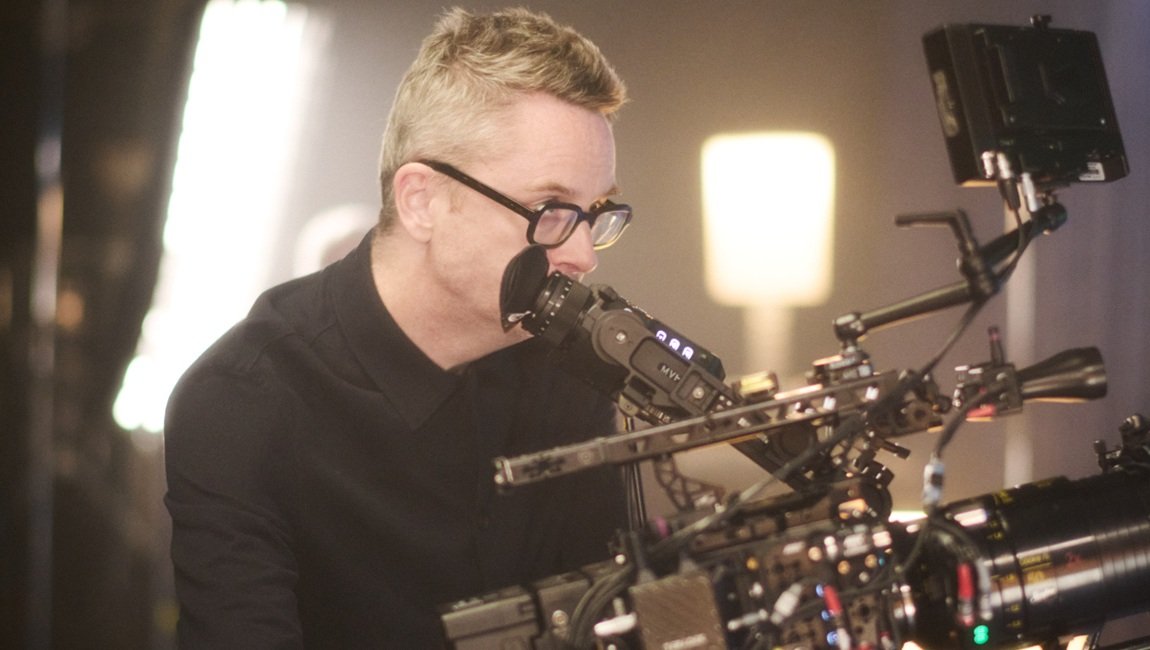
Nicolas Winding Refn resists containment. His earliest films (the Pusher [1996-2005] trilogy and Bleeder [1999]) channel a forceful neo-realist intensity, while his subsequent works venture ever further into the unknown — from the quasi-surreal drone thriller Fear X (2003) to the boisterously dreamlike Bronson (2008) and the mythic Valhalla Rising (2009), and beyond. Following the massive critical and commercial success of the action-drama Drive (2011), he reteamed with Ryan Gosling to direct Only God Forgives (2013): a hypnotic and ferociously strange exploration of uber-Freudian abstractions. The mesmerizing Her Private Hell (2026) is his first theatrical release since The Neon Demon (2016), and it builds off the narrative and tonal experimentation of his recent miniseries, Too Old to Die Young (2019) and Copenhagen Cowboy (2023).
As Her Private Hell hits U.S. theaters, I sat down with Refn to discuss Her Private Hell, the unconscious, fantasy, the process of artistic exploration, and more.
Mike Thorn: I watched Her Private Hell last week and I can’t stop thinking about it. The first thing that struck me is that it feels like an expression of pure unconsciousness, with all its archetypal imagery and mist and dreams within dreams. You often describe your creative process as exploratory — what role does the unconscious play in Her Private Hell?
Nicolas Winding Refn: Well, the experiment — or the idea — was coming to work every day and then purely basing everything on your instincts, so that it became like an amalgam of whatever I wanted to do that day. And even though it was all planned out in script form, there was still this constant opportunity to change.
And so, you used your subconscious more than ever, because that became your kind of roadmap: how could you continue to always turn the crystal again and again and again? Because each time you would turn it, it would reflect something in you. If you kept on turning it, it would continue to reflect. But every time you came to the beginning of the turn, you had gone somewhere else, and it was reflecting a new experience. So, it never stopped until I ran out of money.
MT: I’ve heard you describe your early films — like the Pusher trilogy and Bleeder — as efforts to capture authenticity, whereas your recent work is much more interested in unreality and fantasy. I think fantasy has a double meaning. There’s fantasy the genre, and then there’s fantasy as a state of desire. I think most of your work is very interested in both. How is fantasy working in Her Private Hell?
NWR: Starting from Bronson onwards, the idea was basically to, you know, look at the possibility of fairy tales. And you see, most entertainment is like, if you take a piece of paper, if I hold up a piece of paper like that [mimes holding a piece of paper toward the viewer], you can draw lines across, which is basically codes of information. And you can structure that accordingly to how people’s attention spans would play out. Or you can, through research and technology, almost precede expectations — or at least you believe you can. But there’s an enormous amount of limitation, in my opinion, in that. At least for me.
But if you take that piece of paper and turn it like this [mimes turning paper sideways], it’s very, very, very thin. But on that string — which it now is — you build a very simple narrative, which is what fairy tales are based on, a very simple premise, which is why most of our storytelling is really based on that premise. You have a very easy understanding, almost to the point of being simplistic. So, you can follow that fairly easily. But then if you turn the paper again, there are suddenly all these interpretations now. And interpretations have no limitations, because it’s endless.
So again, going back to the idea of the crystal that turns, every time you turn five angles, and you feel you’ve come to the end, you start again, because you have aged in that period. And every time you age a second, you look at the same experience with new perspectives. So it continues and continues and continues. It’s why you can revisit certain books or films again and again through your life, because the experience of them changes. Not the movies… but you change. And I think that’s very inspiring. But I also think it’s a way to penetrate the mind, in ways where you now see you’re going to travel with for the rest of your life.
But obviously, that approach is almost a chief enemy of the algorithm. The algorithm is based on good taste. Good taste is the enemy of everything. So, I think it’s very important in this day and age — where because of technology, there are so many layers of control around us — that we need to be able to break free. And the reason why people are detached so easily is because if everything is just made by an algorithm, essentially, or most of it, then why should we care? I wouldn’t care. Why would I expect my kids to care? However, if you create with the heart, it’s almost like, “don’t give them what they want. Give them what they desire.”
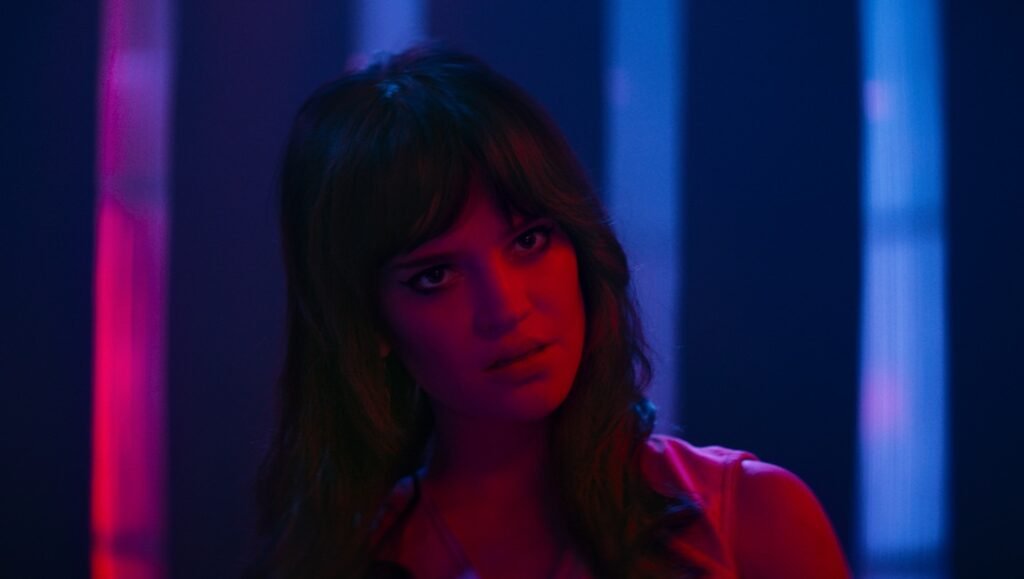
MT: That relates to the unconscious as well, because you’re not ceding to these kinds of surface-level desires. You’re not ceding to something so legible. I like how resistant Her Private Hell is to legibility. It’s not just spoon-feeding.
Looking at your recent work, I see an increasing genre slipperiness. And that’s resisting the algorithm, too. You can’t really contain Her Private Hell. What is it? It keeps shifting. It’s an opera. It’s a fairy tale. It’s giallo. It’s fantasy. It’s a crime film. Are you interested in genre, as an artist?
NWR: Well, I think genre is fantasy. It’s your imagination. It’s boundless. Genre is everything and nothing. And I think that for me, what I like in that space, is that you can exist without being labeled. And there’s nothing wrong with being labeled, but I think that there is more of a personal pleasure in being uncontrolled. For me, the act of expression is the foundation. The result is secondary. You’re alive when you create. The ending is the product. But, like that space, it’s no longer yours. It’s everyone else’s.
And it’s a very important thing, in my opinion, to remember that success and failure have no real definitions. They’re all about expectations. And if you create with the heart and you stay true to what you want to make, then you’re beyond the concept of good or bad. Because then it’s just you. The question is, “is that interesting to other people?” Which is then obviously the unknown. But there will always be, I believe, someone who sees the world in your same vision. So that means that there’s an audience for everything, as long as you create with your heart.
MT: I like what you said earlier about good taste, the tyranny of good taste. I think good taste is always imposed from the outside. And again, I keep returning to this idea of unconscious. It feels like your films are going deeper and deeper into the recesses of something that is very unknown. It’s very archetypal. That’s the fairy tale… it’s something kind of ancient. What do these narratives signal to us? Why do we keep going back to them? Why do we keep rewriting them?
You’ve discussed the influence of opera and fairy tales on Her Private Hell. My wife said it reminded her of Kazuo Ishiguro’s novel, The Buried Giant. It also reminded me of some of Peter Straub’s novels, like Shadowland. Does literature play a role in your creative process?
NWR: Please thank your wife. I mean, it’s very honorable to be mentioned in the same sentence as these artists, but my conditions of my dyslexia make it very difficult for me to read and write. So, I’m by nature forced to use other avenues. I used to wish that I didn’t have these conditions. But I’ve come to realize that, like Daredevil, if you have something which is such an obstacle, you begin to train muscles that people don’t even know exists in them. So, in a way, a superhero is the imperfect human.
MT: That’s a fascinating way of looking at it. You’ve talked about color blindness as well, and how that informs your approach to shaping images which really are singular. There’s no one else making NWR images.
Too Old to Die Young and Copenhagen Cowboy remind me of early film serials, like Fantômas and Les Vampires. Obviously, Pino Donaggio’s score does a lot of work in Her Private Hell, but it also made me think of silent film, like some of Fritz Lang’s work. Are you a fan of silent cinema?
NWR: Oh, yeah, absolutely. I mean, six months ago, I showed my youngest daughter, who’s 17, Joan of Arc by Dreyer. I was watching it with her, who was obviously a complete newcomer to silent cinema in certain ways and, you know, she cried. This is a movie that’s shot in pure close-ups. So obviously, it’s like the foundation of everything we do, you know, so I admire it enormously. And you can kind of say in a way that had talkies not come, it could have been interesting to see where cinema would have gone had it lasted for another 10 years without dialogue.
MT: Have you seen anything recently that has particularly excited you?
NWR: Well, I thought Obsession was dynamite. And I think I saw Excalibur in, like, 4K. I really enjoyed that.
MT: I love that movie.
NWR: Its use of music is fantastic. It’s a crazy film. What else did I see recently? Oh, yeah, I saw a movie that I’d never seen before called The Model Shop, which was a very L.A. movie. That was terrific. It’s a great L.A. movie.
I like all kinds of groovy stuff. So, I don’t really have any areas I don’t go to. I think that’s just… there’s so much space. And there’s so much to see and hear and read. I just don’t know where to find the time.
MT: Are you able to say anything about Maniac Cop or any of your forthcoming projects?
NWR: I’m doing Maniac Cop next year here in L.A. I bought the rights like 15 years ago. So, I’ve just sat on it and explored different avenues on how to make it. But I believe everything happens for a reason. And sometimes you just have to wait for the right time and the right moment. And it just happened to be now.
Comments are closed.