
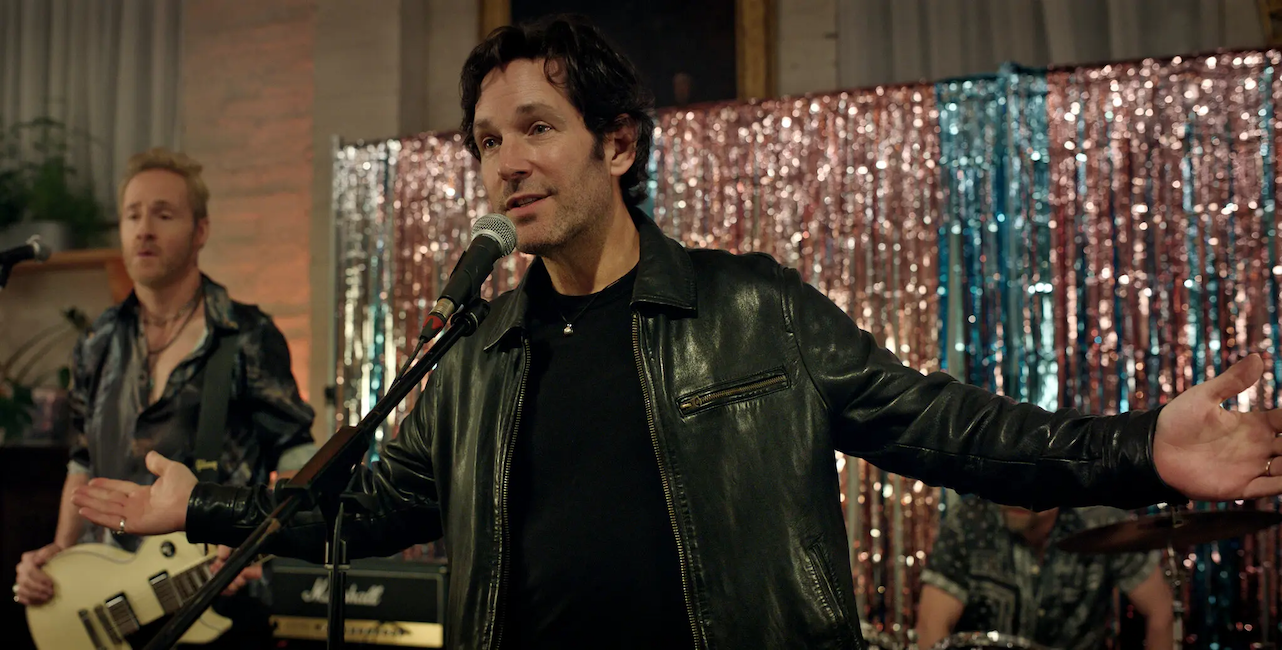
In John Carney’s latest work of music-centric cinema, Paul Rudd is Rick Power, frontman for The Bride & Groove, a Dublin-based wedding band. They tear through covers of Thin Lizzy, Bruce Springsteen, and — on occasion and to lesser effect — Power’s own ballads. Rudd’s performance as a rock singer is passable. His vocal performance is over-produced, clearly not recorded live, but his energy carries the effect most of the way. Cleverly intermingled with these local pub scenes are Power’s visions of selling out Madison Square Garden, raising a whole body of screaming fans with his soaring artistry. He snaps back to reality. A bandmate tells him to knock it off, to let go of his dreams, saying, “We’re not rock stars, we’re human jukeboxes.”
Power Ballad is, if nothing else, the kind of film that earns the description of being a breath of fresh air — light, competent, funny, well-wrought. It’s also a very self-aware work, amiably reaching for low-hanging fruit, specifically in the form of smarmy, aging Gen-X humor, which Rudd is a master of and carries off well. The characters are palpably relatable, in a decidedly simplistic but heartwarming way, and yet also retain some cultural specificity — the film’s real bite comes through in its Irish wit, which Carney and cast effortlessly leverage to wring laughter from an American audience.
Narratively speaking, Power is on a collision course with Danny Wilson, a former boy band star and a rather autobiographical sketch, the actor-performer who plays him, Nick Jonas. They meet — where else? — on stage at a wedding. Friend of the couple and global superstar Wilson steps in to cover Stevie Wonder’s “I Wish,” and in this scene Rudd and Jonas demonstrate an instant on-stage, and on-screen, chemistry. The duet ends up bubbling over into an all-night drunken songwriting session. Wilson, like Jonas, is searching for a spark that will rejuvenate his post-boy band career, and in the mysterious way of kismet, that spark comes in the form of forgotten songster Rick Power, still toiling over demos in his home studio. Power is trying desperately to impress his teenage daughter (seemingly named for the Steely Dan album) Aja, who, of course, cares more about Danny Wilson than about her dad’s silly songs. But what would she say if one of those silly songs became Danny Wilson’s next smash hit? And, as these things go, it does. “How to Write a Song (Without You)” jumps to #1 on the Billboard Hot 100 and saves Wilson’s solo career. Power’s career as a wedding singer, too, should be changed forever. Only problem? Rick’s writing credit seems to have slipped Danny’s mind.
Jonas delivers a sturdy turn as an artist trying to distance himself from his boy band days, trying to prove that he’s more, but he’s also helped immensely by his partnership with Rudd, who proves again his versatility within the bounds of a lightweight flick eager to entertain. In this way, Power Ballad is a throwback, really, to the Apatow-orbit films where Rudd first ascended to legitimate star status, sharing some DNA with the likes of I Love You Man and Forgetting Sarah Marshall. Though not a romantic comedy, Power Ballad possesses the essential breeziness of works of that ilk, a too-easily discarded pleasure these days, fading since the mid-budget blockbusters of the 2000s. This was, of course, also the precipitating period for Carney, whose oeuvre has been defined by the cultish success of his 2007 musical romance Once, and his work since has never deviated far from this niche of sweet, heartwarming music films. Power Ballad is par for the course in that sense, with Rudd and Jonas proving to be perfect players for Carney’s latest confection.
Power Ballad‘s biggest stumble, ironically, comes in its music — which is different from saying the musicians, who acquit themselves well. Specifically, the issue is the film’s core song, “How to Write a Song (Without You),” the track we’re told becomes a surprise smash that brings sold-out crowds to spontaneous tears. The tune itself is fine enough, passable as a hit — arguably a lower and lower bar to clear these days — but it’s a far cry from rising to the level of inspiring, impressive, or even memorable. When Rudd or Jonas sing it live at the piano, intimately, it does possess a certain resonant emotional cadence, but once produced for the radio, it lands more like background music — call it a poor imitation of James Blunt, perhaps, or maybe one of those written-for-the-finale American Idol singles destined to be soon forgotten. Indeed, when Rick Power encounters it for the first time after six months, it’s heard echoing in the foyer of a shopping mall — literal background music.
So in the absence of a strong sonic presence, Power Ballad’s primary strength comes via its sentimental core. Power, a through-and-through American boy, is a Dublin-based wedding singer because, decades ago, he played a gig on the “Emerald Isle” and fell in love. His family, including wife Rachel (Marcella Plunkett) and daughter Aja (Beth Fallon), is his world, and Rudd’s work here makes a strong case that there are few roles better suited for the actor than that of a messy, striving dad (and husband). Rudd’s keen embodiment of Power’s motivations functions as the film’s beating heart, moving without being overly manipulative or twee, which ultimately allows the film’s musical core to land with more power than its technical achievement deserves. Carney aims us straight at the sappy center of it, and what’s most surprising and impressive for a slight, throwback film like this is that it’s hard not to fall for it, even just a little. In this way, Power Ballad quenches a certain thirst we all might forget we have amidst a present cinematic landscape rife with heavy, self-serious cynicism.
DIRECTOR: John Carney; CAST: Paul Rudd, Nick Jonas, Jack Reynor, Havana Rose Liu; DISTRIBUTOR: Lionsgate; IN THEATERS: June 5; RUNTIME: 1 hr. 38 min.
Comments are closed.